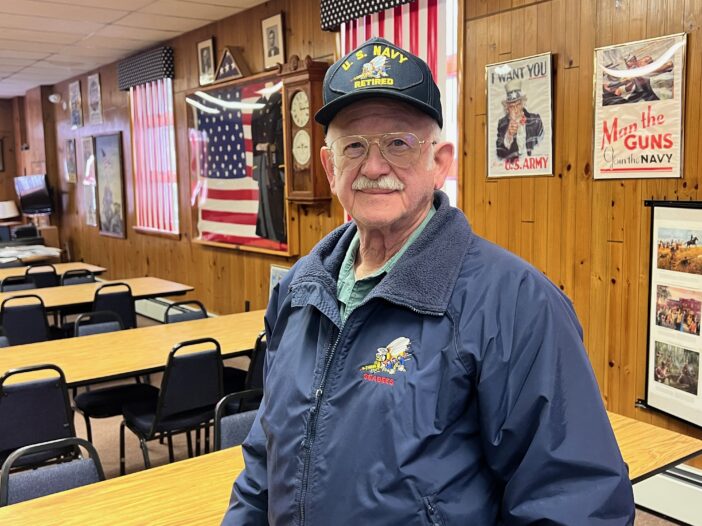
Paul Mosley, BUC, USN, retired, is the unofficial steward and watchman over Waldoboro's Charles C. Lily Post American Legion. Yes, he may have grown up elsewhere (outside of Gorham) and spent most of his life living in other parts of the country and world through his work for the Navy-Seabees (known as the Naval Construction Forces). In fact, Paul has barely lived in Waldoboro (he moved to be with Maria whom he married last year). But drop in on a Saturday night of Bingo, and you’ll see his joy and love for this Waldoboro institution. The building opened in 1951 as both the Fire Department and the Municipal Office. Fire trucks parked on the left side, street level, and the town offices were on the right side. Below on the ground floor, more fire trucks parked inside. Then, in the late 1970s, the town built new offices on Route 1 and sold the building to the Legion; and they erected its gable roof and renovated the interior to make it into the town anchor that it is today. Enter from the street (not usually open, however) and you’ll find yourself standing before Waldoboro’s Honor Roll of foreign war veterans. Waldoboro being Waldoboro, chances are you, yourself, know more than a couple of the hundreds and hundreds inscribed on that Honor Roll. Charles C. Lily is in the column for the First World War. I found my own father, along with my many aunts and uncles, in the Second World War columns; Maynard Nash (the subject of this column in 2023) can be found under the Korean War; and Paul’s wife Maria is in the Vietnam War column. But the centerpiece of the structure is the wood-paneled meeting room, regaled with flags, posters, and framed portraits of luminaries. This is the room generally used for American Legion meetings. A side table displays pamphlets for services available to vets, including a veterans crisis hotline. On the ground floor is where most club meetings are held plus Saturday night Bingo (from 6-9ish) and the winter “Soup Suppah’s,” always on the last Friday of January, February and March – which you still can catch on this Friday night, from 5-6:30 PM, where you'll see Paul and Maria, too. And if this isn't enough, behind the scenes, Paul is the Finance Officer, and Maria, the Post Chaplain. For Waldoboro’s civic clubs, like the Lions, the Women’s Club, the Republican Club, and the mobile home park behind Hannaford’s, it’s a place to meet, converse and work on various projects to better our community. This Post is generous that way. No wonder Paul and Maria think of it as a second home.
Right after graduating from boot camp, they flew me out to LA for my next training because I was posted to the SeaBees. I was the only one, out of almost 1,500 people graduating with me, who had made it to the SeaBees. I was alone, with my bag and papers, waiting at the bus stop after I’d landed. And suddenly, I’m thinking, “What the hell am I doing way out here?”
But I couldn’t turn around. I couldn’t chicken out. I’d signed up for this thing. And that’s when I formed the attitude, “Not only am I going to do this, but I’m going to do this as good as I can.”
And at that bus stop, my whole attitude about joining the military changed. With every fork or challenge since, I’ve remembered those words.
I worked hard, too, like my parents taught me, because with eight of us kids, we all had our chores. There was no sliding off. In the morning, I had to go around and make all the beds. And change the sheets when they needed changing. At night, I wiped and put away the dishes after my sisters washed them.
So, I put all my energy into the SeaBees. We trained and did construction. Though I was never in combat, we all trained constantly trained for it. I also volunteered instead sitting back in the barracks, drinking beer and watching TV like a lot of guys. I got to learn more, and I got to do new things. I excelled.
When we grow up, we all have a family unit. It can be brothers, sisters, parents, and children. And as a family, we’re dedicated to that nucleus. But apart from that, in civilian life, you generally don’t experience the comradery, friendship and dedication you have in the military. There, — and by that, I mean every one of us who has served, combat or not – you also have that nucleus of a family. That’s because each of us was willing to sign on the line. Each of us was willing to put something at risk. In training we learn that we depend on our brother and sister on our left and right to help and to protect us — because we’re doing the same for them. And that makes us a family. I believe we survive better if we’re protecting one other.
Civilians don’t have the necessity for that. Nor have they had the training to learn and understand the necessity for it. So, sometimes they don’t understand what it means to be in the military. When I first came to California in the early 1970s, I saw firsthand how badly military people were treated. You’d hear it and at the same time you didn’t pay attention because it was things like, “Baby killers.” Or, “You’re despicable.” Or, “Why are you obeying orders?” People would flip the finger and spit at military people. We weren’t respected, and we were over there fighting a war that nobody wanted us to be in. I don’t even know if any of us military guys wanted to be in it either. But we had signed up for it. We were doing our duty.
To me, this American Post is where military veterans can gather and be themselves. We have about 85 members yet with only a handful or two are active. Our oldest is maybe 93, a Korean veteran, and maybe there are one or two others from that war. The majority of us are from the Vietnam era. A lot are now in their 80s, retired, and maybe with health problems or not be getting around as much.
We hold a coffee hour every Tuesday morning, from about 8:00-10:00, with coffee, donuts, a little fruit, some pastries, and it’s for any veteran, combat or not, that wants to stop in and have a cup of coffee. We don’t ask for anything. We just say, “Come on it and join the conversation.” The other day, a young person who’d been in the Navy for six years dropped in and said, “The way we were sniping and badgering each other today, all in friendship, that’s what we used to do in the service. This was what I’ve missed.”
The other thing there that happens is that every so often someone will loosen up. A few Tuesdays ago, all of a sudden, a guy opened up and talked about what he had gone through. It was amazing. But he could do that because he’s in an environment where everyone in the room has the same understanding. That makes a difference.
And that’s why we’re here. To support one another. We’re here to support veterans, and we’re here to support the community.
Leave a Reply