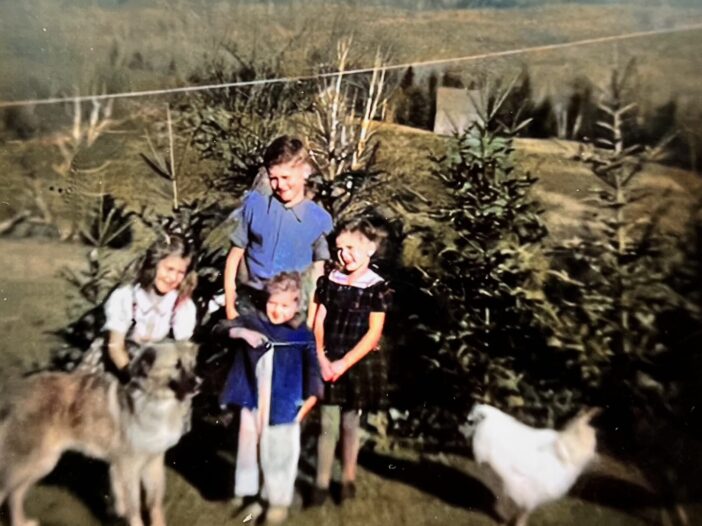
To visit Pat Cross in her home in North Waldoboro is to feel as if you’re sitting on top of all of Waldoboro. On a clear winter day, you can even see Medomak Pond whose waters feed the Medomak River. But listen to Pat instead. At 87, she has memories of a life of a life here that spans at least a few eras. Yet despite the richness of her stories, she shakes her head in wonder that anyone else would find them special. They were poor, that’s all.
I’ll tell you about the Hill. They call this Burnheimer Hill. Victor Burnheimer was well-known. He ran Burnheimer’s Store which was right here, across the road at the corner of Old Augusta Road and Route 220, Washington Road. And he lived next door, a little up the hill, and literally right across from where we are right now. Joanne Weston lived next. And next to her, on Augusta Road, was Muriel Burnheimer. She had a horse farm.
On this side of the street, down the hill again to the intersection, Cleve Walters lived and just up the street from him, Maude Mank. She was our postmistress, with a little post office there. She also wrote for the Waldoboro Press. And next to her, Lex Mank’s blacksmith shop where he made horseshoes and wagon wheels. It was also where my father and the men used to congregate. And then this house, Les and Alma Mank lived until they died.
The North Waldoboro Methodist Church sat right behind this house on the upper lawn. All of us went to that church. But then it closed and we went to the First Baptist Church. Eventually that church fell in such disrepair that we had to tear it down.
Now, if you went down 220 a bit towards what was the old Grange Hall on one side and the old Nazarene Church (which turned into a dance hall later) on the other, you’d come to Florence Smith’s next door to the church in the Waldoboro direction. She had a little candy store with a glassed-in thing with all these penny candies. And she sold ice cream. She even had a bar where you could go and sit and eat your ice cream. But none of that’s there anymore.
Back then, we lived down the hill on the east side of Medomak Pond, between it and Little Medomak Pond. They call it Noyes Road now, but it used to be Sidelinger Road. From there, you could walk right up to Union.
That was where I grew up, on a farm, and I was one of twelve children with the four boys being the oldest and the rest girls. But for much of my childhood, the first six were pretty much out of the house.
I was the fourth youngest, and I was a tomboy. Most of my activities I did with my father. I used to take care of the chickens and cows and the pig we got in the spring and slaughtered in the fall. When I got older, I milked the cows with my father and chopped the wood.
Back in those days, we didn’t have toilets in the house or anything. We didn’t have water in the house. We had an outhouse. And for our other water needs, we had a brook where my father had put a barrel, and when we needed water, I’d walk all the way down the hill, dip my bucket in it, and lug it back up to the house. I lugged water for all of us to wash, for my mother to wash the clothes, for the dishes, and for the chickens and our two cows, too. I did all the stuff that a boy would have done. I was pretty rugged in those days.
My father was Ruel Orff, and he was raised in North Waldoboro. He was a millworker. He used to work at Ellard Mank’s Barrel Mill which was about a mile from Burnheimer’s, just past what we called Autio Hill. A was a huge Finnish chicken farm was on the left, right before the bridge. The mill was on the river, because they used that to run the saws and machinery. And he’d bring home wood from there for me, round pieces of wood he’d cut, and I would take it to make wheels out of them for the little wagons I’d make.
When I was about ten or eleven years old, I’d spend my whole summer with him at the mill, working with him. I helped him make barrels — he’d put them together, and I’d nail in the things around them.
And then, on the way home, Burnheimer Store was right there. It was a big building, and they had a grain store there, dry goods, they would have everything in that store. Meat, milk, clothing, all that stuff, and it was amazing. Anyway, after working together all day, he would stop and buy me a bottle of either orange or strawberry soda. It only cost 5 cents, but it was a lot of money to us because I think he only made $25 a week, working hard. That was one of my adventures with him. We were pretty close.
My mother was Edith White. She was from Jonesboro, one of eight children. She met my father because when she was sixteen, her mother and father put her on the train and sent her up to Augusta to work at Togus where she waited on tables. That was during the first World War. My father was working there, too, doing construction, and I guess he would come into the cafeteria there. That’s where they met. He was ten years older than her.
When they got married in 1924, they moved back to North Waldoboro near where my Aunt Rachel had a farm, and she let them use it. When she died, I was three weeks old, and we moved there. I grew up there.
We had chickens and cows. And big gardens, two or three of them. We raised all our food, and my mother canned it all for the winter. We loved dandelion greens! She canned them, but a lot of times she’d just salt them down in a crock. She did the same with the pork from the pigs we raised, too.
Each year, she would can maybe 200, 300, or 400 quarts of different things. Vegetables and even things like the white perch we’d catch down at the lake. We used to pick wild strawberries, and she would can those, too. Then in winter, we’d have them with the blueberries we’d picked. Once in a while, my brothers would go get a deer, and she’d can deer meat, too.
We had an ice box with a huge cube of ice inside for the cooling, and that’s where we’d put milk. But mostly it was for the cottage cheese that my mother made. We called it cheese curds back in those days. My mother also made butter. And if she had a lot left over, she’d sell it and save the money to buy us shoes for school and stuff. There are so many stories about North Waldoboro.
My mother was a worker. Every morning she’d wake up, start the fire, and make hot biscuits or donuts. She was always making donuts. I don’t think my mother ever stopped working. After we all were either out of the house or in school, she found work processing chickens in Union. So, every day she’d walk all the way up there with Elizabeth Storer, and they’d work at gutting and pulling out the feathers. She worked a lot of things. She worked at the fish factory in Port Clyde, too. She even worked at Hillcrest.
Lately, I have been thinking a lot about growing up with my mother because we weren’t close like I’d been with my father. But I think my mother was so involved with trying to keep the house in order and doing all those things, that she never had time for compassion. We knew she really cared for us, but we never had the feeling of love and closeness, because she had twelve children, and she was doing all the washing of the clothes by hand, doing the gardens, the canning and stuff, plus the cleaning.
It was like this: she’d mix up a chocolate sheet cake, pour it out in a great big pan like this, and bake it, while boiling the frosting on the stove to spread on top of the cake. And within two days it was gone.
Leave a Reply