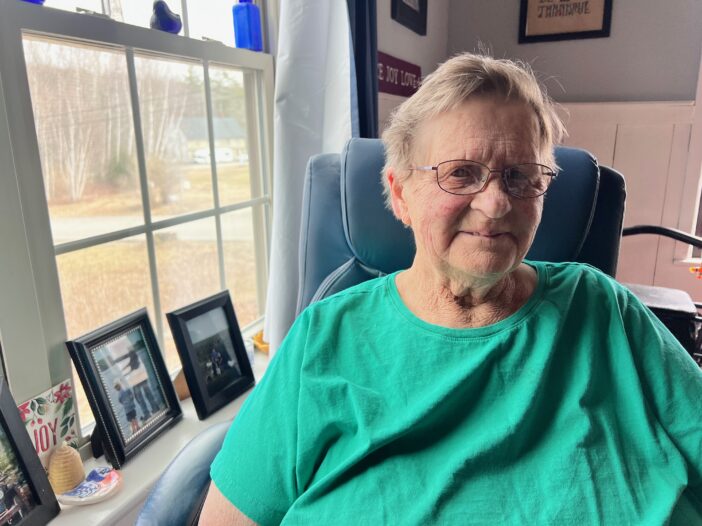
At 87 and with bad knees, Pat Cross doesn’t get out much any more. But her grandson Will Pratt recently gave her a shout out at a budget meeting. He said she is the force that propels him on snowy nights between midnight and daybreak to plow Waldoboro's roads. Thank you, Will Pratt and Pat Cross. Pat the fourth youngest of twelve children. She was born Patricia Orff, in 1939 in North Waldoboro, where she has lived her whole life. That’s 87 years of lived history in a part of Waldoboro tucked away from the industry and commerce around the 5-masted schooners (though surely the ships’ masts originated there). This part of Waldoboro’s history has always been quieter. And no less important. After all, it’s where the lumber was milled, the grain and food grown, and where many people eked out livings on the land upriver to almost the head of the Medomak. How much richer we are for Pat’s stories! We start in the middle:
My mother grew up in a house where there was not much affection, and I think I’ve been a little that with my kids. I’ve had to learn, and I think my grandchildren have taught me. They always say, “I love you Granny.” Or “I love you Memma,” because that’s what some of them call me. It’s so easy for to say, “I love you” back. And some of them have even lived with us for a spell….Leslie, Will, Christine…
Christine was living with us when Francis passed away. And I don’t know what I would have done if she hadn’t been there. Francis was 76 and I was 73. We had no idea. He had pancreatic cancer. Just like that. We took him down to Maine Med and they were going do a something, put in a catheter or something, and when he came back down again, they told him he had only four days to live. Just like that.
It was hard on the girls. They loved their father. His name was Francis Cross.
I met him when I was helping Chuck Begley for a Saturday program at the high school for young girls because they still didn’t have any organized sports for girls back then. And while I was doing that, Francis came in by himself and took a seat to watch. When practice was over, he come over. He challenged me to a game of horse, the one where you shoot from certain parts of the floor, and I said, “Okay.”
I beat him! He was good natured about it.
I saw him again at a basketball game in Wiscasset. He come over again, and that’s when he asked me out. And that was that. We went out, got to know each other, and we were married — married almost 52 years. And I still – well, it seems like yesterday. How good he was to me! How patient! And I could be stubborn and stuff like that. We had three girls. Elaine who is Will Pratt’s mother, Shelley who lives in Maryland, and my youngest, Jennifer, who is a gifted teacher at Oceanside.
I would have to say Francis the person who made the biggest difference in my life. I’d get so upset sometimes. It was hard for us in the beginning. And he was only making $2,800 a year, teaching. He taught chemistry and physics and biology at Waldoboro High School. Later onhe was a vice principal to Ronnie Dolloff. It was 37 years of teaching. And he had a gift for the kids who were a little troubled.
But I had my own struggles. After Jenny was born, I couldn’t get off the couch. It was post-partum, but I don’t think we called it that. Francis even had to cook for the kids when he got home from school. I couldn’t manage even that.
Peg Lyons came up in that time. She was someone I used to work for occasionally, doing a little cleaning. And she kept coming to visit. Finally, she said, “Would you like to go with me to a women’s bible study”?
I said, “I would love it!” I knew I needed to get out with people. And through that group, people like Nancy Genthner, Nellie Jones and so many others that I could name — these people really made a difference in my life. And Peg was the one that always was there. She helped me through it, and we became really good friends. We still keep in touch, even though she lives in Pennsylvania now.
But for a long time I felt inferior. It was especially hard in high school. My friends’ houses had electricity, and a bathroom indoors. We had an outhouse and a table with an Alladin lamp on it in a kitchen with a ceiling that was open — I mean, now everyone loves it now, but back then, I felt I couldn’t invite them. We had bare wooden floors which my mother was always washing, but there was just something about it all.
And my clothes weren’t the best. A lot of our clothes were made from the calico grain bags my father would get from Paulie’s Finnish Farmers up in Union when he used to haul grain. And I raked blueberries in the summers so I could buy two or three different clothes that I’d liked to wear.
But all of that was my problem. It wasn’t their problem. It just took me a long time to get over it.
I think being a mail carrier helped me the most. I was 55 when Barbara Zucchi and Wes Waters drove up here. They came in and just sat down on the couch, and said, “Pat. Why don’t you be a sub-carrier for the Post Office?”
And I said, “Oh, I can’t do that.”
Barbara said, “Well, you’re going to have to deal with mail that goes to the ceiling every day, case it, and get it out,”
And I thought, “Oh, I’m not going to remember all that.” I was 55!
And I said, “Okay, I’ll do it.”
Then I had to go to Portland to take this test, and I passed. And she hired me.
Then, I needed a vehicle, so Francis and I went down to Portland, and they had these mail jeeps that you could buy, and we brought one for $250 and brought it back to Waldoboro. I loved it. I wished I could have worked longer. I retired at 67. It was the people. And doing stuff for them. There were shut-ins, and I would take the mail all the way up and into the house for them, like for Clyde Sukeforth and his wife, and Ralph and Gertrude Hoffses, too, as well Ruby Hoffses. One Christmas Eve, I even emptied Ruby’s port-o-potty because her person wasn’t going to be there over the holiday.
I never left packages on top of the mailbox that wouldn’t fit in. I took those to the house. I figured that was my job.
And I really loved Barbara Zucchi. Matter of fact, I babysat for her when she was a kid. Her father was my civics teacher in high school.
I look back on all those jobs. After high school, Sylvania wanted me, but I knew I couldn’t sit all day at those machines. I was an outdoors person. So, I attempted different things. I worked at Hood’s for a time, the egg place. Then, at Abattoni’s hatchery, but I’m not sure of the spelling. I also raked blueberries and ran a blueberry crew.
Then, after marriage, kids, and once Jenny reached sixth grade, Ethelyn Morse came down here and asked me to work for her. She ran Morse’s Sauerkraut. She knew all of us because we grew up in this area.
And I worked for her probably nine or ten years. I did everything. Sowed seeds for the cabbage and planted the seeds. I drove the tractors and harrowed. I harvested the cabbage heads. I even made the sauerkraut. She was a wonderful boss. She let you work. She didn’t tell you what to do. She trusted you. Just like Barbara Zucchi.
Leave a Reply