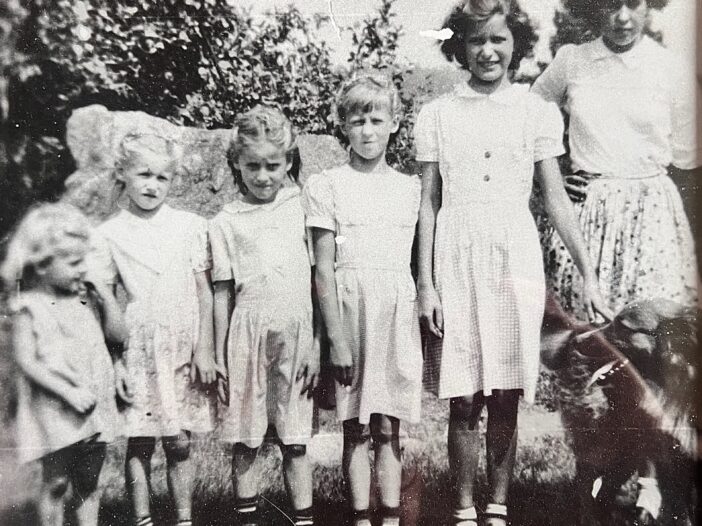
A caption to explain where Pat is in the line-up -- standing on the lawn of the Orff children North Waldoboro Methodist Church the second six of the twelve Orff children pose in their Sunday best. From left, Darlene, Judy, Elaine (d. 1953), Pat, Rayetta, and Charlotte (d. 2012). Today, the church, which was built directly behind the house where Pat lives today, no longer stands. By the time Pat moved, it had long been closed, and sometime in the 1960s when it was becoming a hazzard, she and Francis took it down. But then again, it's a fate that has happened to so many of Waldoboro's buildings. And now over to Pat, in her own words:
I’ll tell you the story of this house. When I was growing up, Alma and Lex Mank lived in this house, on Burnheimer Hill. As a little girl, I dreamed of living on Burnheimer Hill. And I knew just the house where I wanted to live. This one.
When Francis and I got married in 1960, we rented a house in Waldoboro. But when my father passed away, we moved into my mother’s house to be with her. Lanie was two or three years old, and I was pregnant with Michele (we all call her Shelly). But after a while, we knew it was time to move out. And, just at that time, Alma and Lex Mank’s daughters were selling the Mank house because Alma and Lex had passed away. The price was $6,000. We went to the Savings & Loan in Waldoboro. They gave us the loan because we put up as collateral the little camp we’d bought on the lake a while back.
But the house needed a lot of work. So, we started on it slowly. We put in a bathroom because it didn’t have one, and we started work on the septic field. And we were just getting the money together for the insurance policy that we’d signed for.
Then, suddenly, my mother’s house burned down to ashes. Everything.
Word got back to Francis who was still at the school, and he came running because he thought we were all still inside the house. My mother, who was working at the fish factory in Port Clyde, didn’t find out until she arrived home.
My mother lost everything. We lost our clothing and the new furniture we’d bought for the move. It was so hard for all of us. It was where I’d grown up. It was where my mother had lived all those years with my father. It was all gone, poof.
We also had nowhere to go. So, we decided to move here, into the almost-finished empty house which at least had electricity.
When we drove up, we saw that the neighbors had also gotten together. Ethelyn Morse was in on it, too. They brought in a couch, a couple of beds and mattresses, bedding, a refrigerator, and a freezer that they filled full of food. They brought bags of clothing for each of us. They brought us everything we needed.
And the insurance company gave us money, too, even though we hadn’t paid for it yet. It was a blessing. When the money came, my mother used it to buy a single-wide mobile home that she put back where the old house was, and she lived the rest of her life. We used our part to put in a furnace.
I’ve come to appreciate that we grew up poor. I don’t take anything for granted. Even now, it feels like we had a lot, and I don’t need a lot. Our neighbors and the people around us have been so good to us.
Back in high school, my sister Rayetta played basketball, and I wanted to play but it was my first year, and I didn’t make the team. So, I stayed behind and watched her, and afterward each night, we would walk the six miles from Waldoboro High School to our home. My father didn’t have a car, and we couldn’t get anybody to bring us home.
Well, one night we got halfway up, coming by the cemetery on Route 220, and I said, “I can’t go any further, Rayetta,” and I sat down on my lunchbox.
And she said, “You get up and start walking.” So, we get walking, and Bob Burnham came along. He worked at Sylvania and lived just up the road from us, and he gave us a ride all the way up to the Four Corners that night.
The next year, Rayetta graduated, and I made the team; and Bill Zucchi who lived right over here past my road, would stay after school every day and give me a ride home. so I could play basketball and then softball. He was such a good man. The Zucchi’s were good friends of ours. Barbara Zucchi was their daughter.
Growing up poor taught me that I didn’t need much, and I appreciate that. And Francis, too. But I also have to say that the help from others made a big difference in our lives, especially on Francis’s teacher’s salary. We had a big oil bill, for instance. Red Martin was head of the company, and we earned the money to pay our oil bill because Francis worked with Chuck Begley over the summer painting houses. But sometimes, I still had to borrow $15 from my mother to buy milk and bread for the kids at times. Until we got paid again. But we also never had the need for buying anything new.
Our first washing machine came from Bill Zucchi, because they’d gotten a new one, and knew that we needed one. They gave us a dryer, too. That helped because I was hanging out the diapers and all our clothes, through every season including winter.
Then, when our refrigerator was going, Peg Lyons told me she had an old refrigerator in the cellar that she wasn’t using, and she gave it to us. At the time, I’d been doing a little cleaning for Peg. She’d give me $15 to vacuum.
Since Francis passed, oh, gosh, at least ten years ago, I’ve lived alone. I think about that. I think about my mother who lived by herself and had been alone since she was 57, when my father died. My mother lived to 99. When I was delivering the mail, I’d always stop in. I think about the nights and how it was for her. That’s the hardest time for me, too, especially in winter, when it gets dark so early.
I know I should get out more, but because of my knees, I use a walker and it makes me a little self-conscious. A friend asked if I’d join her widows’ luncheon group like we used to do before COVID. But what if it’s not possible for me to get inside with the walker?
In my mind, I don’t feel 86 years old. I feel like I’m 60, still wanting to go cross-country skiing because I used to do a lot of that. I played a lot of tennis, too. I was active in bowling. I did everything physical. Hoeing cabbage. Chopping wood. Lugging water. I miss those things. And I miss the people, too. Francis, of course. Our neighbors. All my brothers. Four of my sisters. There’s only four of us siblings left. But at least I have two of my sisters living close by.
I have so much of my own family close by, too. My youngest daughter Jenny comes in every day after teaching school to spend an hour or so with me. Lanie, my oldest, comes in regularly around noon after she gets off work. William, my grandson, now lives in the house behind me, and I’m hoping this summer his girls can come over to see me. Julian, another grandson, used to come in regularly. He’s coming to dinner tonight. He’s a mechanic working in a garage in Warren and he loves it. My granddaughter Kristine comes every Sunday and helps me clean and organize, and I’ll make a custard pie or something like that for her to take home. Leslie Lorentzen, another granddaughter — she takes me to all my medical appointments. And most Fridays, I play Spades with my two sisters and one of my nieces. I am so thankful for my family. I am blessed by having them in my life.
Leave a Reply