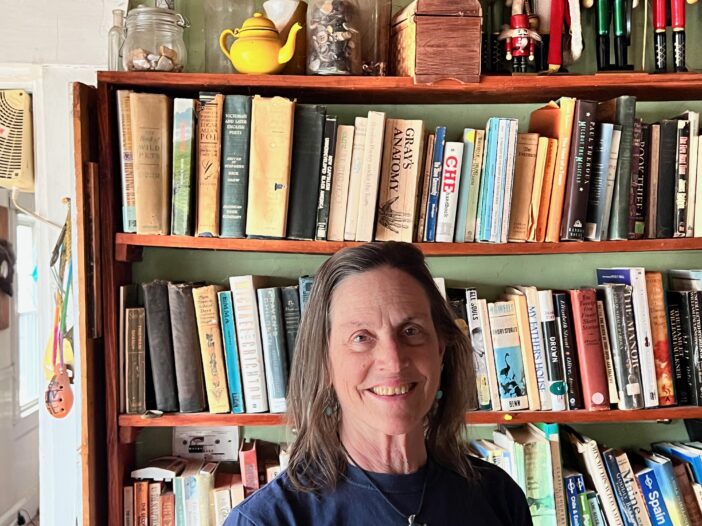
For Laura Buxbaum, two threads zigzag through her life. The first is community work. Though she does not remember it, she was born on an Apache reservation where her father was a doctor. When she was two, her family began an eastward journey, eventually settling in Newton, MA. But wherever they lived, the notion of service was central. The other thread is the arts. Laura’s childhood was reading, writing stories and poetry, and playing the cello. So, at times her life tilts toward the arts while at other times, towards community. At Princeton, she was an English major who wrote about the poets Edmund Spenser and John Milton. After college, she still wrote, but this time for local Massachusetts’ weeklies covering the flotsam and jetsam of town life including the police beat and utility meetings; plus longer features about history and the characters inhabiting on the North Shore. For service, she found volunteer work at a shelter for homeless families. Then, a couple of paid part-time shifts: one at a shelter for women struggling with substance abuse and another; another at a facility for people suffering with both mental illness and substance abuse. At the same time, she became active in the anti-nuclear movement in Cape Ann. She began to think deeply about policy and how it can either cause or help in these issues. She got a degree in Urban and Environmental Policy, followed with work at various Community Development Corporations (CDCs) in Boston and on the North Shore. And when she and her husband Bryan Dunn moved to South Waldoboro in 2007 with their son, Laura joined Ron Phillips at Coastal Enterprises, Inc. (CEI) where she worked until she retired last year.
I like to say that work got in the way of my other pursuits, and the big ones have been music, running and writing, with the writing being poetry.
When I began, it was like exercising a muscle. The more I did it, the more it flowed. I started looking at things differently. To me, poetry is taking big feelings and then finding ways of encapsulating them in a way that other people can appreciate.
I’m part of an online community of people in various stages of their writing. I also have a writers group here, and every month or so, Melissa Barbour, Susan Kellam and I read and comment on each other’s work. Both of these groups, online and here in Waldoboro, have been helpful in motivating me to write and to get my poems out.
Sending out work isn’t hard. It’s something to do between writing and revising. It also means tons and tons of rejections. I like to look at it as a numbers game. Last year, I sent out 89 submissions and had 18 accepted.
One poem was rejected 21 times before being accepted. Next month it’s coming out in “Painted Pebble.” My poems have also been in “Thimble,” “Brawl,” “Rats Ass Review” and “Gyroscope,” among others. Yesterday heard that a second poem has been accepted for “Poems from Here.” I also learned I’m a finalist for the Maine Literary Awards.
And just a few weeks ago, a publisher accepted my chapbook of 29 poems, titled “Roadkill and Other Encounters.” That will come out in the late fall. It doesn’t have a big, central theme, but there are more than a few about the collisions between humans and the natural world.
Plus, one about my father’s death, and another about my sister’s. There are love poems, and poems about family. In my mind, these things are all tied together anyway.
The whole process felt important to me. I had so many poems that Melissa Barbour helped me edit them down and with their sequence. I’m looking forward to giving my mother a copy.
Some of the poems are about the body, and what happens as you get older. While I don’t feel that I’m aging, I’m 67 so I must be. Death also makes me think about aging. Ten years ago, my father had a brain tumor. And he was still working. Up until then, he and my mom had been so healthy.
Just about five years ago, my sister died in a terrible accident. That really stopped me. It shook our whole family.
Those are huge landmarks. But death is with us in hundreds of other, smaller ways. It could be a roadkill or a chicken taken by a hawk. Or the natural death of a puppy. I write about those things, too.
People ask me if music influences my poetry. I’ve never written a song so I’m not sure. But running definitely does. When I’m moving along a trail — that is, when I’m not focusing on roots and not falling – I drift into this rhythmic, meditative state when images, memories, thoughts, even words, float up. Any one of them could turn into a poem.
Back at the house, I write them down, either on in a notebook or in my phone. Some have already made it into poems. Others that I’m still thinking about are: ‘Driving past Sandy River Redemption and Self -Storage, on Easter morning.’ ‘Good old God, good old dog.’ ‘Better angels.’ ‘Thank you for your attention to this matter.’ ‘A bottle of rum, a six pack and a small yogurt.’ ‘My thin bones awkward inside my skin.’
Sometimes a phrase comes from someone else. I heard Morganne Price say, ‘I only knew you in a spread sheet.” Travis Hoffses said, ‘Herodotus: the father of history or the father of lies.’ Then on a zoom call, I heard someone say, ‘Death has his hand up.’ They were calling on someone whose name I heard as ‘death,’ so I wrote it down.
I’m now writing a poem about ampersands. And I’m thinking of another, off the old English name for August, ‘Weodmonath,’ which means ‘weed month.’ Weeding is something I contemplate but don’t do much.
I feel fortunate I don’t have much writing anxiety. I also am not expecting to be in The New Yorker. I remember being in a poetry workshop and talking about poet laureates, and I thought, “Well, I’m the poet laureate of my own home.”
When we talk about ambition and expectations, I’m reminded of my years when I was young and playing the cello, even going to chamber music camp. And somewhere in there, among people more or less gifted than I was, I realized I myself didn’t have the caliber to be a professional cellist. And I was okay with that. It didn’t change my love for the instrument. All through those years before Waldoboro, I’d drag my cello with me, from place to place.
Then one day my husband convinced me to jam with him on my cello. It felt like a very peculiar idea at the time, but I did it anyway. I’ve been playing again ever since. And now, we get together with a bunch of other musicians at Cider Hill Farm on Sunday afternoons, and everyone leads a song and we jam together.
I don’t know what is ahead with poetry for me. I’m taking it step by step. I love it when an editor of a journal writes back to tell me how much they loved my poem, and that’s a little bit of ego, but who doesn’t love it when someone loves their poem? I like being recognized.
But there is another side: poems are meant to be read. If someone reads one of mine and connects with it, that’s everything — if I have that, I don’t need to be the Poet Laureate.
Leave a Reply