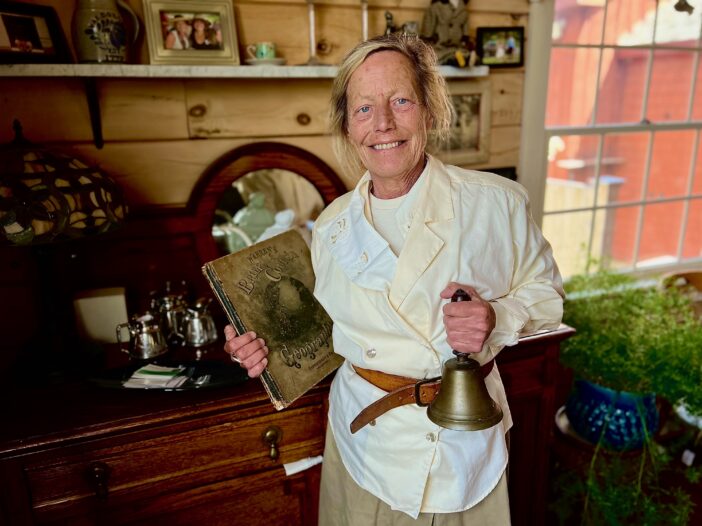
Kay Flanagan comes from generations of teachers, and she followed in their footsteps. Early on, she even taught in the classroom next to her mother’s, at the Friendship Street School. And when it closed, they taught at Miller. But probably most of Kay's teaching years were at Friendship Village School. Kay has deep roots in Waldoboro and thereabouts. Her mother was Elizabeth Sproul; she was a Miller who came from the Walter family. Her father’s family was from South Bristol. Both families date back to the mid-1700s. And both families were committed to education with the resources to support that. They were also letter-writers. Kay and her siblings have trunks full of them. A few in her family have even published books such as her great-grandfather William R. Walter’s “Life’s Poems.” Another is her daughter Elizabeth Flanagan’s “The Secrets They Left Behind,” a story that imagines a young girl in Iowa who loses her father in a fire. Kay herself is retired but involved with the things that make her proud of Waldoboro, such as this year’s Waldoboro Day and the Waldoborough Historical Society.
My parents, Frederick and Elizabeth Sproul, were teachers, and they subscribed to something called “Instructor Magazine.” One day my father saw an advertisement: “Teachers Wanted in Remote Areas of Alaska.” The US government, after treating the indigenous peoples there so poorly in WWII, was pouring money back into their communities.
My parents were used to traveling after my father’s enlistment in the Korean War, so they applied and were accepted. It was 1956. My father went first, and my mother followed carrying my one-year-year old sister Alice. I have the letter where she is describing all planes they took, each one getting smaller and smaller until the last one, in which the bush pilot reached over to latch the door with a hook. She was so brave!
My father taught in Alaska for eight years and my mother taught, too. We lived on Kodiak Island, and I was born there along with my brothers William and David. Thankfully we were already on the mainland in 1964 when the devastating earthquake hit, 9.2 on the Richter scale. I think by that time, my mother was eager to get her family back to civilization.
For the trip back, we drove from Alaska to North Waldoboro. I was three. I rode in the back with the spare tires.
We moved into what had been my mother’s family house, and my parents both taught. My father was ahead of his time. Together they did the laundry, washed the dishes and chopped the wood.
We had a farm with a few cattle for beef, plus a pig and a lamb. But no chickens. We had dogs, but outside. No cat. We all rode our bikes, jumped in the hay and barrel-walked. That’s where you get on a barrel and walk backwards as fast as you can while it’s rolling downhill.
Alice went to school and Marguerite Shuman babysat the rest of us. She would walk up with her red wagon and after getting us breakfast, she’d put us in it and wheel us down to her house. They had what, to me, was a scary dog. On the wall also was a picture of Billy Shuman who was killed in Vietnam. His death shattered everyone. A lot of things like that affected me.
Burleigh Mank’s death was another. The Mank’s were our friends. Burleigh had been cutting wood and hauling it out by the Warren-Thomaston border when his tractor went through the ice. I never ice-skated on any large body of water after that.
When I was six, I went into first grade at the Friendship Street School. Back then we didn’t have kindergarten. Lena Cream was Head Teacher, and she taught my first grade in the front room while my mother taught in the cellar. I remember it as if it were boot camp. But with 35 of us, I guess if you wanted law and order, you had to mean business. I was frozen in fear.
Second grade was upstairs, and the fire escape was outside the building. It had metal stairs and grates that you could see through, and I was always terrified when we had to climb down it for fire drills.
I am the fourth generation of teachers in our family. My great-grandmother Addie Sidelinger was the first, but I don’t know where she went to school or taught except that it was in North Waldoboro.
My grammy Ruby W. Miller was a student at the Boggs Schoolhouse for her first five or six grades. Her parents sent her to Augusta for the middle grades, staying with relatives there on school nights. Then she went to high school at a seminary in Bucksport. She graduated from from Emerson College in Boston. Back in Maine, she taught at a couple of places: the small schoolhouse on Main Street (it’s a daycare now); the historic yellow schoolhouse in Union; and at the Boggs Schoolhouse. In fact, it’s her handwriting on the blackboard in the back of the room: “Oft to this room, my memory flees…”
My mother was the third generation to teach here. After high school here, she, too, went to Boston for college. She studied education at Lesley College. She was the reason I went there.
And she believed in me so much that in that first summer after college, she raked blueberries with me. All the money we earned went into my college account.
My first teaching job was at a daycare in Damariscotta. Back then, it was hard to get a teaching job. But I didn’t have much confidence either. The next year, Great South Bay hired me as an ed tech.
The following year, though, the first-grade teacher at Friendship Street School was moving away, so I applied for the position. And, lo-and-behold, they hired me. Mary Dunderdale was the principal, and my mother was Head Teacher and teaching in the front classroom. I taught in the classroom behind hers. It was 1985, and I had sixteen kids.
Two years later, that school closed, and we all moved over to Miller. I’ll tell you a story from those years that we all love. My mother had little Jimmy Letteney (the son, not the father) in her first-grade class, and when it gets to be lunchtime, he pulls out a beer. He’s six. Well, my mother comes from a long line of teetotalers. That beer just might as well have been a bomb inside his lunch bag. She sends it over to me, and then we call the principal who calls Linda (Letteney) who’s teaching at the high school. And when she gets off the phone, she’s thinking, “Good grief, what’s Jimmy done now?”
When she gets to the principal’s office, he pulls out the beer and sets it on his desk. And that’s when she remembers that after her operation a ways back, they’d put the beers alongside the soft drinks inside the barn refrigerator; and how she’d told Jimmy to grab a soda from it, and he’d accidentally grabbed the beer.
There are so many things I loved about teaching. But after my husband Joe Flanagan died and our daughter left for college the same summer, the daughter we’d had together, I didn’t have the stamina or heart to continue.
But I didn’t realize how hard slowing down could be. Until then, my life was teaching, going home, cleaning the house, and cooking. All of a sudden, it was: “Now what?” My life had come to a screeching halt, and I had to ask myself, “What do I do now?”
Well, Mary and Jonathan Storer helped me get a dog which has made all the difference in the world. But I also think I sort of woke up. Being in a small town, you can get more criticism than kudos. But suddenly I realized, “What’s the worst that can happen?”
So, this year I volunteered myself to get as many people as possible into this year’s Waldoboro Day parade. I’d been remembering the torrential rains at Waldoboro’s 250th celebration and how it sort of put on damper on things. I thought, “If you want a good parade, Kay, step up and do something.” And Bill Maxwell and Clint Collamore said, “Have at it.”
So, I’ve been getting as many different groups as I can, to ride or to walk in the parade, from all parts of town, and all professions, and all parts of our history, too, to highlight all that Waldoboro has to proud of. As for me, I’ll be at Historical Society inside the Boggs Schoolhouse, ringing the bell and welcoming visitors.
Leave a Reply