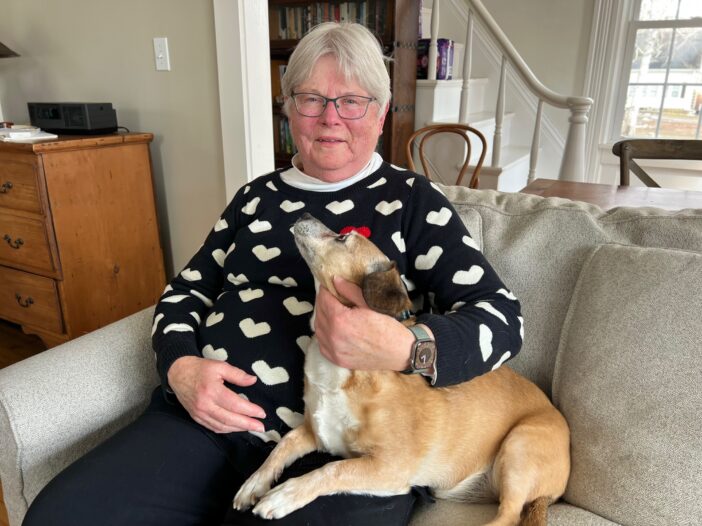
The daughter of two immigrants from Germany, Dorothy Petersen grew up in Bay Ridge, Brooklyn. As a little girl and through high school, she worked in the neighborhood, at her parents’ ice cream and homemade candy shop. Back then, (before the Verrazano Bridge was built), Bay Ridge was a sleepy place. You either lived there or were visiting. After college, though, she got the yen to follow a few fellow teachers to Alaska, something her mother encouraged: “Go! I’ve always wanted to visit Alaska, and if you’re there, maybe I’ll get there.” Her mother did indeed get to Alaska. Dorothy stayed on for ten years. Dorothy had only taught or worked at her parents’ store, so, the prospect of odd jobs was thrilling. One highlight was being an officer for Public Nuisance Control, dealing with overturned trash bins, junked cars and barking dogs. There, she also met the man who would be her husband. He was 20 years older, a homesteader since the late 1940s. Though his land was only ten miles away from Anchorage, it was wilderness in those days. When oil was discovered in Prudhoe Bay, the town’s population swelled to ten times from its former 30,000 residents, and the homestead was sold to a developer. It was time to leave. They cast around for a place unlikely to change so quickly. They chose mid-coast Maine. In Newcastle they raised a daughter. And when their toddler started school, Dorothy did, too, to earn a degree as a LCSW (licensed clinical social worker.) She practiced at Miles for many years, and then she went off on her own. Her husband died about seven years ago. Dorothy moved to Waldoboro where she’d become active in the Congregational Church. Dorothy turns 80 in a few months.
As much as I love working part-time and being as active in the church, some days I wonder, “How long can I do this?”
On the other hand, I don’t really have any hobbies. I mean, how many books can I read if I’m not working?
I like to think I’ve learned a lot, and that I’m more pragmatic, more accepting of things as they come up. Like owning a house by yourself. When you’re in a crisis, you don’t know who to call. I was married to someone who could fix anything, do anything, even build a house. It’s taken me a couple of years, but now I have a plumber, carpenter, lawnmower and electrician.
Everything is good right now – that is, for as long as I can afford to pay for repairs. But I was never interested in money, so I didn’t plan very well. I realize that now, in my old age. And at some point a house becomes a luxury, because all your money and energy go into it. That’s why I think that in a few more years, I won’t want to own a house and have that responsibility. If they ever build those apartments on School Street here, maybe that might be something.
Another way I’m preparing for the future is letting go of stuff. My husband loved to collect things. They were meaningful to him but not always to me. So, I culled them. My daughter has regrets about what I’ve let go. But then, recently she said she’s happy I’ve done it because she’s not going to be stuck with it all.
I’ve always worked with older people. It may go back to when I was a child. My grandmother lived with us for two years when I was a little, and I spent almost all my time with her and with some of her elderly friends in Brooklyn. She didn’t speak English. I was her interpreter.
I’ve also always had an interest in grief and loss. I think that’s another reason why I have mostly older clients.
Older people are vulnerable. They’re also very strong. They’ve been through so much in their lives. Yet at the end, even for those with attentive families, they often feel they’re a burden or in the way. A lot of times, they’re asked to understand the challenges in their children’s lives. But no one wants to take the time to find out about their own feelings and problems. I wonder if it’s because younger people don’t want to imagine getting older.
In the people I counsel, I see many who grapple with the choices they’ve made. It could be their choice of a spouse or a partner, or the one they let go of. Or how they treated someone.
Their stories have expanded me my own life, too. They’ve helped me try to separate enough from my daughter, so that I have my own life without looking to be taken care of by her. I watch and admire people who have a close relationship with their children while not being overly involved. It’s a real balance.
To me, counseling is an opportunity to learn, and learning is something we have for our whole life, until the very end. The psychologist Erik Erikson said something like, “Being older is the age of generativity, where you give back. You teach. And you pass on.” I find this very comforting. It’s our purpose.
Life is a lot about loss. It doesn’t matter what age you are. We’re constantly losing things, letting go of things – people, places, pets, or other things. It’s all in preparation for giving up this life, I think. Some people do this better than others. They adapt to that loss, and they learn from it, and they change. Others fight aging and the fact that maybe they can’t do everything they could do before. Or they hold on too tightly and miss out on the gift of aging. Because there’s opportunity for growth even at the very end of our lives.
When you have to move out of your home and into some sort of facility, you have to adapt to a whole new society. One of my clients told me how she hated going to the dining room because it felt like heading into the high school cafeteria and not knowing where to sit and where the mean girls were. I really felt for her, because I’m sort of shy and would rather stay in my own home than deal with being social in that kind of setting.
I try to mentor people. Like, how when you’re 90-years-old, you might deal with a 20-year-old caregiver. Because for the caregiver, your space is her place of employment. But for you, when she enters, it is not a room. It is your home.
I think, though, for older people, one of their biggest losses are friends. A friendship is a unique relationship. If you’re fortunate, a friendship can develop over a lifetime. You don’t choose your family. But you choose your friends. So, to lose a friend, on top of all the other losses, it can be devastating.
But I also know this: what remains behind is love. In this sense, we never lose the people we’ve loved. They are a part of us, and they always will be. And this is because our love for them. We will never lose that.
I believe that when we are born, we come from a place of love. And when we die, we return to a place of love. In fact, that is what I’ve identified as the purpose of life – to love, and to become still more loving to one another. I think this is what life means.
Leave a Reply