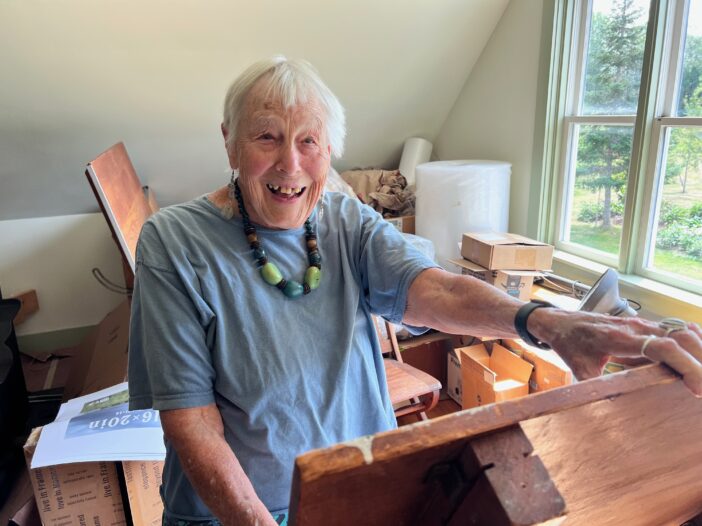
Can destiny appear at three years old? That was Audrey Bechler’s age when she transfixed her parents with the crayon drawings she’d made on the walls of the house her father was building. With nary an artist in either family, and yet her parents embraced what they saw as a gift, making sure Audrey was never without paper, watercolors or pencils; and Audrey has never stopped. After high school, she enrolled in the School of the Museum of Fine Art where she encountered a whole world of color, composition, anatomy, perspective and so much more, not to mention all the art she saw in the Museum itself, from ancient to abstract. When she met jazz pianist and composer Charlie Bechler on a blind date (they were both very shy), another world opened up. Together they created a life of art that included their two sons, Christopher and Douglas, who are also working artists. Audrey and Charlie moved to Waldoboro in 1984, and more about that in Audrey’s own words below. Charlie died in 2007. Audrey herself, after a heart problem, moved to Eugene, OR where Christopher lived. She’s made a home there, but she views Waldoboro, where she returns each summer, as her real home.
I have never stopped painting every day. I cannot NOT paint. But I have to have subject matter. I’m into composition. I don’t like paintings that look as if there’s no order to them. I have always liked to paint what I could see.
In school we painted in oils, and after school, I continued, even after marrying Charlie. In 1962, Charlie got a summer gig playing at the old Thorndike Hotel in Rockland, and we fell in love with Maine. We always said, “When our kids leave home, we’ll move to Maine.”
We lived in Newburyport. When I had the kids, I went back to watercolors because they were easier to drag around. But I got into this terrible slump that I couldn’t fall out of. I thought, “I gotta do something else because I can’t be crumpling up watercolors every day.” So, I bought some acrylics which I’d never done before and a book, too. Well, the first thing you do when you’re learning something new is make squares of all the colors to see how they paint and mix.
That led into my doing abstracts. I used them like watercolors, very thin, and I glazed with them, laying down a color and adding another so that the original would come through the top color. I pulled right out of my slump.
I started to see differently, too. I moved on to painting interiors and especially things like the view of a staircase, or hallway, or from a window. I kept on going and made a whole series of those. And from there I made other series.
When Christopher was out of the house, Charlie doused the maps of Maine. He was good at dousing. We told the pendulum what we wanted: in walking distance of the water, an old barn, studio space and cheap. We went all over Maine, as far as Eastport. But that was too isolated for us. Then Charlie remembered a woman who listened to him play all those years ago and was in real estate. The first thing she did was take us to Back Cove. And that was it!
We didn’t know anybody when we came, but finding people was easy because Charlie was a musician. And Waldoboro was in one of its upswings. At the time, Henry Cabot owned a restaurant, and Charlie played there weekends. Charlie also hosted a jazz jam at the Waldo Theatre Annex in what was the Hounds Tooth Café.
Back then before he moved to Damariscotta, Fernald’s was inside the 5&10 on Friendship Street, and he’d make these amazing sandwiches. Once a week, we’d go into town for them, and they always took a long time to make, so there would always be a group of people waiting. That’s when we socialized.
We worked every day, with Charlie downstairs in his studio, playing and composing, and me, always upstairs, painting. I’m not a perfectionist, but I guess he was one. I would hear him go over and over the same damn bars. He had to get it right even though I couldn’t see the difference. But we were very good together. He was interested in what I was doing, and I was interested in what he was doing. It was lovely.
He actually helped me change, too. He got interested in computers. He wanted me to get interested in them, and I didn’t want anything to do with them. But he started buying these little paint programs. Back then, it was 64 pixels, and you could practically count them. He would keep calling up to me saying, “You can learn this! You can draw on it!”
Well, he finally did hook me, and that set me off a whole new way of seeing things. In the beginning, I’d draw this thing on the computer and then, he’d make all these variations on what I’d drawn, applying my color palette to it. He knew how to work all that stuff. I didn’t. I just did the drawing, and he’d do his thing with it.
Oh! But then! I’ll never forget this day! I’m up there painting and he’s down here, and he’s, “You gotta come down! I just found the most amazing thing for you! Come down!” He’d bought this new program that changed the shape of the pixels. And he’d scanned a quarter inch of my paintings. All you saw were these pixels. It was a complete abstract.
Oh my god! I got so excited. You could go across the page of my painting and there would be thousands of images. Abstracts! So, I started to paint these little things. I’d take a photograph of little sections, and I’d make these large paintings. They’re my pixel paintings.
Then I had another series – I was cutting mats for a show because I couldn’t afford to buy them, you see — and when I looked down at the floor, I saw all these shapes and said, “Oh my God! I got to make a painting of that!” They became my paper piles series.
I tend to go on to something else and never go back when I finish a series. That’s because I paint for myself. I never painted for the public or what the market wanted. But that can mean that galleries or people don’t recognize you because they’re used to one style of your painting. And when I was younger, it was hard because I didn’t like being rejected.
But in the 1970s, I read some of Jane Roberts’ Seth books. They changed my life: they made me realize I’m the one creating my own life! I started to change, and over time, more. Now, I’m fine with rejection. I love other artists’ work and look at it all the time. I don’t judge any more. The only series I haven’t moved on from is my sacred geometry series.
I made up my life for this purpose – I wasn’t good at anything, and I’m very slow at everything I do. I had to work at selling the artwork because I wasn’t good at anything else and I didn’t want to do anything else.
Charlie was the same way. But because he was such a good piano player, other groups would hire him all the time. So, he had work, and I managed to sell a few paintings, and between the two of us, it was enough for us to survive. And we didn’t need a lot of stuff.
I think you have to follow your heart. Most people won’t do that because they got to make a living. But I think if you do, even if you do it gradually, the universe will give back to you.
Leave a Reply