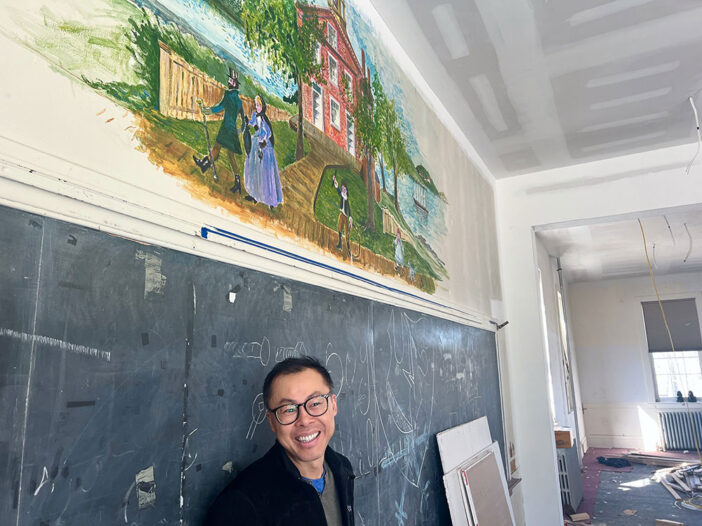
Like the caption says, Willy Wong has done a lot of different things. What it doesn’t say is that before high school, his family had moved at least five times. So, Willy learned to be flexible. It doesn’t note either, how in high school, he noticed that some kids were both good in sports and a superstar in science. Willy saw it was perfectly fine to pursue contradictory interests. In college he majored in Asian Studies, but studied both economics and art. He also coordinated an arts program for the college’s teaching hospital. He learned that he could pick up things quickly. Most importantly, he saw he could use that ability, and just do things and see what came. He learned basic finance when he interned at a bank. He learned to code when he was at Price Waterhouse Coopers. And when he got a tech job and then laid off, he realized while standing on the curb with his box of things, that it was an exciting moment. He was free to figure out again what it was he wanted to pursue. That took him to New York, and to graphic design, and to art, new media, and yes, advertising. One project was working the launch of New York City’s bike lanes. More projects followed. And a pandemic did, too. Concurrently, as well, was the urgent need for studio space that was not his apartment. And that brought him to Waldoboro.
I did not have a locked-in idea for the schoolhouse, but I did have visions. Originally, I thought it could be a creative space for either galleries, or exhibitions, or workspaces. And because the property had been a shipyard owned by the Kennedy family for generations, with buildings that went all the way down to the river, I even had a grand vision of putting little bungalows where people could stay — maybe visiting residents or artists — and building an artistic compound. Or maybe studios for poetry.
But with time, and all the constraints we’ve run into, and from all my conversations with people here as well, all I can say is whatever it’s going to be, it needs to be flexible. I want to do artistic, creative work here, but Crystal down the street has always asked about it being a yoga space. So, we’re designing it so it can accommodate all these different needs.
When we bought it, we knew the ceiling was falling in on the second floor. And we knew the heating system had failed (the main reason Head Start left). Happily, the roof didn’t need repairs, though. So, I’d planned in terms of months, instead of years, to renovate it.
Then we discovered that the pipes had burst and that needed all this remediation before anyone could work in there. But most of all, we didn’t realize about the labor shortage in Maine. When I started calling people in the area, people didn’t even pick up \the phone. Finally, when I got a Maine number, I learned they were booked 18 months out. We couldn’t find a plumber or an electrician. We couldn’t find anyone.
People said, “You just need to be here, at the Home Depot or Lowe’s ,meeting people in line, and in the Narrows Tavern, and talking to your neighbors.” So, we moved permanently up to Maine.
But then, it was hard finding housing. So many challenges that I had read about and then experienced! Housing is a challenge that we all collectively need to figure out how to solve.
So, it’s been a slow roll. And that’s been good because I keep meeting people and hearing what is needed. And, I’m learning about the things people got excited about, launched and then abandoned. And that makes the former business consultant in me ask, “Why didn’t they survive?” It makes me want to make sure we can get it right; that we’re not wasting resources; that it can work for our needs to pay for all the work we’ve been doing; and that it can also keep us going over time.
I’m an introvert which I’m always trying to fight. So, when I meet people, I talk to them. I’ve met lots of different people. They’ve either lived here their whole lives, or they’ve retired here. After the third conversation, I discover they’ve done all these things. We all could benefit from their experiences. I love these stories. That’s why I think at least some of the programming needs to be intergenerational.
And because this had been a school and because I’d taught for a long time, I’ve been asking, “How do we design life-long learning experiences here and use what people know? How do we bring young and old together to learn from one another?” There are all these secret pockets of people who have built so many things. How do we leverage everyone’s capabilities? What I know, from my own life and from all the projects I’ve worked on, is when you see the experiences and when you hear the stories, you make bonds. And through that, you make a stronger community.
It’s too easy to just look at our phone and see and hear everything that we care about and live in a bubble. That is only one reality. It’s not everyone’s. There are other realities that we don’t see, and those unspoken differences have made us antagonistic. I feel that what changes us will be to be around different types of people and finding commonalities. Through that, we can work through the differences. And that’s something that I’d like to do in this building, or, by extension, working with everyone on that.
My mother only had completed high school, and my father not even middle school. They did not have money. But in the pictures of my grandmother, I saw that there was a moment when our family did. But then they lost it all.
And I think that was embedded in me. Tides change. Things come and go. My parents had a vision of where we would go. I have visions. But underneath, I think: “Enjoy the ride. Whatever comes, comes. Whatever goes, goes. Just do the best you can.”
Leave a Reply