Tyler Lupien wasn’t even born when his parents Gerry and Nancy Lupien built their first wooden greenhouse, from scratch, in 1973. They’d come to Waldoboro via New York and Sudbury MA, to settle on a homestead on Castner Road. Tyler’s childhood summers were a mix of picking strawberries and raspberries, milking goats, and later, selling vegetables, flowers and plants at a farmstand on Route 1. To support his family, Gerry worked as a bus driver for RSU40, something he did for 25 years. With his summers free, he and Nancy began a garden business. The first greenhouses were of wood and on their homestead, and they raised flower and vegetable plants. In the 1980s, Gerry purchased land on Route 1, and they built their first metal-framed greenhouse there for raising more plants. They named their fledgling business Moose Crossing Garden Center, after the D.O.T. sign nearby that said “Moose Crossing.” Today, all three sons – Jeremy, Tyler and Ben – are in the business. Jeremy and Tyler own and run Moose Crossing, a business that sustains both of their families, and Ben owns his own garden centers in Connecticut. Moose Crossing is a family business. Gerry still works there; spouses and partners work there; Tyler’s teenaged children work there, and all in a business in which no one stands still.
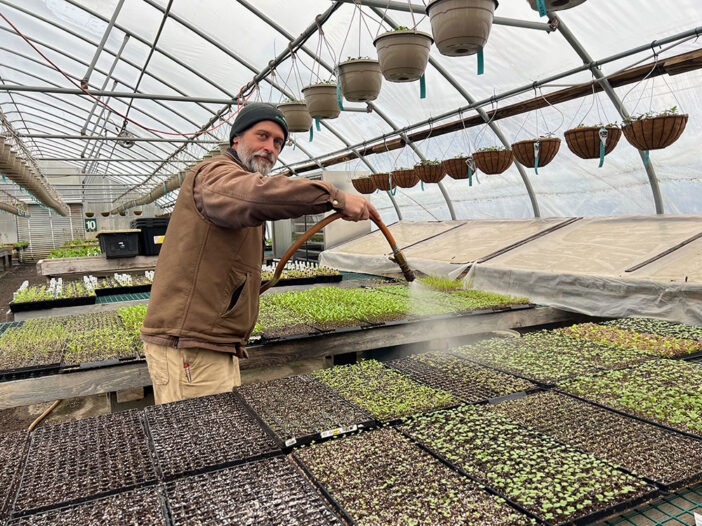
This greenhouse might not look full right now, but by April 1 it will be packed with seedlings, tens of thousands of them, and that’s just in this greenhouse. And our other 23 greenhouses will be just as full.
Each month has its own character. January is for doing our website; our planning and logistics; all our ordering; figuring out prices; making production plans. This lays the groundwork for the rest of the growing season.
January means often means snow, so it’s keeping the area plowed, and the snow and ice off the greenhouses. Once, when I was in high school, Ben and I even spent the night in greenhouse #2 because they were predicting ‘the storm of the century.’ It was March 1993. All night we took turns all night going out in the blizzard to clear the sides of the greenhouses. If we hadn’t, we could have lost them.
February is when we start planting. We like to start slowly and open each greenhouse as we need them. We begin with potting the perennials because they are slower growers. But all plants require time and physical labor, whether it’s from seed, nurturing a seedling or potting it into a pot or a 6-pack. Yes, we have machines that do some of it, but a lot takes a gentle hand. My mother was one of the best transplanters. For years she was our only one!
By March we are both planting by seed and getting in trays and trays of pre-seeded vegetables and flowers (plugs) from Long Island and Canada. Just to give you an idea of the number, one tray holds 288 baby seedlings. We’re starting these trays of broccoli in greenhouse #10.
Once they have more developed roots, we move them to greenhouse #18 where we transplant them into 6-packs. We’ll let them get stabilized, and then we’ll move them to #13 for a cool treatment.
By the first week in April, we are working with hundreds of thousands of plants. They each need to be transplanted, tended, and watered before the next trays come in. Some weeks we’ll be getting 300 to 400 trays of new plants.
We open in the middle of April. Our broccoli 6-packs will have been hardened off and be in greenhouse #2 for customers. Meanwhile, back in greenhouse #10, we’ll have started the whole process all over again; and again; until it’s too warm for broccoli but perfect for warm-weather plants.
This job is intense and physically demanding. From March through September, we never stop moving. We’re picking stuff up, and some of it is heavy, up to 40 pounds. We’re twisting and turning and bending. We’re pushing full carts and shelves and racks of plants, and nursery stock is heavy.
Some of the work is repetitive. There’s always a hand putting a plug or seedling into the 6-packs. That’s millions of plugs being transplanted. And we are lucky. We have staff who are really excellent at this, and many who have worked with us for years.
The day begins long before we open, and it continues long after we close. In the morning, we are watering; stocking the greenhouses with plants; unloading what is coming in, and if we don’t finish, we do it at the end of the day. Along with spraying for insects and watering again — 24 greenhouses full of plants plus and then all the large potted annuals, perennials, shrubs, bushes, and trees that are on our grounds.
Our busiest time is from May to mid-June, and believe it or not, it’s my favorite time. I love seeing the greenhouses full of plants. I love seeing the seedlings we have nurtured now looking primo and ready to sell. It’s fulfilling.
A perfect day is when it’s sunny and 65 degrees, and you throw open the doors to get a little breeze. And meanwhile, customers are coming through and everyone is happy that spring is finally here.
Buying a plant is not like shopping for necessities. People buy them for their color. Plants brighten yards and homes and make people happy. Plants also bring people together, and just being here you can hear people’s excitement about a new plant, or which variety of tomato or pepper is their favorite. People smile at each other, they talk to each other, they trade advice and recommendations with each other.
I took horticulture with Mr. Neil Lash in high school. Other than my dad, he’s one of the reasons I do this. He had a wonder for everything. The weather! Saving seeds! Clouds! He loved to learn. That’s how I feel, and I hope our customers feel the same thing.
By late June and July, customer traffic has slowed, but not much because being in Maine people are opening cabins and cottages all season long. But it allows us to close an hour earlier; and that helps staff get done the things they’d postponed at home.
And then it’s August. We’re back doing a second planting of seedlings like broccoli, peas, kale and other cold-weather crops. And we plant chrysanthemums. We work hard, but the pace is more measured.
By September, everything is even lighter, and we take a breath, and by month’s end, we close. We are exhausted.
Over the next months we clean and put away the trees and shrubs for over-wintering. We tackle putting on new doors or re-enforcing end-walls. We upgrade. And we re-cover three or four of the 24 greenhouses, something we do each year.
Suddenly, it’s the holidays. And the snow. And it’s January again.
You can’t walk away from a greenhouse. They need attention, whether it’s plowing and clearing in winter or caring for all those plants inside. Plants need to be touched, moved, watered, and aired and it’s all by hand. It can’t be outsourced to a computer or AI. At least not yet. So, we are perpetually pushing the rock up the hill.
People say to me, “You have it easy. All you do is put a seed in a pot. And then you sell it.” That makes me smile.
Leave a Reply