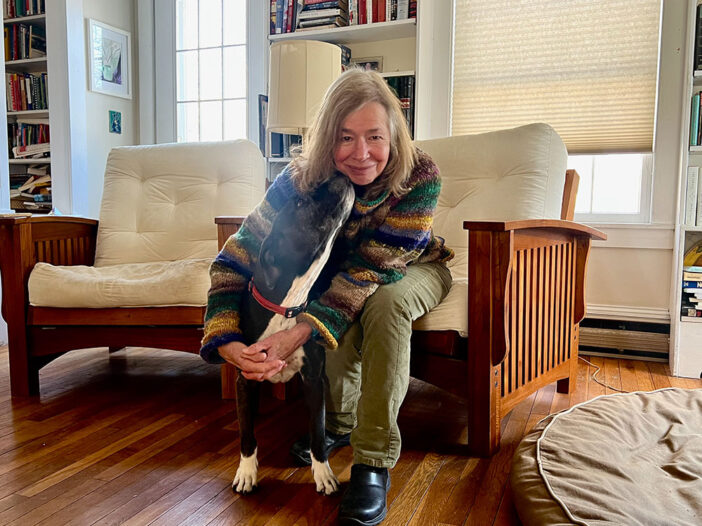
Believe it or not, some people really love to write. Like Susan Kellam, who wrote even as a little girl and went professional, with a first job at Rolling Stone Magazine. And then, she left New York City for Maine, to write the Great American Novel. For five months she wrote. And finished it. But alas! By her own account and that of friends, the novel was terrible. So, she reset her compass on journalism with the promise that, one day, she would return to Maine. She landed a job at the Southampton Press (on Long Island). It was great training because the paper was staffed with Washington Post alumni. Having caught the bug for journalism, she headed to Washington, DC. She freelanced for the Washington Post and Baltimore Sun. She got a staff job at Congressional Quarterly where she honed her craft, both of reporting and writing. It meant covering the swings and shifts of the news and always meeting tight deadlines. She’d started to make a name for herself. Brookings Institution offered her a position, and Susan immersed herself in policy and numbers. It was a high-powered and stressful life. A college visit with her son was what brought her back to Maine. He was considering Bates College. He ended up at Penn State. But for Susan, it was her promised return. She moved in 2010 settling in Waldoboro nearby where some friends had moved, to start a new life.
When I got here, I felt I was home. I could be myself. I could breathe. Sure, I was doing some freelancing and consulting in the beginning, but things relaxed for me. The long days became my own. I went hiking. I kayaked. I went to Narrows Tavern where the Wild Women of Waldoboro was started. I met people. I made friends.
At the same time, I got really obsessed with the history of Waldoboro. I read Jasper Stahl’s books, bookmarking them everywhere. And I started to see, in the people I was meeting, Jasper Stahl’s people from way back to the early German settlements. There was something about Stahl’s books awakened my imagination.
Ever since I was a little girl, I had the ability to imagine worlds. I remember when we moved back to live with my grandmother, how I would sit underneath her piano and pretend it was winter outside and I was in Canada.
Where I live now – this house was once was a one-room schoolhouse. Neighbors came over one day and showed me a bunch of old photographs of this area. And I got intrigued by their story.
In fact, I would sit in the part of the house that was the original the schoolhouse, by the woodburning stove, and feel a little haunted. I kept feeling, “This is what you should be writing.”
I began to imagine characters from those times. So, I started a novel, “What Happened to John Fish?” It’s about a young child who disappears at one of the big festivities that the German people would have every year. The boy is never found again, and the community has a sense that they are cursed.
But in the book, we learn that John Fish, who was the seventh child of the seventh son, is thought to have special powers. So, with the help of his older brother, he’s kidnapped by an evil man who sells him to a sea captain. The captain believes the boy’s powers will keep his ship safe. But, of course, it crashes. John Fish though, somehow makes it to shore, in Canada, and he is adopted. But after all that, he’s lost memory of everything that happened. And the story goes on from there.
Writing that novel was like living in a fantastical world, sort of like my old world under the piano, each with a slightly supernatural quality.
It was bittersweet to finish, to say goodbye to my characters. But they had reached a crystalline moment of awareness, and there was nowhere else for the book to go — except to the world of agents and publishers and editors, where everything felt cold.
It never got published. But I truly like what I wrote, and so did other readers. You know, sometimes I will come across it and read a chapter and think, “Why aren’t I still working on that book?”
But I’m a writer. I moved on. I wrote a memoir next, which did get published. I drew on all the journals I’d written in my Rolling Stone days and wove my childhood into the story. And that was difficult because it had to touch not only on our parents’ divorce but also the conviction and disbarment of our father for embezzlement. And, on my brother’s suicide at the age of 39. I had to look at the things back in our childhood that could have led him to take his life and not me, my life.
When our parents divorced, I was three and he was six. Being the younger, I think it insulated me from the accusations, shame, anger, and judgement. And I had that ability to slip into a world of pretend which my brother didn’t have which I think saved me.
As painful as it was at times to write, it felt so good to publish it.
Now I’m working on another book, non-fiction. It’s about the dogs in my life. There are eight chapters, each one for a dog, and each one with an arc. It’s really, though, about what each dog’s taught me, because they’ve each made a different impact on my life. Each dog helped me grow up.
I write just about every day. I’m of the Annie Lamott school: write a shitty first draft. Just get it down. So, I am not afraid of the blank page. As a journalist, that was something I couldn’t afford anyway. For me, and especially now, to be able to sit down and write is a joy.
I start fairly early, and begin with re-reading what I wrote the day before which I’ll edit and revise, and then move forward. And if I get stuck or if I don’t like my revisions or where I’m going, I’ll get up from the chair, take the dogs for a walk, return and then sit back down again. That’s a luxury I have now.
Yesterday I had a great writing day. Days like that don’t happen that often. I had written the second chapter and I went back over it to revise. That chapter is about hitchhiking across the country with my puppy Peanut. I started work on it and suddenly, I brought it to life! It was a delight. Everything just jelled.
Leave a Reply