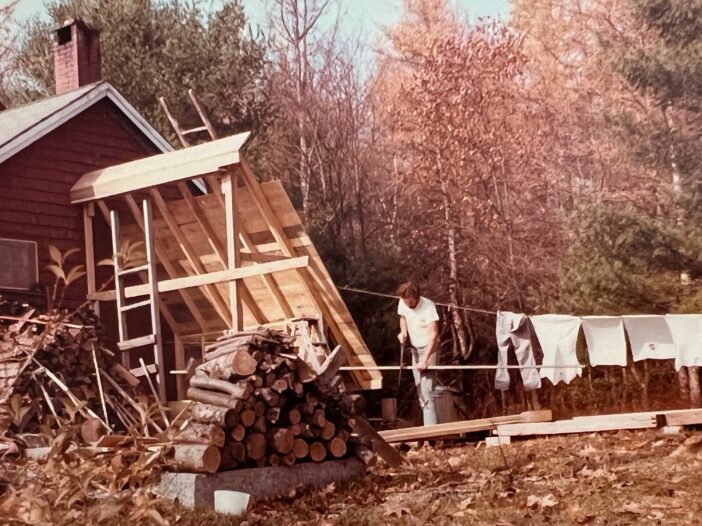
It’s hard to get more Waldoboro than Steven Heyer whose lineage goes back to Martin Heyer, the father of Waldoboro’s Conrad Heyer. It’s a straight line, too, that’s followed by: Cornelius I Heyer, Charles Heyer, Elbridge Heyer, Lawrence Heyer, Kenneth Heyer, Donald Heyer and finally, Steven Heyer. And that’s where the male line ends, because he and his wife Carol have been blessed with two daughters instead. Our last story touched on Steve’s birth and childhood here, and then those years after his father’s death and his mother’s move to her own family in Massachusetts. This story starts where that one ended and leads us back to Waldoboro.
After high school I went to Boston to study electrical engineering at Franklin Institute. Maybe because my grandfather was an electrician, so I was grandfathered into it.
It was also during the Vietnam War. And that year, if you went to college, you got exempt or deferred from the draft. But I don’t think I was aware that I was doing that. I wasn’t paying much attention to anything. In high school, I spent most of the time looking out of the window. Looking for deer, I guess. And in college, it was the same. I only lasted a year. Then they put in the draft, and I had a really high number so I didn’t end up going to Vietnam.
Instead, I returned to my mother’s. I got work in the computer industry where I was for a couple of years. I made power supplies, devices that made it possible to operate all little gizmos inside the computer. The computers I was working on were machines that were six feet high with a big tape reading things. You got paid by the unit.
All around you could see that Massachusetts was changing. It was turning into a technological computer factory. And all the farms and surrounding lands had become housing developments, with no end, and the roads just went back and forth, and every house was the same all through. They built them by the hundreds. What was once a farming community was now a bedroom community where people lived and commuted to Boston or Burlington, or wherever their computer place was. It felt like a foreign land.
Carol and I were seeing each other, and we were both getting tired of it. Even though we lived on the opposite sides of town, for both of us, things had begun to feel a little violent with drugs and stuff happening on the street each night.
The culture of the place had changed, and I wasn’t comfortable with that at all. I was used to more of a farm and rural mindset. Once it changed, I never felt like I fit there. We both were ready to leave Massachusetts.
At work I was doing the same thing day after day. I did a lot of soldering in my job, and there was smoke but no venting, or a fan to suck it out. It was pretty toxic.
I wanted to move back to Waldoboro; and I wanted us to move into my mother’s old house, the schoolhouse which she had never sold but had rented out – that is, once she’d put it on a foundation and dug a well. So, we gave the tenants a year.
We moved back in 1973. But in Waldoboro, we felt like we had moved back to the 1950s.
I worked for Weston’s for 17 years. I worked for Ronnie Barbour. I made deliveries. If it wasn’t propane, it was well-work. Or island work. Or hardware. We opened and closed a lot of these camps, too. So, I was around, and I came to know everybody in town, or just about everybody. If I met someone, chances were, I knew who they were, and they knew who I was.
When I wasn’t on the propane truck, I was a plumber’s helper. After finishing my regular work, if Ronnie needed somebody to go pull somebody’s well out or put one in, I was there. We did all the well work for Hatch Well Drillers over most of those years. They would drill the well, and we would do all the piping and put the pumps in. A lot of times we would do some plumbing for the water to be used. We also used to do a lot of frozen pipes in the wintertime, and stuff like that as well. I was Ronnie’s helper for those seventeen years, for when he needed more hands than he had. And off we’d go.
I’ve done a lot of different things since Weston’s. I’d always done some woodwork – both my grandfathers had woodshops, especially my grandfather in Massachusetts. My grandfather Heyer, he could do carpentry besides the electrical work he did. So, being a helper, I was kind of grandfathered again, on both sides.
On the other hand, back then, everybody did a lot of things, because they needed to. So here, I’ve always done as much as I could figure out how to do. And if every once in a while I’m faced with a problem, I’ll say, “How would Ronnie do this?” And then, I just shift my mind into how he would go about it.
He was a singer! If we were doing plumbing somewhere together, if you’d be working on one section, and maybe there was a long piece of plastic pipe, the next thing you’d know, there’d be a piece of pipe by your ear with him singing to you.
He was very Christian. He did a lot of hymns and stuff. But he also had a cowboy-Gene Autry kind of side.
Waldoboro has changed from what it was in 1973 and those years. Nowadays, it’s, “Who are all these people?” It feels as if I’m surrounded by strangers these days. I hardly know anybody.
Well, there’s a few, but as you get older, as we all get older, you might even be inclined, like me, to feel guilty that you’re still alive and everyone else is gone. Most of the people I worked with have been gone a long time.
Today, if I go out and watch trucks go by, there’s a child driving that truck! Ayuh.
Leave a Reply