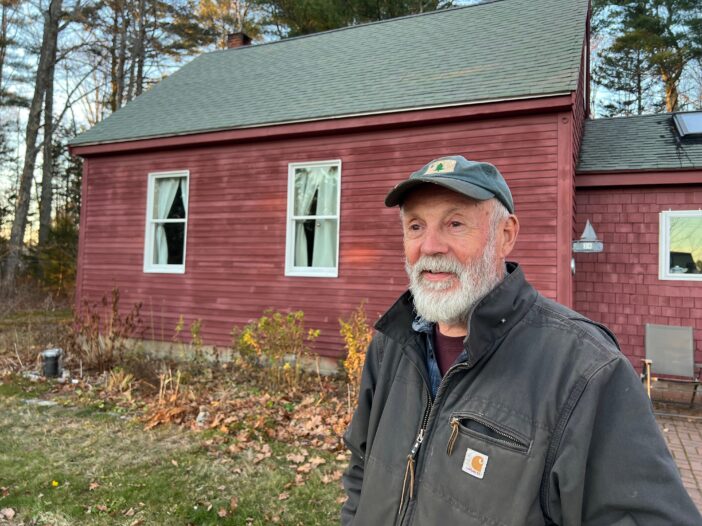
Sit down with Steve Heyer (pronounced “higher” in case you’re from outside of Waldoboro), and he’ll tell you he’s related to almost everyone in town. With a name like Heyer, it’s kind of believable, because local legend -- plus Google AI -- asserts that Conrad Heyer was the first child born to the settlers in Waldoboro. That is a falsehood -- Philipine Elizabeth Rominger was the firstborn. Regardless, Heyer was known then and now as the Patriarch of Waldoboro. After all, he lived over 100 years, served in the Revolutionary War, and was a husband who fathered of many children, a farmer and the cantor of the Lutheran Church. Historian Jasper Stahl notes, “His blood binds a quarter of the town in ties of kinship.” And to come full circle, Steve Heyer knew Jasper Stahl as a young boy. This is the first of two installments of Steve Heyer’s Waldoboro, because it’s a rich and dense narrative, describing a time that is worth lingering over. And so, we begin at the beginning.
I was born here in Waldoboro at Dr. Randolph’s office on Jefferson Street. My family was living with my grandparents, that is, my father’s parents. They had a farm. And a big garden.
Well, my father bought the old Hahn schoolhouse for $300 from the town, and we moved there. It was across the street from my grandparents. But we didn’t have any water. And the nearest well wasn’t at my grandparents’ but at Mildred and Harry Kuhn’s right up the street, so we went there. When I was old enough, I went with my father to the well to carry water.
But I was little, and the buckets were heavy, and sometimes water spilled. On one of those trips, my father asked me, “What would happen if I turned this bucket upside down?”
I told him the water would spill out. Well, he took his bucket and swung it back and forth. It went higher and higher, and then it was over his head, and none of the water came out. That was my first lesson in centrifugal force.
My grandfather was an electrician, and he worked at Forty Fathoms Fishery in Rockland. He worked on all those fishing boats in Rockland harbor, doing their electrical work. And he had all the salt-water fish that he could carry home.
When my dad came home from World War II, he worked at Forty Fathoms, too, but in their office. I was four and a half when my father died from kidney failure. I think it was a blood infection, but they didn’t have antibiotics at that time. People died then of things that normally now you wouldn’t die of.
Afterward, my mother wanted move in with her parents down in Stoneham, Massachusett, about twenty miles north of Boston. So, we did.
Then, after a year or two, my mother married again. And we moved to a town nearby, to my stepfather’s parents’ farm.
They had five huge greenhouses. They were probably 100 feet wide by 500 feet long, all glass. In the winter they grew lettuce, and in the summer, tomatoes. I picked a lot of tomatoes. They also had two fields where they grew pansies, and another big field for Hubbard squash, truckloads of them. I worked on the farm a lot.
After we got done from picking, we had to go to Boston to the distributor so it could be shipped it all to the stores. We had to do it right away because everything was perishable.
I was the helper. Once we got to Faneuil Hall Marketplace, we unloaded it. But back then we didn’t have forklifts. We had to slide each of the big crates to the rear. My Uncle John was big and strong enough to load them onto hand trucks and wheel them into the market. When we were done, we’d head back home. Those were long days.
We all lived together, my stepbrothers and my sister Nancy and I, but it was also kind of split, because in the summer, Nancy and I went to Waldoboro to stay with my father’s family, my other grandparents while my stepbrothers did their thing in Massachusetts. Waldoboro was where I always felt at home.
Maybe after all that saltwater fish he’d been given, my grandfather was inclined to go after fresh-water fish. So sometimes on weekends I’d do that with him, at lakes up north.
For the rest of the week, while our grandparents worked, we had for ourselves. My grandmother would leave for the Button Factory and my grandfather to Rockland, and my cousins and I could do whatever we wanted. If we wanted to go to town, we’d walk there. If we wanted to go to Union, we did that, too.
Later in the summer, we raked blueberries. There was one company that had an old yellow school bus, and they’d pick up all the kids along the road and head over towards Union or someplace where the blueberry fields were, and we’d do that. All the local kids did it. It paid for school clothes and shoes, when you needed them in the fall. Was it hard? I guess that depends on how old you was about it.
As you got older, you got more serious, though, because you realized that you got more money if you worked harder. And by the time you were twelve or fifteen, sixteen, you had more endurance. It wasn’t uncommon when you were that old to rake 400, 500 pounds a day. You were paid by the pound, and a basket could carry 30 pounds or so.
But, when the raking was good with a lot of berries and easy raking, the company would drop the price, so you didn’t make much more money on the good raking days as when it was poor. Maybe a little more, but not much. But we were just kids, so we didn’t know the difference. All’s we knew was at the end of the week, we got money.
And I felt rich because I didn’t have any expenses really, so we went to the Union Fair. And to the carnival in Waldoboro, which would set up every year where the Town Office is today. They had all these booths, where you’d put your quarter down for a game, and usually you won a prize that wasn’t worth your quarter, but it was still a prize. The older people could gamble money, like spin a wheel and put their quarter down, hoping the ball would fall into a number. They always came away with no money.
And then it was getting time for school. Kids in Waldoboro went back about a week earlier than we did in Massachusetts. And that is when I left for Massachusetts.
You see, my uncle owned an egg business. But it wasn’t chickens. He bought eggs from the egg farms, and he processed them. He’d pick up the eggs from farms, clean them, and store in the building that used to be across the street where the gym is now. Then, he’d pack them in crates to load on the trucks that would go to Massachusetts. And the egg truck happened went right near where my other grandparents’ farm was. It was really handy. So, at the end of the summer, I rode the egg truck back to Massachusetts.
Leave a Reply