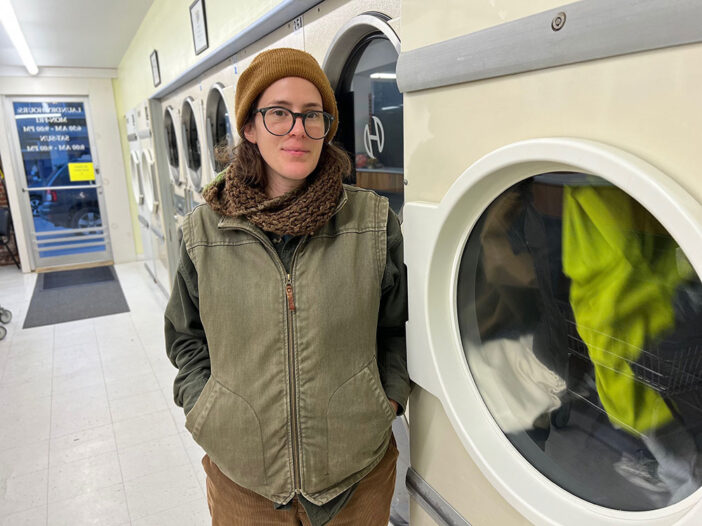
Sharon Mann and her partner have been doing their laundry at Friendship Street Laundry since moving this past August from Portland to Waldoboro, to be closer to work. As such, Sharon is the designated laundry person in their progressive household, an irony not lost on her. On the other hand, the laundromat is an escape from the noise and sawdust of making the needed structural repairs of their new home. It’s also a break from working on her dissertation that she’s completing at Bigelow Laboratory in Boothbay – looking at how algae and other micro-organisms are responding to the re-introduction of alewives populating streams they’d once rightfully inhabited centuries ago. For Sharon, a job like folding laundry can feel peaceful and meditative. It gives her permission to put aside the worries of finding something new that needs a repair, or the questions that might suddenly pop up in her research. In the time it takes for the clothes to wash, she can get a coffee from Perch. In the time it takes them to dry, about 60 minutes, she can make the loop down by the river, look at the golden rod and come back to fold clothes. She’s even read a book for pleasure there. With 23 top- and front-load washers, 13 commercial dryers, and with weekday hours of 6:30AM to 9PM (and close to the same on weekends), Waldoboro’s self-service laundromat is remarkably quiet, a spotless oasis. It’s also an important Waldoboro mainstay, as important as Hannaford’s or the Narrows Tavern.
We’re what they call millennials. We don’t have trust funds. So, buying a house that needs a lot of work is really the only option for my generation to get their foot in the door and get a house. We started with a real fixer-upper. The old part of the house is like a camp, where all our plumbing is. So, sometimes we don’t have water. That’s why we’ve been going to the laundromat ever since we moved.
I usually do at least four loads every time I come here and use the cheapest machines, but even they are $4 for a wash. Then to dry our clothes, it’s twenty-five cents for every four or five minutes. So, it’s about $25 to do our laundry.
But I don’t want to complain. The owner is a really nice guy. He had to raise prices last year and put up these signs saying, “We’re sorry we had to raise our prices because of rising electricity and water costs.” It’s not the his fault that the price of electricity tripled in the middle of last winter. It’s just the way that it is. It would be nice to do laundry at home.
On the other hand, if we didn’t have this laundromat, I don’t know what we would do. We don’t have another option for our laundry right now. And we won’t, until a significant amount of work at home gets done first.
People depend on the laundromat. I see a lot of mothers coming in. A lot of families. And single guys. Fishermen type of guys.
That Waldoboro has an older, working population doesn’t feel strange to me. I grew up in Kittery. Back then, there was only the Shipyard Tavern for a downtown. It was fishermen and yard people. It was a workingman’s town. So, I’m used to being around working-class people. Those are my people. Dad built houses, and Mom worked in a warehouse. And we had a farm.
I’m always hearing, even in the laundromat, people going, “Outsiders!” Or, “I’m born and bred in Waldoboro.”
Unless you’re some tech company coming in, acting like an angel and trying ‘to revitalize’ or change the entire culture that you’re moving into and then pricing everyone out of here, it doesn’t matter. Because you don’t choose where you’re born. It’s where you choose to live that’s telling of who you are.
We’re not from money. We have to work just as hard as everyone else. And that’s one of the funny things – you want to see your community prosper, maybe come out of poverty, but it comes up too much, you can’t even afford to live there anymore. It would be nice to see the people of Waldoboro get resources like better Internet. But I don’t know how happy people would be if they started getting those resources. And I don’t know if that would mean some people would get pushed out. Rising property values can be a curse.
My family had to sell their farm. We started off with 100 acres in Kittery. And every year we had to sell off a little bit of acreage. “A little bit of acreage, little bit of acreage.” Or, “We’re going to have to sell the farm this year.” I heard that my whole life. It was this impending sense of doom.
Luckily it held off until I was out of high school, when they were down to twenty acres. But growing up, those twenty acres were a magical wonderland to me, the most precious place in the whole world.
But the day came where my parents couldn’t do it anymore. They sold it. Twelve mini-mansions went up on those acres.
And we’re all still not over that. It sucks. It really hurts. My parents divorced a while back, but this was land they’d bought together. It was where they started their farm. I was one year old when they got their first sheep. We lived in an unfinished home, in one room with a wood stove, and all the pictures from then have pink background, the batting of the fiberglass insulation. We lived that way for a lot of my childhood. My parents had four kids and were trying to set up a farm and finish a home at the same time. It wasn’t a cakewalk.
And now I’m doing the same thing myself.
Leave a Reply