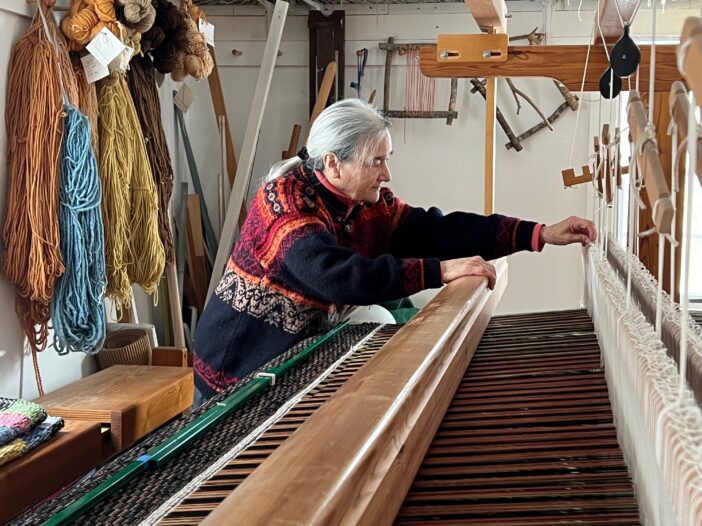
On the morning I visited Sara Hotchkiss, a red balloon was launched in the sky in South Waldoboro. It floated at the same height that the proposed cell tower will be. Friendship Road hummed with traffic, while on foot, photographers, company representatives and town folk tried to find it. Sara, who lives about a quarter mile from where the tower will be, was not able to see it from her house. A relief. Sara is a weaver who describes herself as an introvert. She’s probably most visible through her work which you can see online. Her weavings are abstract, yet with colors and titles that evoke Waldoboro. It’s only on occasion that you might catch Sara in person, at a Select Board meeting or some other civic event. And this is because she takes her citizenship as seriously as she does her weaving.
When I was four or five, my mother taught me how to knit, so I could make clothes for my dolls. I got totally hooked on fabric and yarn. My mother sewed. So, all through school, I sewed, too. I made all my clothes. And my grandmother, who was a traditional housewife, was a trained painter. So, art also was always part of my life.
I think I had this dream of weaving even before I got to college: I was outing with my aunt and my mother, and we were visiting a friend of my aunt’s. And she showed us her studio – it was above her garage, and she had a couple of floor looms which I’d never seen before. I just thought that was magical, and I knew I wanted to make textiles.
But I also I wanted to learn something in college that I could do as a vocation. So, I went to a college (Skidmore) that had a strong art and textile program. However, those classes were always full. It took me until junior year to get in. Even then, I had to convince the teacher to let me in. And finally, she did.
We started on a floor loom, about five feet long, and the first thing we did was learn how to warp up the loom, and I hated it. It’s all these tiny threads, and you have to count everything, and if you don’t do it right, you have to take it all out and do it over again to make it right.
So, I went up to her after two weeks and said, “I know I pestered you to take this class, but I have to drop out. I don’t like this.”
And she said, “Oh, no. You’re not dropping out. You’re staying right here.” I didn’t know what to say after that. So, I stayed.
Looms are really frustrating for just about anybody. They’re fussy. And they require a neurotic patience. They’re intimidating. For me, I had to warp it out — have it be a mess, have to pull it all out, and then do it again to get over my own fear. I had to go through trials and errors in order to get used to all the elements of a loom.
I don’t remember when it happened, but I reached the point to where I was just always in the studio. And I did the gamut, from sculptural textiles to flat weaving. I discovered that a loom is just a structure on which to throw yarn on and see what happens when you work the treadles.
After college, I did a bunch of things to make ends meet from bread-making to office work. But I always was weaving, and sometimes I was selling.
When I left Saratoga for Portland, I worked in an office located behind a rug distributor, and every day I would pass by these dreary wall-to wall rugs, or cheap braided rugs made in other countries, or hooked rugs with no spirit in them. And I thought, “I want to weave rugs!”
At that time, quilts were having a heyday, and I got really engrossed with the patterns. I morphed the designs into the tapestries that I was weaving and made them into rugs. And then I took them to shows all over New England. The whole thing blossomed.
I began to travel everywhere to show my work, and that’s when I’d meet people who’d say, “Oh, you’re from Maine! We have a house in Maine.” Or, “We go to Maine every summer.” And they all went on my mailing list.
Traveling that much was stressful. I wanted to retire and move up the coast in a place where I could establish myself in one location and sell from there. In 2002, I found the house in Waldoboro. It had with big open rooms – perfect for my studio and looms. With another for a showroom, and other rooms for living. And the people I’d met with houses in Maine would come by and buy my rugs.
It happened, but not the way I’d imagined. I opened my showroom a year or so later and people came. To bring in a wider audience, I also exhibited people’s work, making it into a gallery. I had my own open house weekends, plus I participated in SoWA’s Open Studio weekends, Artwalk Waldoboro’s Friday nights, and the annual Maine Craft Association weekend. And I could support myself.
People call me a weaver, but I think I’m more than that. I’m an introvert who likes to learn how things are done. So, I’m interested in government and civics. From time to time, I’ve been on various committees, one of which was the Planning Board, for six years.
This past summer a neighbor knocked on my door to tell me about the big cell tower they were going to erect nearby. I hadn’t met her before, but I’d read the notice about it in the paper. She said, “I’m opposed to the tower because I’m RF sensitive (the low-level radio frequency radiation), and I need somebody to help me organize an effort. They told me to come to you.”
It’s complicated. I know there are people who don’t have enough cell service and need it. I also know people who don’t have cell phones at all. But I agreed to help because I wasn’t crazy about a big cell tower down here.
And citizens can make a difference. When I was on the Planning Board, if a bunch of neighbors came and spoke to an issue, the board members really listened, because they wanted to reach an amenable conclusion. And if a bunch of people were there saying “We don’t want this, this and this because of that and that,” and if makes sense, the two entities together can really steer an issue.
On this, though, it’s been a little hard to gather people, like of like herding cats. But I’ve thought a lot about the process.
Cell tower companies are in the business of towers. They’re looking for opportunities and locations that work for them in terms of land and cell coverage. They pick a neighborhood and then drive around. If anything looks good, they’ll ask a homeowner for permission. Most probably say no, but then they’ll find the person who says yes. When the two parties sign a contract, the ball gets rolling.
But it’s for a project that could affect a wide variety of people, and for a range of reasons. A contract between two entities is not neighborhood decision. That is what doesn’t feel like a democratic process.
But what has is everyone meeting with the Select Board and Planning Board. In this case, the company is re-locating the tower to be further into the woods, and further from the road and neighbors. And they just did today’s balloon test to see how visible it would be for us.
Fairness, representation and democracy have always been important to me, ever since I was a little girl. This is why I love democracy. It’s basic to the fabric of our community. It’s a process, and it’s where decisions get done in an equitable, fair, and forward-reaching way. But we still need to pay attention, we need to be awake, even with very full lives. Because everything we do — or don’t do — has consequences.
Leave a Reply