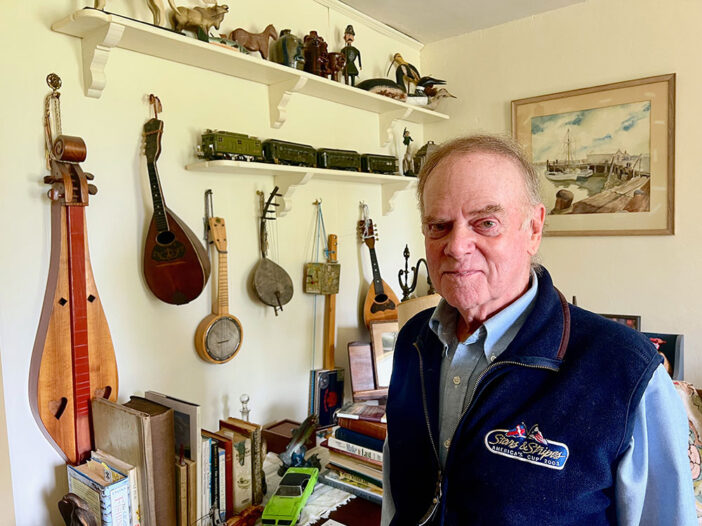
Rob Clark, born and raised in Henniker, NH, was going to be a minister. But one thing led to another, and he went from being an English major to working happily in construction and abatement for his working life. He’s retired now, but having a job never stopped him nor his wife Fran (a schoolteacher whose family had moved to Maine) from restoring an 1820 log cabin in West Virginia (where they met), a Colonial in Alna, a Greek revival in Bath and an 1850 farmhouse Waldoboro. Rob has curiosity galore, a zeal for antiques, and the discipline for studying old ways of construction. Moreover, he has the skills to repair and preserve the history of a house. Indeed, he can tell the story of all his homes, including his in Waldoboro.
The original deed is signed by Henry and Lucy Knox. This land was owned by them for a very long time. It was deeded by General Waldo, Lucy’s father, who gave her the land. And he was smart. You see – there are two signatures because while Henry owned it by marriage, but Lucy’s signature means she owned it, too.
In the late 1840s, the family sold it to a Daniel Webster Castner. And he built this house. You can see his signature in big cursive letters inside on what was the entrance to the privy in the barn. He must have been some proud of that privy.
In Waldoboro’s beginning, the first houses were built on the river. Then people would cut an open pasture to move the house back — about halfway from where we are. And then they’d move the house further. This was the third house built, and it’s the permanent one. And from what I understand, it was the same way on the other side of the river, too.
This house had six buildings — little blacksmith which was in rough shape, so I took it apart and put it back together again out back. The carriage barn where I found in the loft someone’s name written in pencil: “Damariscotta, Maine and still living at 16 years of age.” There’s a grist mill up the hill at the end of the property on Slaigo Brook, and there was a slaughterhouse. Next to it was a chicken house which had a long boardwalk leading out to it. The other two buildings, I haven’t figured out. But this farm looks to have had everything.
And I think this was a well-run and well-operated farm. There are stone walls that I cannot begin to tell you what they were for. And stone impoundments everywhere. And old fences that go back. It was quite an extensive farm. So, I think they had a lot of cattle, probably mostly for dairy with some beef, and they had chickens. Hence, the need for a slaughterhouse.
Even though this house is from the late1840s, the wood is older. You see, people used to tear down one house and build another with the wood from the first house. So even though the house was built around 1850, the wood is a lot older. And the building techniques are, too.
The Castner’s (and it used to be spelled Kastner) were German, and the Germans held on to the old ways of building a lot longer than a lot of the others, and that’s true here. All the woodwork in this house has been hand-planed. The windows have been pegged, as well as the doors. The moldings are hand-made. In fact, the whole house is made of huge timbers that have been pegged together. By the 1850s, houses in towns were being built using typical framing and studding. But this house was built the old way.
Even the foundation. If you walk out back, you can see where they cut the stones, where they drilled and split the stones apart. The entire house is under one foundation. Yes, it was built in the old, Yankee method where you had the big house, a little house (below) and the back house was the privy, and then the barn with everything is connected. This house was built at all one time. It was planned, not added on. And that’s always amazed me.
I think about the amount of labor! They were such hard workers. And tough. Also, set in their ways. They were people who would say, “This is the way we always built it. And this is the way you build a house because it’s going to last forever.”
Even in the design, they did things that had been out of fashion, and I think it was the German influence, the German community and solidarity they felt in tending to the old ways. We discovered, for example, a ‘borning room,’ an old concept from colonial times. It was a room built always right off the main bedroom, for when a woman was having her baby. There would be a bed and next to it, a cradle. She would give birth in that room, and it was a private room where she would stay and tend her baby.
They also had a room here for ‘waking,’ after someone had died. Generally, they used the parlor to ‘wake someone’, or as we would say now, to hold a wake. I always thought the wording was funny because if he waked, there would be a lot of confusion.
Upstairs, the grandma and grandpa would have slept. The children might have slept there, but probably on the other side, with a separate staircase leading to their quarters.
The original barn, the main barn for livestock, was across the street, and we never owned that. Sometimes I wished we had, but now I’m kind of glad we didn’t end up with it because I would have felt compelled to restore it. Thank God it was taken out of my hands. It was an enormous barn, and the back wall had been moving out and out. Then, one day, the whole thing went flat. Just like that.
But some things you learn with hindsight. When we first got this place back in the ‘90s, somebody – and he was old — stopped by and said, “You bought the place where I spent years as a farmhand. I stayed upstairs. And I lived here in one of those rooms!”
And I didn’t have enough sense to say, “Come in! Sit down! Have a cup of coffee. Do you drink beer? I’ll go get some. Tell me about this house.”
I missed that chance. And you can’t bring it back. He’s gone. I know he is. There is a lot I would have liked to have learned from him.
But that’s how it goes. There will come a time when we will no longer have the right to it. We’ll be gone. But the house will be here. Who’s going to get it? And who’s going to do what with it?
We’re hoping that it will be somebody who appreciates crooked floors, and doors that creak and come open in the night all on their own. This house moves with the wind, and it’s built that way. This home was built with extreme labor. It was a labor of love. You can see that everywhere, in all the details. It was built to be around forever.
So, to me, you owe it to them to keep it the way they built it. I know you can’t do that completely. There are modern things. But you can do the best you can.
Leave a Reply