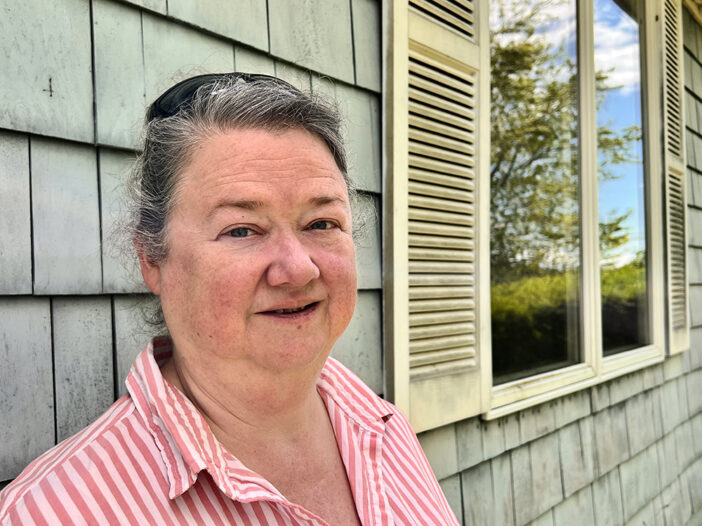
Jen Merritt grew up in Falmouth which, at that time, was a town like Waldoboro with its multi-generational families and egg farms. And like many before her, she left Maine at 18 for work. She started as a childcare worker at the Perkins School for the Blind in Watertown. She became a program manager for the deaf-blind; went to U Mass to study public service; worked as a case manager for the Department of Mental Retardation; and was part of a team creating a new state program for multi-handicapped adults. Her father used to say “Someday,” meaning that someday he would leave his job for something he liked better. But a stroke in 1993 that partially paralyzed him meant that “someday” would never arrive. But it prompted Jen to follow what she wanted to do, which was to have her own business. She called small business owners to learn how they started, how they made decisions and what sustained them. Then she put together her own quilt of work that she loves, helping small offices and individuals manage their businesses. Jen came to Waldoboro in 2000 to help her mother buy a home and move. Falmouth had grown too expensive. But Jen missed Maine, too, and so in 2002, she followed her mother to Waldoboro and bought her own home. Today she works with largely internet e-commerce businesses. But even more satisfying is lending her expertise and time to Waldoboro’s Economic Development Committee where she is Vice Chair and to the Waldoboro Business Association where she is a board member.
Waldoboro wasn’t always a sleepy little village. Not at all. In its heyday, it was full of manufacturing and businesses. We even had police in the village to manage the traffic from the shift changes at Sylvania. Many people were traveling to Waldoboro for work because we had some of the best jobs in mid-coast Maine. We had the Science Source, a local company with national sales. We had a call center in the village, and it was a really good call center with three shifts a day and a T-1 line that could compete with companies like Lands End in terms of call centers. That might not have been a living wage, but it was a great second job.
But between 2004 and 2014, some of our best employers left. And that’s when jobs became a big challenge for Waldoboro. Local employment with good paying jobs is still a challenge. But when you have that, people tend to spend their money in town. And businesses do, too. Which benefits everyone.
Right now, we’re at the place where we have some small businesses with around 20 or fewer employees. But we don’t have any larger businesses offering good jobs to a lot of people. Before COVID, most wages were not enough to support living here. If you wanted to earn $15 an hour, you often had to go to Brunswick or Augusta. And now, with housing costs, even the raises people are receiving can’t still cover the cost of living here. And that leaves many businesses understaffed. The employment sectors nowadays that pay a living wage in Waldoboro are clamming, the school system, and the town office which just unionized.
About 20 years ago, back when Sylvania alerted the town that some 250 jobs were going to disappear, the town formed an Economic Task Force. I got to know John Blamey (CK) in those meetings. This was around the time when Walmart was trying to get that property in Damariscotta, and it was a hot button issue. Walmart was never one of my favorite companies because of how poorly they paid people. But John said, “I want to stop you for a moment. I have some information you need to hear.” And he started giving me statistics about Waldoboro… how many single-parent families there were in town, and the number of people who needed more than one job to support their families, and where those jobs were, and how far people had to travel for them, and how a lot of those jobs were working for companies like the Walmart in Rockland. And gas prices were starting to fluctuate, too. He told me how much it cost to commute. And about the difference it would make to someone’s pocketbook if that daily trip were closer.
That conversation impacted me profoundly. It shifted how I thought and how I think of things now. John got me to understand that every issue needs a broader perspective. It doesn’t matter what I think personally — what matters is that I see things through someone else’s eyes. And I’ve come to think that it’s kind of a luxury to say, “I don’t want that.”
Work is work in Waldoboro. We understand, at least on a community level, that we are all in the same boat. And we know we need to work together to solve our problems, because nobody is coming to solve our problems for us.
People here may have differing perspectives on the concept of climate, but they don’t differ on the need to protect our environmental resources. Resilience is the word that is in my head all the time. We need to protect our water. And we’ve worked really hard at that and largely succeeded with the river. We need to protect our air and soil. Whatever new industries might come to Waldoboro, fishing, forestry, farming and tourism will remain, and they depend on our natural resources. Going forward, I think if we let our concerns about the environment lead what we propose and create, we will create better solutions for everyone.
Leave a Reply