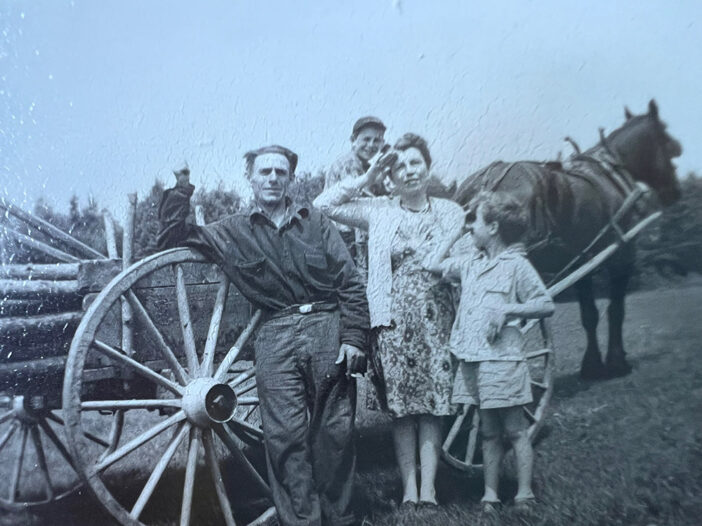
At least for me, the days of December are when I think about family the most. Whether I am with them or not (and they are mostly not with me) I am holding them in my heart. And for those parents, grandparents and aunts and uncles who are buried in the cemetery down the road, I am remembering them with love. And to friends, I find myself telling stories about them. Maybe that’s the lesson of these dark days. In September of this year, Bob Benner remembered his own life in this column. The following week, he recalled his mother Ida’s life. Obituaries, useful as they are, can never give the vivid picture that first-hand anecdotes and stories, such as Bob Benner’s, can. Without us to remember and tell them, they die when we do. My holiday wish for all of us in town to listen to and hold close the memories and stories of our parents and grandparents. We have so much to learn from their loves, mistakes, victories, and challenges. It’s my hope we’ll pass them down to our children, and in turn, they to their children. Bob Benner is 88 and has gone into hospice. Time is precious. He has no regrets and is not afraid. He is ready and his fate is with his savior Jesus, as it has always been. I, myself, am grateful for the memories he shared a while back of his father, Otis, Sr, Benner, 1897-1960.
People think my mother was the only one in the world, but she wasn’t. My dad was wonderful. He was born in 1897. His older brother Arthur, in 1895, and Henry, in 1898. They all worked on the farm.
Their dad worked them hard. Real hard. I mean, very hard. They got a beating every night whether they needed or not: “Because you need it. That’s all.”
Maybe that’s why Dad never talked about family or anything. All I ever learned, was from what little Mum could squeeze out of him and my Auntie Ethyl, too.
We had cousins all around us, but if I found out that somebody down the road was one, Dad would just say, “Yes.” And that was it. So, I never knew all those cousins. And probably three quarters of Nobleboro, or even 90 percent, were our relatives.
Dad kept to himself, even at home. If there was an argument between Mom and him, he didn’t argue. He would just walk out the door and start working outdoors. So, there were not many arguments because Mum knew better than to talk to him. But I think some of that frustration just broke out of her, like when she was spanking Ronald and me on our bare butt. I think she did it to us so she could be good to Dad.
He was a small man, only 5’3”, and he might have been 120 pounds. But he was strong, extremely strong. And he had a way of lifting.
He could do things alone that would take two or three people to do. And figure things out. He could move a large building by himself. And without all that effort, too. He was like one of my ancestors, Valentine Mank, who was accused of being a sorcerer in the 1700s because he did these amazing things, like tell people he was going to move this big, huge barn. They didn’t believe him, and then, one day, that barn was all moved to another position – that huge, barn! I think people were probably quite nervous of him.
Dad could do that, too. I kinda think he had something that other people didn’t have. He was good at most anything he did. And he worked real hard.
Dad did a lot of different things, but he liked farming the best. He could be here on the farm, and the rest of the world would be gone (outside of sugar and flour and the horses). We were completely self-sufficient.
He was a good woodsman, too. Mostly he got the deadwood for us. But if he cut some trees? He never wasted a thing. Not even a limb. If it couldn’t go in the stove, he made a pile and burned it outside. He always left the forest clean.
As a carpenter, he could do most anything. If you could have seen that barn – well, he did most of it himself. And it was huge. Only along towards the end of it, my brother Otis come home, and together they finished it.
When I took it down, Mum and Dad probably turned over in their graves. But I did it because Otis got himself up on that barn, and he did one of those things without ladders to try to patch it up. And, of course, the wind was blowing. When he got down, I told him, “You’re never gonna get up there again. Never!” After the barn came down, I gave Otis the lumber. It was all good lumber, lumber that was cut off our land, that Dad had cut and then hauled to the mill to be sawed. Otis used that lumber to build another barn and anything left over, he used for anything he needed to build.
Dad’s father, and before him, his father, used to have a Christmas tree business. Well, Dad started it up again, with Otis, Jr., and it was very successful. Dad’s trees were always very good, and people came over by the trailer to load them up. Year after year. It was perfect for Dad and Otis. I even worked on it one year. I was the puller.
One year, my uncle asked Dad if he could do the business with him. Oh, my mother was furious! Dad was very particular about his trees. But my uncle wasn’t. Well, that was the end of the Christmas tree business because the quality was so bad. None of the customers ever came back.
When you think of it, it’s amazing Dad was able to do everything he did, because every year that I can remember, Dad had an illness. It was a kind of complicated thing according to the doctors, and they would tell Mum, “He’s not going to make it this time.” And then she would doctor him and do everything she could. And Dad would pull through.
But one night when I was in bed, I overheard my grandmother say, “He’s going to die this time.” She said he had ‘the death rattle.’ But Dad made it through.
Sometimes I think he got it because his father worked him so hard. But it could have come from digging up graves. It was basically his lungs. But if anybody mentioned tuberculosis, oh, my God, Dad didn’t like anybody saying that to him. And I don’t think he ever had it. But he might have. It was a violent, violent cough. It was bad.
I found Mum’s diaries many years later in the attic upstairs. I couldn’t believe how much about all of our lives that she wrote. When I came across that particular part about Dad’s illness, I could feel her grief. It almost brought tears to my eyes, thinking of what had been going on. As a little kid, I didn’t realize how bad it was.
By the end, he was bedridden for over four years. After he died, my mother lived for another sixteen years. It was a very long and difficult time for her. I can understand how she felt, losing him.
I’m really missing Dad a lot now. Maybe it’s because I never felt I had much time with him. I’m hoping that they’ll greet me when I go. But they might not. Because that barn!
Leave a Reply