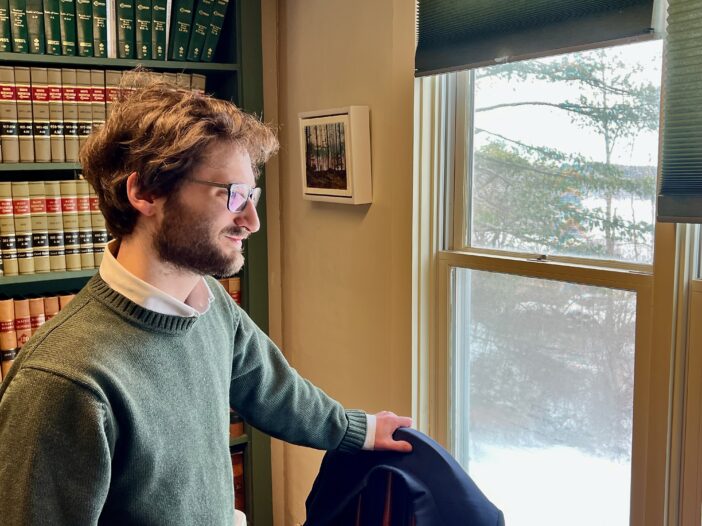
Nick Stiles wasn’t going to be a lawyer. He was going to be a farmer or homesteader. But in Florida, where he’d enrolled to be closer with his father, he discovered you had to specialize either in turf grass, citrus, or roses. So, after a year, he headed back to Augusta, his hometown, and enrolled in the University of Maine at Augusta. Today Nick’s name is on the shingle that hangs outside of Waldoboro’s Cumler, Lynch & Stiles. (And he’s also a newly elected Trustee of the Waldoboro Public Library.) A new lawyer has joined the practice, Rachel Klotz because Bob Cumler and Peter Lynch have recently retired. Yet the firm is very much alive and thriving. But before we go forward, let's go back in Nick's story to moment when he's returned to Maine, from Florida.
I went to UMA for a year and then I took a break because I wasn’t sure what I wanted to do. I got a job as a janitor at the Civic Center where I was more or less happy because it gave me time for being outdoors and lots of time, too, for my reading. I’ve always been a serious reader.
But then my dad got cancer, and on Christmas day he went into a coma, and on New Year’s, he died. I had just turned 21. And I realized, “I can either keep doing what I’m doing, or I can go back to school and figure something out.” I went back to UMA.
I majored in accounting because it seemed practical. But once I had my degree, I found myself applying for jobs that I didn’t really want. On a whim, I applied to law school – in fact, I applied to just one school, the University of Maine School of Law in Portland, thinking, “If I get in, I’ll go. And if I don’t, then it’s not what I am supposed to do.” I got in.
When you first start law school, it feels like you’re learning another language. There are always series of problems, and they start with the outline, and then the painstaking analysis, from the start and to the finish, with all the steps that you need to get there. You might see the logic unfold but you don’t fully grasp it. And you need to for class, because when the professor cold calls you to explain the case, you want to be on point.
I enjoy puzzles, and real estate, what we mostly practice here, is full of puzzles. Oftentimes, you do a title search and there’s no problems — maybe just a mortgage to pay off or something else that’s relatively straightforward.
Other times there are bigger issues like overlapping boundaries, or maybe someone only owns a half interest in a property they thought they owned completely. And then you have to figure out the history. As you go, you’ll see the missing pieces and ask, “What happened that messed up this piece of property?” You don’t always know where to go, but you’re always working to try to fix it. Every day is different, and every piece of land is different.
I’ve even had to go back to what’s called the King’s Grant, where the deed started. Back then, the king of England gave Waldoboro’s land to three governors and told them they had the authority to distribute land. So, they would give huge swaths of land to the people underneath them. And then that land got broken up over time, and here we are today. And you have to read cursive in order to read those old deeds.
But that’s rare. More common is going back to a time where there was once a public road that the town discontinued. Maybe, though, the town retained a public easement, to allow for public use. Or, maybe the town didn’t, in which case there isn’t a public easement.
We still have to go back and look for records, and the records are not always there. When you’re dealing with small towns, whoever was handling it a hundred or so years ago, may not have kept perfect records. And back then, it didn’t matter because everyone at the time knew what was going on. That’s why it’s a puzzle.
Surveys are great. But often there will be a corner of the land where no one knows who owns it. Or the deeds could conflict because someone wrote their own deed as they sometimes did then, and they didn’t have it surveyed. So ,who owns it? That’s the question. The paperwork says that both parties do. Or it says that neither does. And that’s where a survey is important.
You hope both will come to what’s called a Boundary Line Agreement, where they just say, “Okay, it’s unclear where the exact line is, but as the property owners, we are agreeing that this is where the line is. We both sign this document and agree.” And that fixes it.
But if they can’t agree, they go to court in which case, one wins and the other loses, or both lose, depending on the court fees.
Or, they just deal with it and don’t bring it to court. They postpone it and say, “As long as we don’t fight about it, we’ll let it be mystery.” And sometimes that’s easier. As long as they can be civil.
I’m proud of going to law school, and of being a lawyer. I take it very seriously and I am lucky that I enjoy my work.
But this is not how I define myself. At the end of the day, I identify with my reading and my gardening. My love of horticulture never disappeared. Nor my love of reading. I am reading a Thomas Hardy novel right now.
We don’t do divorces or adoptions, and we don’t do criminal law. We don’t have the rush of a reward in helping a family with an adoption, nor the drama of getting someone off a criminal charge. Our work is the day-to-day things, like helping someone start a business or buy a building or home, set up a will, or doing probates, the legal work surrounding a death in the family. It’s smaller, but just as important. It helps people. And we see people’s lives unfold, sometimes over generations.
We see families as a whole when we do probates. Some come in tightly knit in their loss, and others arrive knotted in old resentments, and those are the ones I feel so bad about. My father died when I was young, and I didn’t use that opportunity. I’m closer to my own family now, but I remember that time and wish it could have been different. I just want to say, “Make peace.” Otherwise, I think families could be angry at each other for the rest of their lives.
I often wonder when I’m outdoors in the garden, what the point of life is. I’ve decided it’s living my life, like this — trying to do a little bit of the good that I can, and to enjoy the time I have, while I can. Maybe there is more, but I don’t know what it is.
Leave a Reply