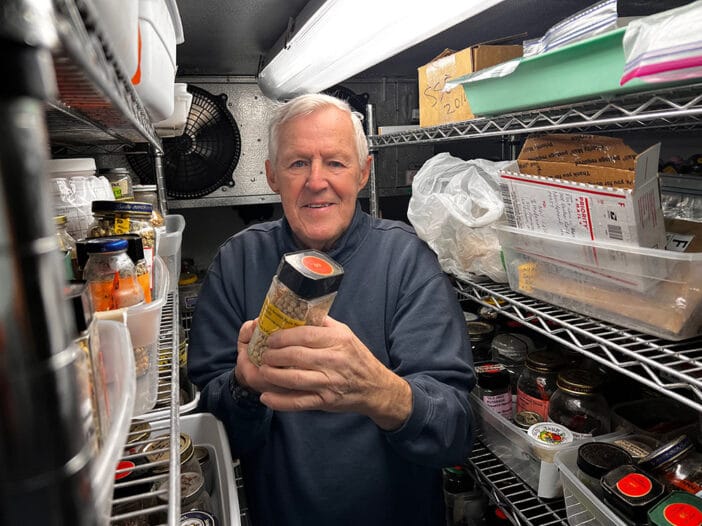
Everyone knows Neil Lash. If you don’t, maybe you’ve heard about the Heirloom Seed Project that he and Jon Thurston started in 1991. It’s the oldest school-based seed saving program in the US and winner of several national awards. On the other hand, you could just as easily have come across Neil’s name in the sports sections because for over forty years, he coached cross-country and basketball. Neil is a renaissance man. When he was drafted into the Army in 1967, he trained as a combat medic but ended up working as a physical therapy specialist at hospitals across the Northeast. As a teacher, he taught biology for twenty years, then moved into horticulture. His zeal for history led him to start an arboretum on the high school’s grounds in 2013, now the most extensive collection of historic trees in Maine with examples such as the last known surviving apple tree planted by Johnny Appleseed (yes, he was a real person), and a honey locust descended from the one under which Abraham Lincoln delivered his Gettysburg Address. Neil’s true loves have always been his family, his students, his trees, and his seeds, his favorite of which is the Einkorn wheat. Why? Because it’s the original wheat, mentioned in Genesis 18:06 when Abraham tells Sarah to take some wheat and make cakes to welcome visitors.
When I was a child, I would watch the clam diggers in February along Hatchet Cove flip over ice cakes to get to the mud, with a little fire going to keep their hands from freezing before they went back to clam – all so they could feed their families and pay their taxes. When I became a teacher, I understood that most of the taxes were going into my salary, even though Medomak doesn’t pay as well as other districts. That is why I tried to put everything into every minute that I was in the classroom. I’ve always kept those four or five clam diggers in mind.
As a student at Waldoboro High School, I was blessed. I had some very influential teachers. Mr. Dolloff, who was in his first year of teaching, taught me geometry and math. Mr. Green and Mr. Begley encouraged me to play sports. And because that collection of teachers who liked me, they tried to influence me to go to college, because I had no idea about college. I only knew I wanted to continue playing sports.
My transcript wasn’t very good. I also was very immature, I didn’t know how to study, and I didn’t know much. But, by the Grace of God they took me, into the same college where Bob Green had gone, Gorham State Teachers College. It must have been an answer to a prayer.
I was going to be a history teacher, but I found that history was a little staid. I wanted something a little more hands-on-action. So, I took college science. I even took an archaeology class. I graduated in 1963.
In 1980, when I was teaching at Auburn High School, a position opened up at Medomak. Mr. Dolloff was the principal, and he hired me. I was blessed to have that.
Fast forward to 1991. The horticultural teacher was retiring, and Mr. Dolloff asked me and Jon Thurston to take over and make the program into a science elective. So, we integrated everything we could and made it applied botany, even though it was still called horticulture.
Well, I used to watch “The Victory Garden” on PBS, and I loved it. One day, a man named Kent Whealy came on, talking about seeds. He’d started an international organization called Seed Savers Exchange. And he held up some seeds and said, “These reportedly came over on the Mayflower.”
The next day, I went to Jon and said, “We’ve got to belong to Seed Savers. We’ve got to get those seeds.” I’m a descendent from five who were on the Mayflower. The seeds were the Mayflower Beans.
Fast forward again. In the huge compendium that Seed Savers publishes each year, our Medomak Valley High School has a full third of the entries.
If you throw away a seed, you never know what you’ve lost. I always think about the Pacific yew, a scrubby tree of no aesthetic value. But then they discovered Taxol in its bark, a drug for treating breast, ovarian, pancreatic, and certain types of lung cancers.
In seed collecting, you’re always looking for landrace – seeds that have been grown in an isolated village away from all other varieties, that have bred and mutated on their own without the influence of other varieties. At the Seed Project, we are working with a scientist from the University of Alaska at Fairbanks who wants to grow Sarkalahti, a fast-growing wheat that has only been found in only in a single village located somewhere between Helsinki and the Russian border. This wheat has adapted to that climate. And this scientist is looking for a wheat that grows quickly and can be harvested as a spring wheat. So, we’ve been working together on this, which I like, because as a boy, I remember hearing people speak Finnish. This past summer year I took the seeds from the early-ripening wheat and separated them from the later ones when we harvested it. If I keep doing this, we can get earlier and earlier wheats.
Years ago, there was a movement to cut back our program, but they didn’t. I am hearing talk again of that. I just want people to realize the absolute importance of grassroots organizations and programs like ours.
We don’t know if this wheat will adapt to climate change better than the wheat we know. But hybridizing seeds is an inbreeding process, to the point where you are getting almost complete uniformity. In doing that, you discard other genes, perhaps losing them permanently — genes that could be valuable in a drought, or in constant flooding, or that have resistance to certain diseases or certain insects. Heirloom seeds have a unique genetic package, adapted over thousands of years. But if you don’t preserve them, you don’t know what they’re worth until they’re gone.
Leave a Reply