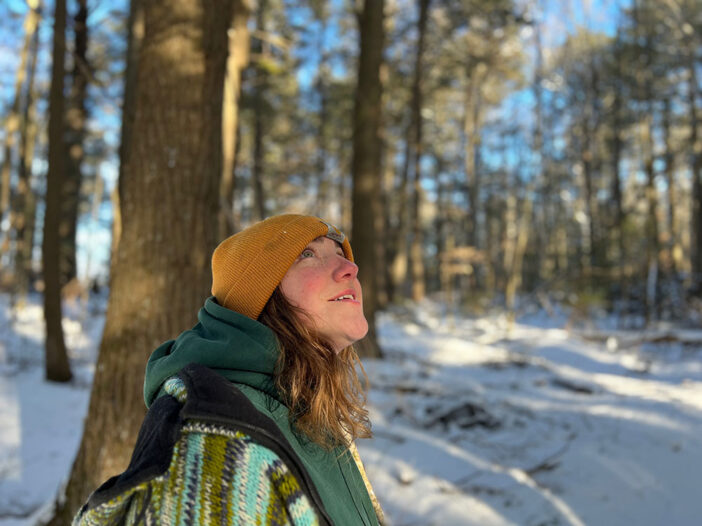
As they say around here, Morganne Price is from away -- but surely it counts that she grew up here. Her family was seeking a rural spot. But for Morganne, Waldoboro was a happening spot with lots of houses, three gas stations, two bars, bowling alley, grocery store, and Dunkin Donuts. In her imagination, rural was reserved for places out West. And that’s where she headed after college, living and working over the course of seven years in Wyoming, Alaska, Oregon, Washington, Arizona and California. Depending on the need, she tested water, worked with fisheries, and collected data for research projects run by various state and, federal agencies as well as for non-profits. With the perspective of being away, she saw how rural Waldoboro was. She remembered that wherever you went, you saw people you knew. And she missed it. She returned two years ago. She did what a lot of people do: she got a dog and cobbled a jumble of part-time jobs including dog sitting, carpentry, landscaping, and gardening. This January, Midcoast Conservancy hired her as the Medomak River Watershed Manager, putting her in the center of the community she loves, doing exactly what she loves which is collecting data, monitoring lands, testing water and talking to people of about the health of the river and the work of the Conservancy. Morganne credits biology teacher Miss Pamela Ramsey for her zeal, and the day they did fieldwork in Union to collect the baby flies that live in the rocks, a macroinvertebrate that is an important indicator of a stream’s health. It was a moment of wow and wonder that Morganne will never forget.
You know that forest you see driving south on 220 just before Finntown Road? It’s the largest intact wilderness below Augusta, between Belfast and Kittery. It’s thousands of acres with moose, black bears, deer, foxes, coyotes, beavers, muskrats, raccoons, and skunks. There’s old growth forest and new growth. There’s ledge, and there’s swamps. There’s big rivers, little trickling tributaries, and tiny streams. We call it the Three Brooks Wilderness. As far as biodiversity goes, that little region right here in Waldoboro has it all.
Public land out West is different than here. You’ve got vast tracts managed by the Forest Service, the Bureau of Land Management, and the National Park Service, all land that is publicly accessible and conserved. That’s great for biodiversity. Because it’s intact wilderness for wildlife and fish to move freely. However, if you put a road in, development tends to follow. And then you’ve just fragmented the spaces where the wildlife used to cross.
Drive up to Augusta and you’ll see a lot of woods, a lot of wilderness. But actually, there’s a lot of roads cutting through it. You don’t see the lots that have been cut in back and the construction. That’s why the Three Brook Wilderness is one of the places we’re working to protect.
In the East, land is mostly private because of the way this country was developed. If it’s private, the government can’t tell you what you should do with it. But conservation-wise it makes for a mishmash. To protect our wilderness, we all have to rely on private donations and easements. And almost all the land in Three Brooks is private, with just a few easements in there.
In an easement, you give up your rights to development. And because you gave up rights to develop it, the land is not as ‘valuable.’ And you get a tax deduction because you’ve ‘devalued’ your land – though in my opinion, you’ve increased its value. But I don’t make the rules.
I am still figuring out the job, but I know it will include lots of monitoring of land and water. Recently I’ve done a lot of meeting with people who have conservation easements on their land with us, because once a year we go and walk those properties. We’re making sure that a neighbor hasn’t secretly cleared part of the land, or that there’s no random sheds in there.
The thing with easements is that while there’s a lot of flexibility, you cannot change your mind. But you can do a lot of different things. You can give it to us outright. Or, you can keep it private and in your family. You can make it forever wild with no trails, no logging, no farming. Or, you can make it a sustainable forest and make selective cuts to go in and cut firewood. Or, you can say farming is allowed so you can still hay your fields, manage the blueberry fields, keep cattle or whatnot. But once the easement is set, it’s legally binding and enforceable.
As a land trust seeking to protect more land, I don’t think we’re taking away from projects that would go to affordable housing. In fact, land trusts are trying to find that balance. I just heard the Maine Coast Heritage Trust did a deal pairing conservation with building year-round, workforce housing.
But no doubt about it: housing is a huge problem here. Many people I know want to move to Waldoboro, and they’re like, “I want to live and work here, but I can’t find an apartment. I can’t afford it.”
I’ve lived out West, and I saw Seattle, Jackson and Kodiak explode with growth. But looking at those towns, it seemed obvious. I just thought I’d never see it in Waldoboro. But it is. Now everybody wants to move here, even people who are from out of state.
But I don’t want to turn this into an us versus them. Like any ecosystem, a monoculture is not healthy. If we are all low socio-economically, that’s not good. If we’re all upper class, that’s not good either. The thing I’ve always appreciated about Waldoboro is its mosaic of incomes. To me, it’s about balance — just like in nature.
Leave a Reply