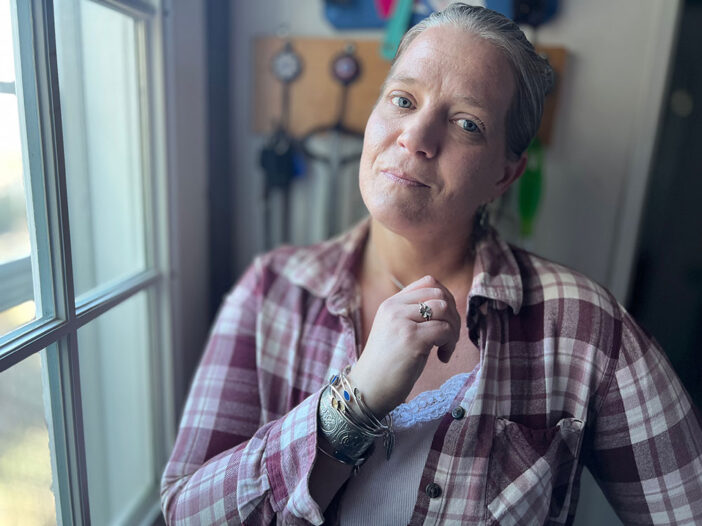
Stop at the restroom on the Maine Turnpike, and you’ll see a metal box by the entrance for ‘sharpies,’ used syringes. Wait in line at Community Pharmacy and you’ll see plastic containers for ‘sharpies’ plus drug tests and leaflets for Narcan. And if you miss those, just read the crime blotters of the local papers. If we are all related by six degrees of separation, surely in Waldoboro we are one degree or less away from someone we have lost to drugs or alcohol. Opioids and alcohol are all around us. Yet it feels largely absent from public discourse or family conversations. That silence was the motivation of artist Peter Bruun in making “Elisef’s Story,” which is screening for free at the Waldo Theatre on Wednesday, January 22. Elisef was his 22-year old daughter. That same stigma also drives Molly Hopkins, who freely tells her own story of loss and addiction, in the hope that just maybe, something will click for her listener. Molly lost her own brother to an opioid overdose in 2007. Her brother Casey was 29 and Molly was 22. She had just graduated from college and gotten a job at the Brain Injury Rehabilitation Center in New Hampshire. With the loss of her brother, Molly, who already was drinking, began to drink for real. For several years she managed a full caseload of people suffering injuries from strokes and other traumas. In that time, she married and had a child. Eventually, though, with increasing seizures and blackouts she lost the job she loved. Though Molly has been sober for seven years, she would say there’s nothing automatic about recovery: putting down the drink is the easy part. The hard part is letting go of the impulsivity, low self-esteem and constant obsessing. An invitation from her father led her to Waldoboro about a year ago. Since then, she’s been volunteering for the Lincoln Recovery Center in Newcastle. She is trained in Peer Recovery Coaching, and she is about to take the exam to be a Licensed Alcohol and Drug Counselor.
Someone says, “He’s a junkie,” or “She’s a drunk,” and I say, “Would you say that about me? Because I was a drunk. And about that man who is using? He is somebody’s son or brother or uncle or father.”
People don’t have to help, they really don’t. I just want to say them, “Don’t assume. Don’t jump. Don’t judge,” because I know there’s so much more to a drug user than their addiction. There is much more to me than being a drunk.
Growing up on North Haven – I was so naïve. Casey was my big brother — really good-looking and a hard worker. And everyone knew that Casey partied hard. I just didn’t know how hard. I didn’t know about his drinking and drugs. He hid that from me. I didn’t even know there were drugs on the island. Casey kept all of that from me.
Even after his rehabs, until he died, I didn’t know the extent of his use. I had this ‘out of sight, out of mind’ mentality. I think when it comes to addiction, everyone thinks that way. It’s sort of that “if we don’t think about it, it’s not there” kind of mindset. But I’ve lived it. So, I know about the ins and outs of addiction.
Right after I graduated from college (I was the first to go and graduate) our family had a big party to celebrate. Everyone was there – my brother, my sister, my grandmother, my mother and all our friends; and Casey was drinking at the party. And I remember thinking, “But you just came back from rehab.” That party was the last time I saw my brother.
A month later my mom called to say that Casey had died of a drug overdose.
I was so angry at him, angry for such a long time. Casey was the one who used to tell me, “I’m going to make sure, Molly, that you go to college.” He was my protector. After he died, I realized that he was the reason no one on the island ever offered me drugs or alcohol.
For weeks and months after, I’d hide in the bathroom and cry, “Who’s going to protect me now?” And then, I’d be angry at myself for being angry at him.
I couldn’t understand why Casey didn’t get better after rehab. He had so much potential. But I didn’t know then that if you don’t think you need help, you’re never going to get better.
On the surface I was normal, but inside, I was a mess. I was drinking more and more, but I didn’t think I had a problem. I had a good job, I was married a man I loved. When I got pregnant, I got sober for those nine months, all the while planning my next drink for right after birth.
One day I drank so much that I passed out, and my husband took our daughter away and left a note. I begged and begged for him to come back, but he told me he was going to leave me for good if I didn’t get sober.
But I wasn’t one of those people who get sober and stay sober. Relapse is a big part of my story. I went into rehab because I wanted to save my marriage, and I managed it for a year. Then, on the anniversary of Casey’s death, I had a shot of vodka, which was exactly what I’d planned. I started back drinking. And everything spun out of control.
One day, my husband came to pick up my daughter, and I was passed out. He filed for divorce and petitioned that I see my daughter only in supervised visits. If I didn’t get sober, I wouldn’t see my daughter. So, I got sober again. He had this portable breathalyzer that I used three times a day to give him instant readings remotely as ordered by the Court. It was to last a year, and as the year was ending, I was planning my next drink.
I’m not going to sugarcoat it. I was on my way to pick my daughter up from daycare, and halfway, I realized I had had too much to drink, and I turned around to go back. And as I did, I flipped the car and got into a pretty bad accident.
Waking up in the hospital, knowing I had left my house in that condition, knowing that I could have killed somebody that day, and realizing I’d had a complete disregard for other people’s lives – that made me see that I had a problem. I needed to get sober for me – not my husband, not my daughter — but for me alone.
I haven’t had a single drop of alcohol for seven years. I think I will be on this journey until I die.
I am finally dealing with my grief over my brother’s death. Casey is my higher power. He’s the one who keeps me grounded and the one I journal to each night. I can’t explain it, but I feel he is looking out for me.
When I first arrived in Waldoboro, I told my story to someone I’d met, and she brought me to the Lincoln Recovery Center in Newcastle. I would go in there and cry.
It’s such an underserved community. But at least I can point people to the Center.
So many people helped me when I thought no one should help me, because I was a screw-up. I was a bad mom. Then, when I got sober, it was reassuring to be around functional people who had been in recovery for five or ten years. They gave me the confidence, by their counseling and example, that I could keep going. And now, if I can pay it forward, that would be my dream.
I don’t believe any addict should ever be given up on. You can’t make people recover on your timeline. You can’t make them see that they have a problem, or that they need help. The only thing you can do is to show support and love. That is how you show up.
When I’m at the Center, I just let people vent. Then I tell them my story. It might not work for them, but it’s how I got my life back. I do it from my heart, because when I was drinking, I was shunned and cast away.
And I say: “Hey, dude, I was right there. Don’t tell me that I don’t understand — because I do. And don’t tell me that I don’t get what it’s like to lose a loved one. Because I have.”
Leave a Reply