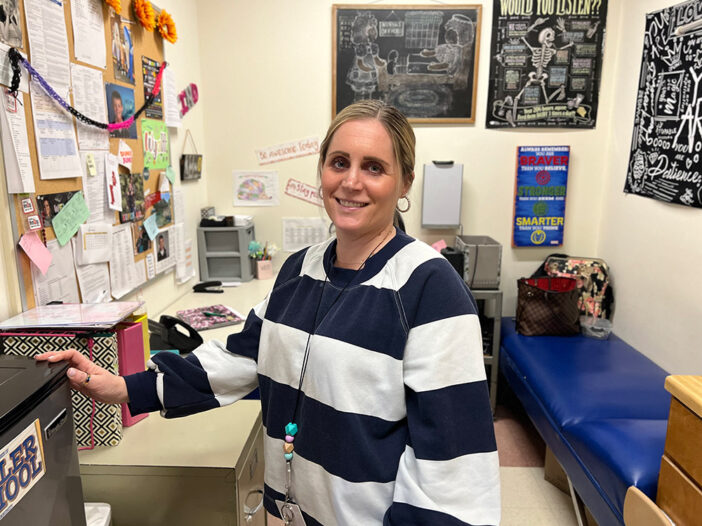
After 16 years of working in ER, critical care, and oncology (her last stint) Miranda Jandreau did an about-face and joined Miller Elementary School as the school nurse. She went from tending to chemo reactions to patching booboos with band-aids and icepacks. Still, she no longer listens for the sound of the ambulance except on the upsetting day when she needs to call one. And she no longer puts in twelve-hour shifts. Her day now aligns with that of her11-year old son who attends Miller. But her job is far from simple. Miranda tends to 354 kids, including the numerous ones with special needs, a lot of kids for one nurse. Among her responsibilities are giving medications to those who need it, repairing or looking over accidents on the playground, and treating kids coming down with infections or simply a stomachache that could stem from stress, hunger, or an oncoming flu. Thankfully, Miranda is part of a team that includes a health aide, the school’s classroom teachers, the guidance counselor, and the staff of the administration, all of whom watch over the health of students there and those at Friendship School. Miranda joined Miller in 2022, but she is no stranger to Waldoboro. She grew up in Warren and graduated from RSU40. Then she entered college, planning a future in accounting. But in the summer after freshman year, Miranda found herself taking care of her grandmother who was dying of lung cancer and whose last words to her granddaughter were, “You should go into nursing.” And a lightbulb went off.
As a nurse, I have trouble staying in my office. I like to go classroom to classroom. I call it ‘house calls.’ I really want all my kiddoes to know my face if there’s an emergency and hopefully there’s never one. I want the teachers to know me. That way, if something happens, I’m not this foreign person that’s coming up to them, touching them, listening to their lungs. So, I make rounds to check up on my littles.
I see more and more kids coming to school sick. They are coming with a fever over 100 degrees or with diarrhea or vomiting or an uncontrolled cough, or with red, crusty eyes that are still shut. Those are the times when a parent needs to keep them home. They can’t learn if they are sick. I’m getting all of it because we’re in the winter. Right now, we have Covid, influenza, strep throat, impetigo, and hand-foot-and-mouth circulating. It’s a lot.
The biggest and hardest part of my job, though, is the dissecting. A kid will come in without fever, have played at recess, and then vomited at the end of the day. I’ll be like, “Ohhhhh.”
I have to ask myself each time, “Is this kiddo really sick or not?” Our goal is to keep kids here to learn. We want our kids to get an education. Is this kid overtired? Is this kid just not liking math class? Does this kid have a test coming up? Figuring out the problem is one of the hardest things because kids have real circumstances.
Maybe a kiddo is going home to a place without heat. Or maybe they didn’t have dinner last night. It breaks my heart that not everyone is having the same life. I know my child goes into the cabinet and gets food when he wants. And I know that that’s not what some kids have.
Mental health is on the huge increase. I was shocked by how much there is. Maybe a little one is depressed or anxious — which can manifest as feeling sick. Kids will come in saying, “I have a headache,” “I have a bellyache.” Are they struggling because they’ve had a rough night at home?
Our district has a lot of homeless families, too. There are quite a few kids who don’t know where they’re going to be night to night. That’s an anxiety that would affect anybody. We have kids in divorced families going from mom to dad, and that’s a hard transition on the elementary level. Thankfully, I have our guidance counselor and folk in the administration to talk to and work with when it doesn’t seem like something simple. That puts everyone to be on the same page in knowing that I don’t think it’s something physical, as opposed to something mental or emotional.
I wish more parents understood my role. Kids will say, “My mom said for you to check me out,” or, “My mom wants to ask if this is broken.”
I’m not a primary care provider. I can’t do x-rays. I am a nurse. I’m here for when you’re sick at school and to direct you in the right direction. I can’t diagnose. I can tell you what I see – bruising, swelling, or whatever it might be. Then I tell parents to see their child’s primary care provider. It’s so important they maintain that relationship.
But I think the hardest thing for parents is understanding, especially at the elementary level, that kids cannot carry their own medication in school. In fact, to give medication in school during the school day, we need consent from both their doctor and their parent. That means getting a doctor’s order and then going to the school office to fill out paperwork and to drop off the medication. Even for ibuprofen and Tylenol. We do have a three-dose consent form for those which permits us to give it out three times over the year, but if your kiddo has chronic headaches, we are going to need a doctor’s order.
Kids are always the favorite part of my day. In the mornings I am seeing everybody who came to school not feeling well. Then from 11:30-1:30 it’s giving medications for things like asthma, ADHC, and anxiety. My diabetics come in throughout the day. Students cycle all day long through my little office. A good day at work is simply being with these kids.
Leave a Reply