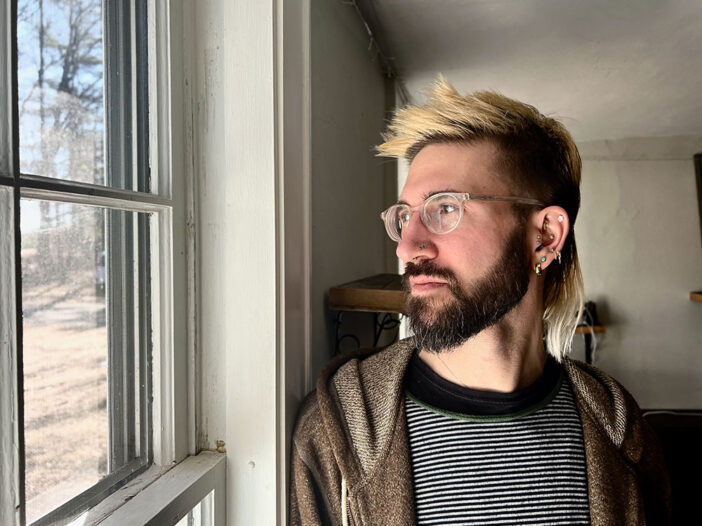
Waldoboro was a random choice for Michael Amico and his husband Conrad Winslow who now live in the Jasper Stahl house. Michael lived in academia, first, completing his doctorate in American Studies at Yale; moving on to do post-grad research in Brooklyn while Conrad composed music; then, to work as a researcher for the Center for the History of Emotions in Berlin. But five years in, Michael began to feel too detached from the world. They returned to the US to re-think. They decided on settling in a coastal town in Maine where civic participation was possible. With no previous connections, they settled in Waldoboro and from the start, forged connections by attending Select Board and other town meetings to listen and learn, asking questions only as they arise. Once a professional actor, Michael also sits on the board of the Waldo Theatre. Lastly, Michael and Bill Maxwell established the Waldoboro Origins Committee with the purpose of examining the the history and identity of Waldoboro, both for residents and the town. It is a project that will span the town’s planning, development, and branding. When not working on the several books he is writing, Michael is studying the work of Waldoboro historian Jasper Stahl (1886-1970). In the process, he noted that according to Jasper Stahl, Conrad Heyer was not the first white child (April 1749) as previously assumed. Instead, the first recorded birth was a baby girl, born six years earlier (Sept. 29, 1743), and her name was Philipine Elizabeth Rominger. In fact, she was born on the land where the Sylvania factory once stood. Such are the shadows of our history.
Waldoboro is exactly as described to me — more conservative than its neighbors, more politically divided, and more resistant to ideas thought to be liberal or progressive. But Waldoboro is not a bubble. It’s not a place where everyone thinks and feels the same way. You encounter difference here. And that forces you to negotiate, to live beside people who are never going to fit into your understanding of yourself. And it makes me ask, “How do we build communities that are premised on giving space to difference?”
That’s what has energized me. Waldoboro is small enough where I can meet people who share my interests in one activity but don’t share my opinions or politics. Here, it’s easy to be involved very quickly in different organizations. I feel I am dealing with an entire world, not just one of way of life. It can feel a little lonely. But that’s what it means to be outside.
I’ve been slowly reading Jasper Stahl, both his books and his papers up in Orono. He was an eccentric and according to someone who saw him a lot, a gay man. Jasper spent his retirement years writing the history of Waldoboro. He was doing it as a volunteer. And it was a tremendous achievement! When The History of Old Broad Bay and Waldoboro came out in 1956, reviewers wrote that it was one of the best local histories they’d read. It was even nominated for a national award, next to books about the major events in American history. Before its publication, people had rarely seen local history as reflecting the history of the country at large.
Readers would write, “I couldn’t put your book down. It was like an adventure story.” That’s because there’s so much passion in it. So much judgement! He deplored the Puritan elite who owned the land and were willing to exploit the poor. He admired the first Germans who believed in mutual aid and conservation, both qualities they needed for survival.
But sometimes those values crisscrossed. Jasper’s chapter “Amid the Encircling Gloom” on education and schools from 1800-1850 and the arguments between the rich Puritans and the poorer Germans could literally be today, with the same animosity towards people who supposedly have more knowledge telling other people how they need to educate their kids or why they need to pay someone else to educate their kids. There is nothing about Jasper’s writing that is neutral, which makes me ask, “Who was Jasper Stahl?”
He’d grown up here and went to Bowdoin. He lived in Germany for a while. He came back and was an educator at a boarding school in Pennsylvania. He retired in Waldoboro and took on this project. He was driven by the idea of creating a civilized culture, a good world. And he felt that only by understanding the past, could you accomplish that.
I’m only three quarters through the volumes, and I feel as if I’m on the same journey as him. Jasper is asking about Waldoboro’s place in America, and I am, too. He’s also asking what it means to be a good man, among all the different kinds of men. And where can we create spaces for us to re-feel community? These are the same questions I’m asking. I don’t need to have been from here to have a legitimate interest in Waldoboro. It’s a question of America.
Every place in the world has people from away. I think this obsession with being from away, especially in Maine, stems from the first Europeans here, who were isolated on the frontier and living with an immediate, haunting presence right outside their door.
In Waldoboro, it’s a phrase with inordinate power. Yet Waldoboro was founded by people from away, by the Puritan Federalists from Massachusetts. Then came the shipbuilding industry, the economic powerhouse of Waldoboro. The people bankrolling it were from away, as were some of the craftsmen brought in to work on the boats. You could say that being from away is something that lives inside of all of us. We all have the other within us.
I find Select Board meetings such an opportunity to learn what is bringing all these people together and what is pulling them apart. Or, to see if everyone is talking about the same thing even. In public discourses, like on Facebook, everyone wants to get their word in and leave. But that’s shutting down the space. Involvement means showing up, opening up, and listening. It strikes me that all my writing and research been about awakening civic conscience, something that still holds me.
The reason Jasper Stahl wanted to buy this house — and he restored almost everything here — was to recreate this space in order to re-feel the town. After the book was published, Jasper wrote about standing in this room and looking down the road, saddened and angry at the way the world was moving. That people were driving too fast, living a world of accumulated waste. They no longer valued craftsmanship. They had lost the sense of time and patience, values he thought of as fueling a good life – which I take as treating people well and pausing to consider the other instead of racing past the other.
We need to create spaces for us to re-feel the community. What are ways that people can come together? We no longer have AD Gray for annual balls. But how can we create the spaces we do have to re-inhabit or reconsider the ways we are moving through the world today? Spaces for talking about homelessness or waste or recreation or addiction? Where are the spaces where we can get together and be silly with each other, especially with those who are different from us? It’s not rocket science. When people start laughing and singing together it really does make us feel better. It makes us feel together. And it makes us feel like we belong.
Leave a Reply