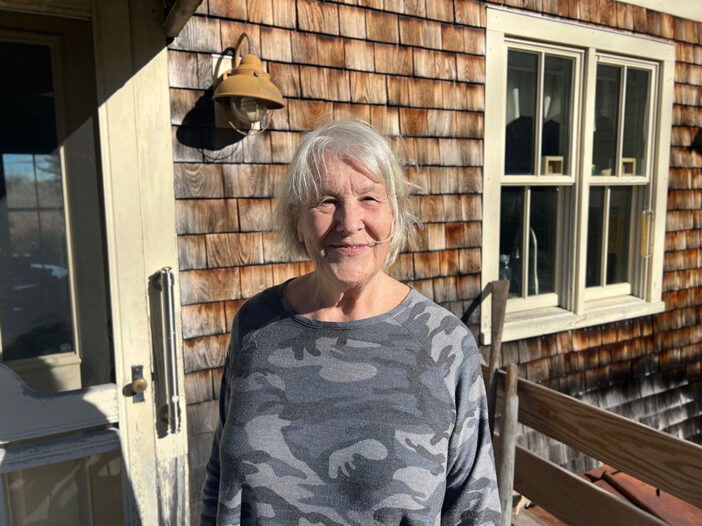
Martha Bush grew up as Martha Winchenbach, with a father who had switched from being a game warden to a mailman and a mother who’d been a summer person, from away, with red fingernails and a fur coat. Every time her parents voted, they canceled each other out. Martha loved Waldoboro. It didn’t matter if it meant navigating animal skins her father was stretching in the kitchen or tending her sheep or weeding the strawberry fields, or heading into town on a Saturday night for the glamor of the crowds – it was a childhood and adolescence that felt free. One summer, Martha discovered Monhegan Island. Whether it was cleaning rooms and waitressing or playing her guitar and singing, she fell in love with it all. Even so, she went off to study animal husbandry. She lasted two years. It just couldn’t compete with performing. She settled in Portland and waitressed. She picked up the occasional gig, hung out with musicians, and still spent her summers on Monhegan. There, she met the gifted painter, Ralph Bush, who, for a change, was not a musician. And something clicked between them. For six years they traveled to and from Portland to Rockport, MA to be with each other. Then one Christmas season, he asked her to marry him. She was 48, and he was 65.
I was never one of those girls who said, “I can’t wait to leave Waldoboro.” I loved Waldoboro. To be in town was so amazing to me. You could go to the newsstand and get candy. You could walk all over the place, and it was so free. I would walk with my friend who lived uptown. She knew her way around and when we passed the Day twins sitting on the corner, if they talked to you, it was, “Wow…” They were known as rebels, kind of rogue-ish, and they were so good-looking.
Saturday night in the Village in those days was an event. You saw all sorts of people and you talked to your neighbors, and the stores were open, like Forrest Eaton’s Five & Ten, and Mrs. Benner’s shop, and the drug store where you could get a nickel coca cola in a paper cone. And in one of those stores, I bought my first record. It was The New Christie Minstrels.
For special occasions, we would eat at Moody’s. I remember always getting the scallops. And they had this relish tray that they’d put on the table with little round bowls and one of them had cottage cheese, and maybe pickled beets in another, and we thought it was so chichi.
Every Christmas, the Fire Department would bring Santa Claus, and he had these clear plastic bags tied up with a ribbon and inside was an orange, a peppermint candy cane and peanuts. And they would pass them to all the kids in Waldoboro. And on Christmas Eve, my father would take us to the drug store to buy Evening in Paris perfume for my mother and Jergens lotion for my grandmother.
On Thanksgiving, we’d have a big dinner. We were Winchenbach’s, Boggs’ and Little’s, about fifteen of us. My aunt lived in the house behind us, another one lived down below us, and my grandmother was just a mile away. After dinner, the men would all get their guns and go out hunting, while the women would get up and do the dishes.
To make money for school, every August, we raked blueberries. A bus would pick up all us kids, with our rakes and our lunches, and we’d drive maybe to Union or Warren or somewhere in Waldoboro, and we’d rake for the day.
We used to go to the Merry Barn, down on River Road toward Boothbay, for hootenannies and concerts. I must have been fourteen or fifteen when I heard the Kin Three. They were two men and one woman, singing and playing folk music. And listening to them, I knew that was all I ever wanted to do.
So, I asked my father if I could get a guitar. He paid for half, and I raked blueberries for the rest. I got it from Sears. I think it came in the mail, and it came with a record, a 45, which showed me how to tune it. I played in my room until my fingers bled because I wanted it so badly.
Around that time, maybe even a little before, my friend Betty Jameson had a sister on Monhegan Island, and she invited me to go with her for the summer. We worked at the Trailing Yew, on top of the island, and we all lived together in a dorm with bunk beds three high, and we got three meals a day. We ate so well we all came back a little chunky.
And we were good workers so Mrs. Day, the owner, she would always have us back. Betty and I would count the days until we could return. For me, being on Monhegan was instantaneous. I fell in love with it immediately. There were all these fascinating people who were artists. And when you’re a girl from Waldoboro, to go there and experience all these New Yorkers with new ideas and different ways of expressing themselves, it was amazing. It was an education in itself.
Well, after I got the guitar, I brought it out, too, and I didn’t even have a case for it. But I would play and sing in the dorm. Then, I branched out to singing to kids in the other hotels, and I met Robert Hall, another singer. He was like a young James Taylor. And we started getting invited to sing at people’s parties. One time, when I was singing at the Sea Gull, Dave Brubeck was there. Another time, when I was waitressing, Alan Arkin was there with his guru and somebody like his manager, and he said, “Oh, we’ll have to get together and sing.” And we did. I would sing a song and then Alan would sing a song, then I would sing another, and he would sing another.
My father died when I was in my forties. And afterwards, that’s where I went. Monhegan was that kind of place. It was safe. It was also where I met Ralph. The first thing he asked was, “How old are you?” When I asked him his age, he said, “I’m 59, but I’m not going to marry you.”
Back then, I don’t think I understood how good an artist he was. I was used to the abstracts and the Diebenkorn’s and the kind of thing where you painted what wasn’t there. So sometimes I’d look at a painting of his and say, “It needs a little of this,” and he would go out of his way not to do that. Ralph is his own person.
We were crazy about each other. Yet, at the time he proposed, I wasn’t sure about getting married. I had lived on my own and supported myself for 48 years. I did not depend on anyone.
But I said, “Yes.” My mother was thrilled. And we got married. On Monhegan.
Ralph wanted me to change my name. That was hard. I had always been just me. But I re-registered at Social Security as Martha Bush.
Well, one day, Ralph saw an ad in the back of Down East Magazine, and he showed me the picture: “That’s your mother’s old house.”.
My father traded our first house on Gross Neck with this one in 1952. I was about five when we moved there. I had sheep there. My sister and I had our strawberry patches. It was our childhood. When my father died, my mother continued living there. Then when she died, we sold it. I was so sad that I couldn’t even come near the property. Even if I needed to drive by it, I’d find another way around so I wouldn’t see it.
When Ralph showed me the picture, I said, “Let’s buy it back,” in kind of a wishing-and-hoping way. I didn’t tell Ralph, but I called the realtor soon after and asked her to send me the papers about it. Every night on Monhegan, I would take out the papers out, read and look at the pictures, then fold them back up again, and put them in the drawer next to my bed.
Ralph, without telling me, either, called the realtor, Betty Lou Simmons. He made an appointment and drove up to look at the house. Then he came into the office where I was working on the Island and said, “I saw the house. And I think we should buy it.”
I was just floored. I couldn’t believe it. And it was – well, coming to home to Waldoboro was beautiful.
My sister doesn’t feel the same way, but I feel rooted here. It’s hard to explain. I have this feeling about where you come from, and what you’re all about. And it felt so right to be here. It still does.
And now, with the years together and the years in this house, they’ve gone so fast! Marriage to Ralph has changed me. I became human. I used to be so non-committal about everything in my life. I was floating, drifting here and there. And marrying him – I am different. I love him so much.
A few years ago, he had a stroke. It has affected half of his body, and it’s changed his brain a little, too. Sometimes he’s like a little boy now. We always hugged and kissed a lot, but we do it even more now. And I just love him. And all I can think is, “I’m going to take care of you and make sure life is good for you, and that nothing is going to hurt you.”
Leave a Reply