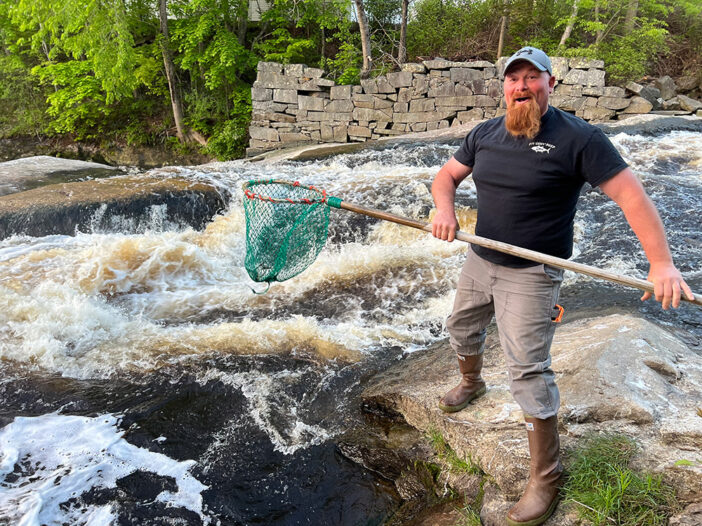
Larry Reed did not need a babysitter. When school was out, he and his sister were always on the boat. By the time he was 10, he was hauling his 35 traps in the harbor from a skiff. He loved it so much he’d go out two or three times again even though he knew his traps would be empty after the first haul. Today, at 42 years old, he has over 600 traps, and he goes going out any time it’s possible on his boat F/V Goin’ Deep which he built himself. He also fishes for alewives, pogies, tuna and halibut. Alewives have special meaning for Larry because his uncle helped set up the Warren Alewife Trap in 1990 after the numbers rebounded. For thousands of years, river herring spawned up Maine’s rivers in abundance. But the construction of mill and electrical dams obstructed their runs up-river each spring, decimating their populations. In the 1970s and 1980s, towns began to dismantle the dams as well as establish regulations to prevent overfishing and in many rivers, such as the St. George, alewives are thriving. However, alewives did not bounce back in the Medomak River. To try to restore them, Waldoboro launched its first Alewife Project in 1983. Additional projects have followed to monitor the population. The current Alewife Project, supported by the Maine Department of Inland Fisheries, the Waldoboro Fish Committee, and the Lloyd David Fish Trust is both taking samples and counting the numbers. The numbers are up, but in previous years the river has been too dry to have a significant population. A female alewife lays about 70,000 eggs in a freshwater lake like Medomak Pond. At summer’s end, the young alewives run to sea where they live four to five years in deep water. When they are ready to spawn, they make the journey upstream to the very lake where they were born, something they will do for every spring after, and their offspring, too.
Grinning ear to ear is how I’d describe it. I don’t know if there’s another word for seeing those fish. There’s nothing more thrilling than the tug on the end of a fishing pole. But it’s also pretty awesome when you set a purse seine and see hundreds of thousands of pounds of fish blow up at you, shooting out of the water and stuff.
I’m a commercial fisherman through and through. I love fishing. All of it. Catching is always better. But I would rather sit and watch the end of a fishing rod more than sit in front of a television, any day. Fishing is a lifestyle. You get up in the morning and you go. I get up usually around 3:30 and try to get out there with the sun and get to work. When the sun goes down, I might not be home but I’m on shore. And if the weather gets nasty, I just kinda smile at it. If fishing is on my brain, and most days it is, I’ll find a way to fish. I can find a lee, or I can just pound it out. Either way, I pay attention in nasty weather.
I lobster year-round. I grew up fishing all the way from Bremen to Bristol. I have an off-shore permit, and I lobster out of South Bristol because it’s a close harbor with safety around and it’s near the off-shore fishing grounds, too.
But I also do other kinds of fishing. I like to be self-sufficient. And the way things are going with the whales, windmills and all the paperwork, I just want to make sure I can succeed. I can be more self-sufficient by staying in all these fisheries. And the more self-sufficient I can be, the more lucrative it is. What I’m striving for is self-sufficient sustainability. Just like I’m working to keep all these species I’m harvesting sustainable, I want my fishing to be sustainable, too.
So, come end of June, I jump into pogie-seining for bait fish, and that goes usually into late summer. I stockpile, which is easier now because I built my own storage facility a few years ago. In the fall, I try to squeeze in all the tuna fishing I can. Then, it’s back to lobstering. I push really hard. I don’t miss a day until deer hunting season comes along. Then, when the ice forms on ponds, I do ice fishing when it’s too rough out at sea. Though I always let my freshwater fish go so I can keep catching them. Then it’s back to lobstering.
When May 1st comes, I’m on-call for the alewives, waiting for the water to recede enough to set up the trap in Warren. I grew up there, helping my uncles set up the weir and all. When I started commercial fishing on my own, they hired me, and I worked every harvest from May 1st to June 15th. Then, when my Uncle Robert passed, they passed on his share of the harvest to me. I’m really proud to be involved with it. I’m part of a family tradition. It’s something I’ve been doing close to fifteen years.
I also volunteer over at the Medomak River for the Alewife Project. Over in Warren, we’re able to harvest a lot because we let so many go. The Medomak River is smaller and there’s only Medomak and Storer Ponds at the moment for spawning. We are working on gaining passage into Washington Pond which could take a couple of years. But with a fish ladder in at the dam, and by continuing to clear the beaver dams and culverts, maybe we could quadruple the spawning habitat of what they currently have. For five days last week we had a count of 90,000 alewives, or more. Maybe someday, maybe ten years down the road, we will get sustainable numbers. Maybe one day, I’ll be able to harvest alewives here.
Leave a Reply