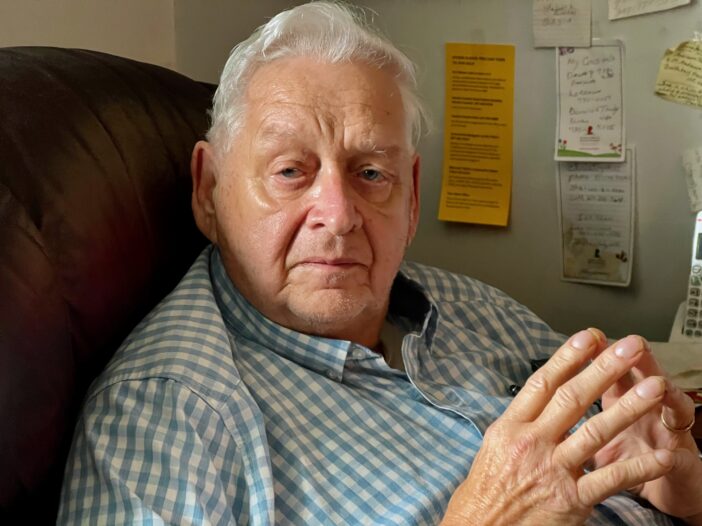
Sit down with Kerwin Elwood Creamer in his Coles Hill apartment to hear his story, and you won’t wonder again how the milk gets to the table. You won’t even begrudge its price. Instead, you’ll drop back into another era, and another world that most of us don’t know firsthand.
I was born at home at Stickney Corner, in the town of Washington. But when my mother came down with tuberculosis, they sent me to my aunt and uncle in Thomaston to care for me until she got better. I was only a few months old.
I came back home, but some years later, when she went to work at Sylvania, I lived with another aunt and uncle who lived right behind our house on a cattle farm. And that was where I became a cow man.
But my parents sold our house to buy a poultry farm in Friendship, and I was just about as homesick as I could be for my aunt and uncle and their farm. So, I went back to visit them as much as I could.
Around the time of graduation, another aunt, one who had never married and lived in Warren, had a major coronary heart attack. She had 33 milking cows and 78 other head of cattle. Down I went to help her. I stayed six years, milking the cows and taking care of the cattle, and also working for Stonington Furniture. I left only after she got her Social Security; then we sold the cattle, and her sister moved in, so she wasn’t alone.
From early 1965 to the fall of 1978, I managed a shoe store in Rockland. I also became pastor at Razorville Church in Washington, an old one-room schoolhouse that we used as a church.
Well, one day at the store a cattle dealer came to see me. He parked right in front of the store, came in, and asked me to look at what he had in the truck. When he opened the back, it was Eleanor! A milking cow I knew. He asked me to buy her. I said, “I’m living at my mother’s house because she’s in Massachusetts cooking — but if you get me a couple of pigs, then I could utilize the milk.”
An hour or two later, he comes back, drops the tailgate, and he’s got two pigs and the cow. He asks me where I want them and I say, “Just put them in my mother’s garage.”
From the garage, I sold the milk. Then, I added more cows until I had eleven plus the pigs, all in one garage.
I needed more space, so I rented a farm in Appleton. By the following year, I had so many cattle on that farm, that I decided to rent another farm, too, this one in Hope. The farms were seven miles apart, I was still managing the shoe store, and I was still with the church in Washington; and all along, I’m milking the dairy cows and managing the rest of the cattle.
And all along, I kept adding cows. I couldn’t help myself, I guess. By the time I’d reached 44 cows, I was married. We bought a farm in Searsmont, and there we added another 32 cattle, bringing it two 76, and then, before you knew it, I even had them tied in the walkway.
But after a while, it became a disaster. When I’d bought that farm, the deed read that I had 272 acres. But I come to find out that both the seller and myself had the same lawyer. Suddenly they were telling me I had only 88 acres. And even though I knew there had been a record in the town office that said I had 272, that page was gone from the town records.
So that winter, I worked at a store. And about then, I saw an ad looking for a milker to work for a farmer in Sebec (about 20 miles northeast of Bangor). I answered the call, and we moved up.
We milked 629 cows. To do that it meant milking three times a day. My wife (she was Volene Delano before I married her) raised the young calves. There were about a hundred stalls for them, and they were always full. And I did the milking. I did that until my feet turned purple. I couldn’t do it anymore. It was a monstrous farm.
Well, someone told us about a farmer in Charleston (a little closer to Bangor) who was milking about a hundred cows and needed help. So, we went there, stayed, and I took over a lot. The owner was a college graduate with no common sense as far as I could see, so I took over the feeding and everything. Within a year, he was nominated “Farmer of the Year.”
One day I heard about a farm for sale over in Kennebec County, the ‘capitol of dairy’ at the time. When we got there, Volene refused to get out of the car because the house looked like it was falling down. But I did, and wow, the barns were beautiful. Just what I wanted!
So, I went back to her and said that I’d budgeted $33,000. “If I turn that over to you, and you re-model the house, would that be alright?” Well, she jumped right out of the car, looked at the house and said yes. And she turned it into a beautiful home!
I took care of the cows and milk, and she took care of all the young stock. She worked in the barn every day with me; plus, she had a farmstand and gift shop.
But meanwhile, I’m getting sicker and sicker. I didn’t really know, but the weight was falling off me, and I was grayer and grayer. Finally, I gave up and went to the doctor. The first doctor didn’t see anything wrong with me, but Volene made me wait for the chief of surgery. Turned out I had a severe infection from diverticulitis. I was on antibiotics for more than eight months. Then, one day in the milking parlor, I fell and couldn’t get up. The doctor had to operate. But to afford it, I was going to have to sell the cattle. I would die otherwise.
Well, someone came by and made me an offer, but because I’d been working with the FHA, they told me I had to sell them at auction.
Well, they stole those cattle. I was going to sell a field, too, because the first mortgage holder was suing me for their money. But FHA said I had to sell the whole farm.
For one winter we lived there with no income. I sold my hay trailers to pay for wood to keep from freezing. And the property in the end? It got deeded over to the government for one dollar. They tore down all the buildings. Everything gone except for one of the hay fields. It’s now called the Sunkhaze Meadows National Wildlife Refuge.
One of the doctors asked me what I did. I told him, and I think he thought I just had four or five animals. I said, “No, we had a large dairy farm, milk and cattle, 400-acres, and we had to put hay. And we had to do it all.” I told him we had only my wife and sometimes my son, and, every once in a while, we’d hire a hand.
He said, “Then God must have been looking after you because you should have been dead a long time ago.”
Then I remembered how in summers, I would work until I had so much pain that I had to lie down, anywhere but usually under the tractor, for about twenty minutes, and then I’d get up and go, but my arms would be shaking. The doctors told me I had to quit.
We gave up a lot thinking that we would have a farm to fall back on. We missed family occasions like our son’s sports games and our daughter’s drum and bugle. But when you’ve got animals, they come first and that’s all there is to that. Volene made some of those events, but I was in the barn.
If you didn’t have faith, you wouldn’t make it. You had to pray every day for the health of the animals. You prayed the grain truck in, and you prayed and plowed your garden before you started the chores to get the milk in.
When you went to bed, you knew you never got everything finished. But you got the highlights. You just never caught up. Still, I’d do it all again in a heartbeat.
Leave a Reply