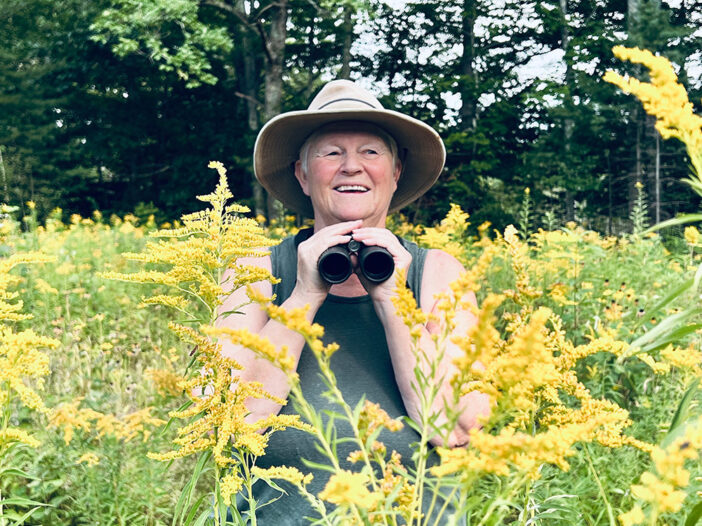
Kathie Brown does not remember a time when she did not know about birds. She grew up in a small town in Connecticut, the daughter of a single mom. While her mother went to college to get off welfare, Kathie explored the woods around her. Nature became her solace. When she was 16 and at Bible camp, Kathie met her life-long friend Trudy Smith, a deaf ornithologist. Over the summer a mentorship formed over birding. And Trudy gave Kathie her first guide, the Golden “Guide to Field Identification of Birds of North America.” Kathie married when she was 20, and her husband’s work in the defense industry took her all over the country. Some years they moved twice in the same year. Kathie picked up work as a home health care aide and later as a certified nurse’s aide. But she also raised four children. She became a volunteer naturalist while in Boulder, Colorado. She went to college while in Presque Isle. She started a blog about birding while in Arizona. She always counted and tracked birds. When e-bird was launched by Cornell, Kathie became an avid contributor, noting not only bird populations but hot spots for viewing them. In 2017, they settled in North Waldoboro on twenty acres of land, her husband gift for her own wildlife refuge. There, she keeps and encourages many habitats including light woods, grass, meadows, and thick, dense brush. For the past five years, she has been working on the Maine Bird Atlas. She has seen 224 species of birds since she started counting in Lincoln County. For Kathie, Waldoboro hums with hot spots, from the Dutch Neck Landing in Waldoboro’s south, to the pocket park at the end of Jefferson in its center, Jones Neck in its east and Riverbrook Preserve in its north.
The Waldoboro Town Landing was one of the first places I found here. For the first three years, I was the only one counting birds. And it’s rich with birds! It’s about the only place in all of Lincoln County where it’s public, where the tide goes out and where you can see shore birds close by instead of way out on the mud flats. As the tide begins to come up, shore birds, who are migrating through now, will feed on the mud flats. When the tide pushes them higher, they’ll run into the little reed grasses on the side. Then, when the tide goes out, they’ll come out and into view again.
Chimney swifts are a real find there. They are probably one of the most important birds you can see there because they are threatened and in decline. They nest vertically, in the chimneys of old buildings. But except for the old buildings in town and at the old Button Factory, there aren’t many left. Most chimneys are topped now. And chimney swifts only eat insect eaters so that when people spray to get rid of the bugs, they poison the birds. They come and stay for the summer.
I like to watch them when all the babies have hatched, and the parents are taking them on flying lessons. I always hear them before I see them, going, “Deedee deedeedee, deedeedee, deedee” in a very high voice. They look like a flying cigar, all black with sickle shaped wings. They’re not very big. And they have this bat-like, moth-like flight. They’re so social, chattering all the time. To me, the way they talk to each other, they’re like this little happy family. I love, love, love chimney swifts.
But I was heartbroken when they cut down the spruce and firs that stood in the middle of the parking lot. The birds would use those trees as a landing for protection when anyone drove in. They hid there from predators, too, like a hawk flying overhead. And on the grass underneath, I’d see Savannah sparrows and chipping sparrows foraging, and white-throated sparrows, too. The Town Landing looks pretty with the baskets of flowers, but they destroyed good bird habitat. God help us, I hope nobody ever cleans up the other side of the landing where it’s all brushy. Birds depend on that scruffy looking stuff. During migration, all the warblers, cardinals and song sparrows hang out over. And they hide inside it for safety. If the town cuts that away, these birds will move on, and we will have destroyed forever a part of what makes this place so special.
I nominated the Town Landing to be a hotspot for e-bird. The app tells me that 124 species have been recorded since people started counting there, with 75 are likely to be seen, and 23 different species seen in the last seven days. Whereas the elusive green-winged teal has only been observed there once.
This is one of the reasons I like keeping data and getting the stats. They can be used. And I get to be outside and do something I love. I’m contributing something that’s going to last after I’m gone. I’m 65 and I’m not going to live forever. There are not many things I’ve done to make an impact on the world other than raising four children. I feel that this is one of the most important things I’ve done.
There are so many great days in birding. It can be as simple as getting my coffee and sitting on the back steps. I like to go completely quiet, become part of the environment, and just watch. Yes, it’s fun to get a big list. But it’s heaven simply to sit, observe and see what shows up. You can go twice, even five times, in the same day and not see the same thing. For me, this is like having Christmas every day. You never know what you’re going to get. It’s this big surprise. You settle in someplace, and then, something unusual shows up.
Leave a Reply