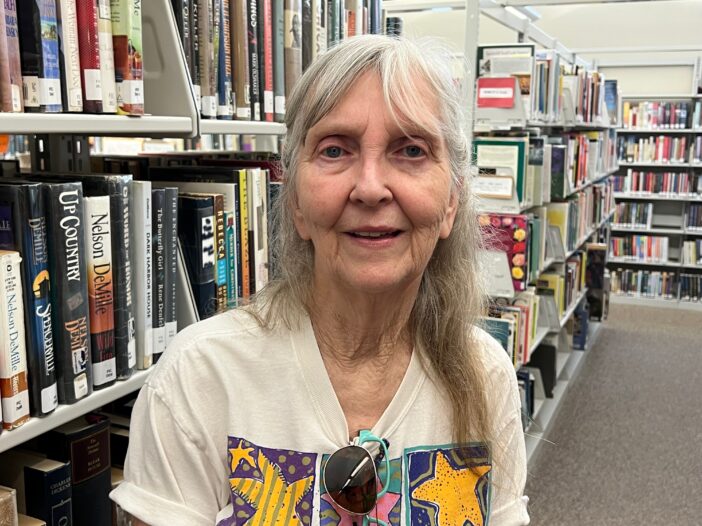
I, Rebecca, didn’t know what generosity was until I moved to Waldoboro, until I started writing this column in 2022. Waldoboro has taught about the kind of generosity, no matter what the crisis, whether about health, food or shelter, that there is a community that comes together to support them, rich or poor, Democrat or Republican. When times are really rough, Waldoboro kinfolk are there. Generosity like this is moving. And contagious. And Julia Adams shows me how big it can be. Julia is a retired special education teacher as well as a licensed marriage and family therapist. But she has a deep love of libraries, so naturally, she is very involved with the Friends of the Waldoboro Public Library and the Skidompha Strummers.
When I was really little, we lived in a first-floor apartment of an old, beautiful building, and upstairs lived a lady. She was probably 40 years old, but she was really like a three-year old. And she would come down and play dolls with me. And when I was learning to read, I tried to teach her how to read.
By kindergarten, I was reading, and I trying to teach the other kids how to read with Dick, Jane, Sally, Spot and Puff. I helped our teachers, too, by turning the pages when they read aloud to us. We lived in Pittsfield, MA, and we were baby boomers. Those were huge classes. Those teachers were saints. Our teachers used any of us who had a skill.
By sixth grade, I was in an experimental gifted-and-talented program in which, for one hour in the day, we went to a special class, then returning to our classroom to help out our classmates, some of whom I’d been working with since kindergarten.
Many of us have turned out to be teachers and educators, nurses and lots of professional people. Even the students who were a little more challenged, the ones who didn’t have the most ability when they were in school, they got so much help that they ended up with good jobs that paid well, too.
We were also the peace and love generation, and after high school, all my friends and I moved to California to get jobs and go to school. And I became a single mother with a multi-handicapped child whom I loved.
One day I took an exam testing people’s aptitude for being a psychiatric technician. I scored really high. The state needed psych techs, and they me a full salary while training me at the same time. That gave me the income to afford to take classes in the early morning and then work the afternoon into the early evening. I could make a life for my daughter and me.
My daughter only lived until 16.
My mother brought me back East. She was failing, and I was an only child. But I wasn’t going to live in Pittsfield.
Every summer I had been coming up to Friendship where I would visit a friend. I loved it so much here that I even looked into living and working here. But with low salaries at the time, I couldn’t afford it.
The next year, though, the salaries were higher, and I was able to move here. I took a job first in Portland, and then when I found a place in Waldoboro a year later, at RSU 40. I commuted on weekends to visit my mother. She died the following year.
But I stayed. RSU 40 is special because of all the programs they offer kids and all the remarkable teachers. It may even be the best in Maine. It’s one of the reasons why we have many students who may start in special education but end up in the regular classroom. It just takes figuring out what kind of support a child needs to get there.
The benefit of teaching students with special needs in their home district is that they can be close to their family and friends and part of their community. It gives them roots.
Over time the offerings have expanded. There are programs for students with emotional delays. Others for cognitive delays. And still others for learning disabilities.
Students’ needs change every year. Teaching assignments change along with those changes. Always, the hope is that students will eventually be able to move into the regular classroom.
I taught in the Resource Room. That is a classroom for students who might have attention deficit disorders or learning disabilities. They might be reading, but not with enough comprehension to handle the curriculum of a regular class without one-to-one assistance. But with that kind of attention in a supportive study hall, one of the students are able to move to the regular classroom.
Over time, I have learned how to read a room, and how to read a student. How read the beginning of an escalation. When that happens, I go over to them. Sometimes it’s as simple as asking them if they need a drink of water or asomething to eat, or if they need to go to a quiet place.
I think attitude matters. If things aren’t going well, you can fold up into yourself, which doesn’t help anyone. Or, you can stand back, look at what is not going well, and try to do whatever you can to make it go better. That’s my theory about how to get through life.
I was working on a doorway a few winters ago and I fell fourteen feet onto ice. I fell off the ladder and yanked it down on top of me. I broke my face. They had to put my eye sockets back in. I broke my femur. I broke my ankle. I broke my wrist on the left side, and all of my ribs.
You can sit around and say to yourself, “My life is over. I’m finished.” Or, you can say, “Okay, what do I need to do to make this better?” I did everything they told me to do at physical therapy.
But you still can’t do much with a cast up your leg, so asked Alan, my partner, to bring out the book and ukelele he’d given me for Christmas. And now I play with the Skidompha Strummers Ukelele Club. Some of my fingering is different from everyone else’s because I taught myself. But I play!
Leave a Reply