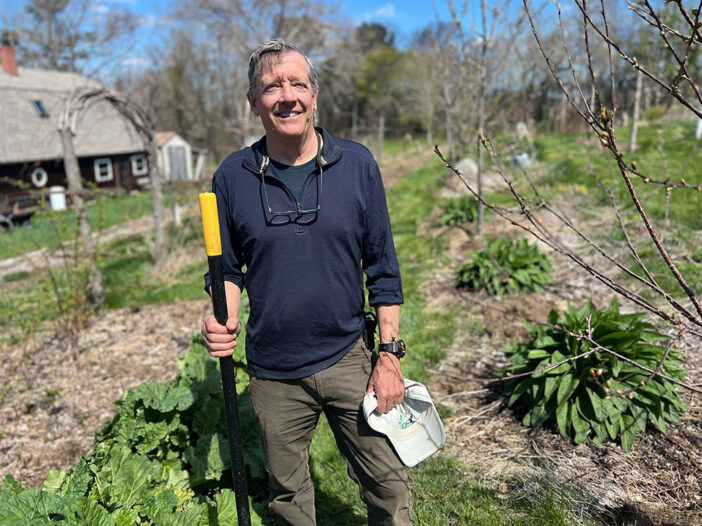
John and Nancy Hayden arrived in Waldoboro a little over three years ago from northern Vermont. They came for a new adventure. They came to be in a new ecosystem. They came to scale down. For the previous 30 years, they had farmed 18 acres in the Green Mountain foothills. They practiced permaculture. It was an evolving experiment, sometimes including livestock, sometimes vegetables and livestock, and sometimes perennial fruits and vegetables. They worked the land with draft horses and plows. At harvest, they sold fruits and vegetables to local nurseries, breweries, and wineries; and they made jams and syrups for farmers markets. When the farm became self-sustaining, Nancy left her job teaching environmental engineering at the University. Together they wrote “Farming on the Wild Side,” published by Chelsea Press in 2019. John is an entomologist, fascinated with bugs and worms of all kinds. After college, at his Peace Corps posting in Mali, West Africa, he catalogued the beneficial and pest there, alongside Malian scientists. In Vermont, he consulted, work that took him all over the country and to many parts of the world. In Waldoboro, he and Nancy are designing and planting Northwind Gardens. They work as a team, with John’s focus on vegetables and fruits, and Nancy’s on flowers, herbs, and native shrubs. To tour the garden is to walk through a jewel box of a landscape where every section has purpose.
When we got here, it was like gardening on Mars. This part had all been scraped of topsoil. It was rock. So, I brought in woodchips, leaves, and horse manure from our neighbor’s horse, to which I added seaweed and seagrass from the marshlands that the northeasters blow in and eventually take back to the sea again, completing the cycle. I’m an organic scavenger.
This patch here is cherry trees, peaches, plums, and apples. But it’s not all unicorns and rainbows. Sometimes, fruit trees will break your heart. One of my plum trees died on me.
I always try to plant so I’m distributing the nutrients. That’s why there’s comfrey in between each of these trees. Comfrey’s long tap root will bring up nutrients that the fruit trees, with their shallow root system, wouldn’t otherwise get. And comfrey is an amazing bumble bee plant which we love for its pollination prowess. Later, I’ll scythe it and that creates mulch. It keeps the grass down, too.
Right below, over here, we have raspberries. Summer raspberries and ever-bearing ones, and a thornless blackberry up here.
We love perennial vegetables. This row is asparagus. There, rhubarb. And over there, sea kale. Then here, our grapes, mostly Concord. And a mulberry tree which I’m really pleased with. We’re looking for maximum diversity in a small place, with everything working together.
We’re still working on these lower gardens. They used to be terraced, and we’re trying to build them back. You can see our rows of onions, garlic, and peas which I plant with echinacea. More rhubarb. Chives. Marigolds. Dogwood. Potatoes. Arugula.
And here, Aronia, one of my favorite crops. It’s this beautiful shrub, a native plant that native bees love because they co-evolved with it. There are about 270 species of bees in Maine, not just honeybees, and they all need something to eat. Anyway, it has beautiful glossy leaves. The blossoms tare just stunning, and it’s got a tannic berry that is great for wine, beer, ciders and smoothies. It has the most antioxidants of anything that we grow, or anything else that grows wild around here.
I don’t want a perfect British garden where everything is neatly manicured. I find the beauty in chaos and functionality, which is just like nature.
Our flower garden, which Nancy plants, has spinach, herbs, and chamomile. In the greenhouses we’ll have tomatoes, eggplant and peppers and the calendula and lamb’s quarters will grow all over the floor.
I pay very close attention to soil life. I knew when jumping worms got here. I’m just trying to figure out how to live with them. They can’t be all bad. They are worms taking organic matter, running it through their digestive system, mixing it up, pooping it out and creating their own kind of compost. Yes, I think they are terrible in the woods because they eat the duff (the under-layer of fungus and decomposing matter) and that prevents new trees from germinating and propagating.
But I haven’t noticed much damage in the garden. They do change the consistency of the soil so it’s more like coffee grounds — it dries out more, and that means more mulch, unless we have a summer like last year.
Insects are the little things that run the world. In college, I thought I was going to be a wildlife vet, but then I took this entomology class. I saw all these hidden predator-prey relationships right under my nose, like ladybugs eating aphids, and I realized that I didn’t need to watch wildebeests and lions. All that drama was right in front of me.
I think jumping worms are like any new invasive: everyone gets upset at first, and then we learn to live with them. Just like the Japanese beetles which we have. My strategy is to dilute the problem by keeping or planting the plants they love nearby. We don’t weed out the evening primrose because it is such a good attractor. The Japanese beetles feed on that instead of our raspberries.
We may not like them, but plant invasives do a good job of conditioning the soil. They drop their leaves, and then later their stems die, and the leaves and stems get composted. I combat them by planting things that will compete with them. Over here, by the Japanese knotweed, I’ve put in nettles which are competing nicely. And we love nettles. We cook them up like spinach.
Invasive species are everywhere. The Europeans brought over earthworms. Honeybees are invasive. They compete with native bees. Clover is invasive. Dandelions. Lambs quarters. They’re all from away. Like me.
For humans to call other species invasive is very ironic. We are the most invasive species probably in the history of life on earth. From the Arctic to Antarctica, in deserts and on mountains and in jungles, humans are everywhere. Impermanence is the rule of nature. Things change. We just need to adapt.
Leave a Reply