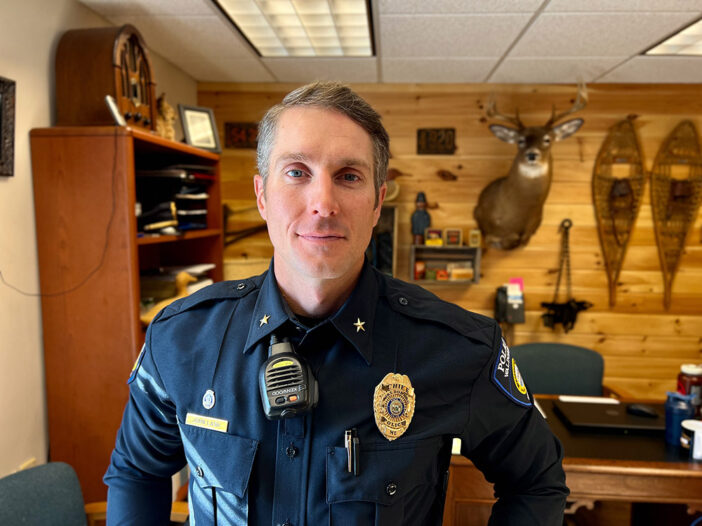
John Lash descends from one of the original German settlers back in 1764. A generation or so later, the family name Losch became Lash. They settled along the river in Waldoboro and later migrated to Friendship where they all still live. As a boy, John loved the stories of a family friend who was a state trooper back in the days when Waldoboro’s reputation was the Wild West and all the bar fights and car chases that he’d been called to. John set his sights on policing because public service being a tradition in his family. He studied criminal justice at Thomas College in Waterville, then postponed law enforcement for construction which paid well, because he was a young, married man supporting his family. Eventually, though, the lack of retirement benefits and the cold winters standing outside on staging led him to throw in the hat and join the Waldoboro Police Department as a patrol officer working the night shift. And it worked for him because he would pick up construction jobs on his off days. He did that for six years until he was invited to apply for the position of Chief. That was October 2018, and the rest is history. John describes himself as a Type B kind of person, the kind who asks questions and listens hard when dealing with people, whether with his staff or the public. His grandfather Doug Lash is his beacon. John remembers a particular incident when a troubled neighbor broke into his grandfather’s woodshop and stole some tools. John and his brother, teenagers at the time, wanted to fight the young man. His grandfather did something else: he invited the neighbor to the woodshop and gently asked, hypothetically, if one were to burglar the shop, how he’d do it. Question after question followed, and the young man confessed and returned the tools.
Most crime in Waldoboro is against property – thefts and burglaries. And a lot of that is drug related – it’s either people stealing from each other to collect a debt, or to buy more drugs. Then there are the OUI’s, traffic accidents and drug dealing. And domestic violence calls which make up only about 10%. But they’re the most dangerous because the feelings are so intense.
What people don’t understand about policing is that emotionally officers are at 100 mph in one moment and back down to zero in the next. Humans aren’t designed for this. But we go from breaking up a bloody fight and putting people in handcuffs to helping somebody whose neighbor’s dog is pooping on their lawn. And for both, we have to have empathy. We train for this, but shutting off adrenalin doesn’t come naturally, and sometimes, especially when we’re backed up, we might come across rude.
But the job has gotten harder, too. In the past, if we told someone to stay away from someone else, they stayed away. But with Facebook and other social media, people have the courage to write horrific things about someone because it’s not to their face. And that’s hard to police. And people get angry that we can’t. But we didn’t see them type it so we can’t prove it. Telling people not to look at it is the best advice we have. But to tell someone to shut off Facebook is like you just kicked their dog. So, things escalate instead of cooling down.
And now everyone is sue-happy. I got sued when I first started because I didn’t arrest someone. It was a borderline call I made, but the other party sued me for not making the arrest. The judge took one look at the complaint and laughed. But it cost me time and stress. And it cost the town money. Suing’s so common, I’m afraid my guys might hesitate in a situation because they’re afraid of being sued. I don’t want my guys to hesitate. People get hurt then.
And then there’s the drugs. I don’t have the solution, but I know we need more resources. This area is flooded with oxy, heroin, and fentanyl. And we’re seeing an uptick in methamphetamines. I know you can’t help those who don’t want to be helped. But for that person who decides this is the day they want to stop, we need help for them, right then and there. We need to make that extreme effort at this. Because if they have to wait two, three, or four days, you’ve lost them, and they’re like, “Well…I’m not sure I’m ready now.” Fentanyl worries me because when people are in recovery, they lose tolerance for the drug. So, the first time they relapse — and relapse is usually part of recovering — they overdose. Every single time.
The job takes its toll. And we’re down an officer which adds stress. In a staff of seven, one officer is a lot. But we can’t get young people interested. And it’s a strenuous process to become a law enforcement officer. There are the polygraphs, the physical and the psych exams. You can wash out in the academy. And there’s a stress inoculation to get through. But the bottom line is that we want good officers.
Of course, in an ideal world, I’d love to have two or three mental health workers, too. A lot of our job is talking to mentally ill people. And being in a small rural town, we’ve always been a catch-all. I’ve heard that in some departments, mental health workers ride with police officers and help counsel the officers, too, which is great. We deal with all kinds of stuff that would drive a normal person insane.
For me, it’s real simple. I feel I was placed in this position and on this earth with a purpose. I pray every morning before I start work. If something bad happens, that happened for a reason. I just find where I fit inside that puzzle, and where I fit inside that purpose.
Leave a Reply