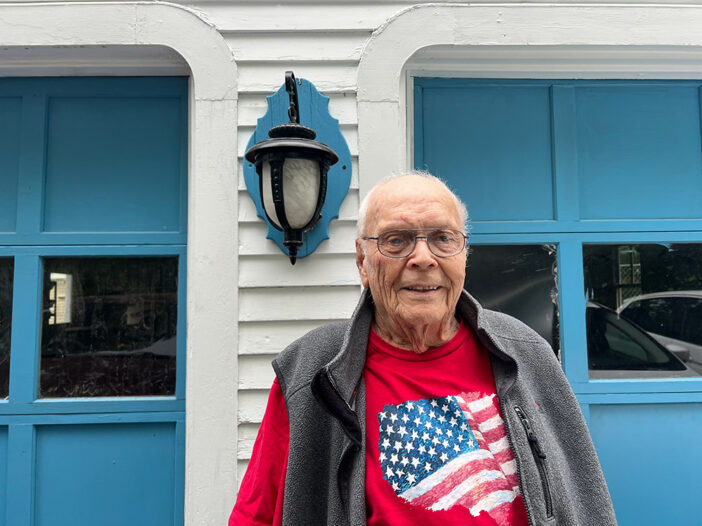
You know you’ve squeezed a lot in life if, like John Gatcombe, you witnessed Franklin D. Roosevelt standing on the USS Potomac as it docked in Rockland Harbor in the 1941. But it’s the doing, not the witnessing, that defines John Gatcombe. At the top of the list is the Waldoboro Ambulance Service, which he started with Police Chief Robert Stillings in 1969. They used the old Pontiac from Richard Hall’s Funeral Home for the ambulance and housed it in the garage John had built for it. John also served a as Deputy Sheriff for Knox and Lincoln Counties. Moreover, he worked part-time as a patrolman on Waldoboro’s police force, filling in twice as Police Chief because they needed him until they could hire the next police chief. He also volunteered with the Fire Department for a number of years. Other years, he served on committees such as Code Enforcement, Economic Development, and Shellfish, where he was the at-large layperson – maybe because he’d led the effort for the installation of a float and dock at the town landing. As for full-time work, John taught industrial arts at Waldoboro’s high school, a stint that lasted 33 years. With all that, it’s hard to believe he is a family man. But he is – married twice (to Joni Gatcombe for the last 39 years) and with seven children. They were busy decades. But when your definition of family also includes your students, neighbors, and Waldoboro, it makes for a very, very full life.
I was the teacher other teachers sent the students to that couldn’t sit still to. I think it was because I could spot the children who were coming under a lot of fire. That’s loneliness. You see, I know what that is. I experienced loneliness. And those students were experiencing that, too. They had different problems from mine, but they were lonely. And lonesomeness can do awful things to you.
I grew up in Owl’s Head, and I was five and a half miles away from the nearest neighbor. That is a far cry from anywhere when you are twelve years old. And back then, I’d also had a hip condition and had to have an operation. Even after I got out of the cast, I still couldn’t play baseball or softball or anything.
And around the same time, my mom had had breast cancer, and my dad said to her, “I’m going to take you to Florida for the winter.”
She said, “What will we do about little John?” So, I got assigned to MCI for the year (Maine Central Institute, a boarding school in Pittsfield). It was 1952. That was a lonely year. That was one of the worst. I think after that I decided I was going to get involved with people. And that’s what I would tell anybody now: “Get involved.”
Anyway, Mr. Begley or Mr. Dolloff would bring down the students who were under stress or not accepted and say, “Do something.” And those students would come into the shop and build something instead. Sometimes, we even took students into our home to live. We still do. We have someone living with us right upstairs.
One time we had a UCC Methodist minister stay with us. She told us she was a lesbian. She stayed with us for two and half years, and she taught us a lot about being open-minded. She’d say, “You’ve got a problem here? Let’s talk about it.” And then she’d say, “Now, let’s do something about it.” She preached at Round Pond and New Harbor.
My mother was a service person. Being involved was natural. My parents were straight shooters and hard workers. So that’s what I did. Maybe there would have been instances where it would have been better if someone else did something, but I was the one who stepped up. I was working part-time as a patrolman when the police chief left, and they asked me to fill in. It wasn’t something I would have normally chosen. But I was there. They needed it. So, I filled in. I did that twice.
Back when Robert Stillings was police chief, he came to me with the idea of an ambulance service, and one thing led to another. The town backed us 100 percent. Up until then, Hall’s Funeral Home was the ambulance because they had the only vehicle large enough to transport a patient. But the state came along with wanting licensing.
We started from scratch. We got twenty volunteers. I saw some lonesome people come in. They wanted to be a part of it, and they had never been involved with anything else before. They all learned First Aid. They all took EMT courses up in Rockland. And now it’s professional, but it still has volunteers, too. I think that’s the thing I’m most proud of in my life.
You want to know what I would say to people? Be kind. Be observant. My neighbor who lived up here – she was a bit of a recluse in the biggest sense of the word. Her family had pretty much abandoned her. Mental problems. So, they didn’t deal with her very often. But I knew that sometimes she got food from the food pantry.
Well, because it was winter, I decided to bring her a load from the Food Pantry. I got there, but there was no sign of her. I kept looking for her in the windows because I knew she hadn’t been out for a couple of days. And her drive was pure ice. I figured her door was locked when I walked up her steps because how it always was, but oooooh, it was wide open. I pushed it open, stuck in my head and heard, “Heeeeelp.”
Jeez. I went through that door like a shot. There was no heat in the house, and it was zero or below. I found her on the kitchen floor. She had fallen outdoors the day before and managed to pull herself inside. I picked up the phone and got an ambulance there to help here. I learned she’d broken her hip. That’s what I mean when I say, “Look around.” Somebody’s always in need.
I’m going to turn 90 next April. I look back on my life and think maybe I could have done more. But I don’t have any worries. I sit out here and see all the clammers go this way and then back. I see the people going to Hannaford’s and back. Sometimes they will stop. Or shout hello. They could have been pimply-faced kids, but now they’re big men with beards. I might have no idea who they are. But they’ll pull over and talk. And I’ll say, “I remember you.”
Leave a Reply