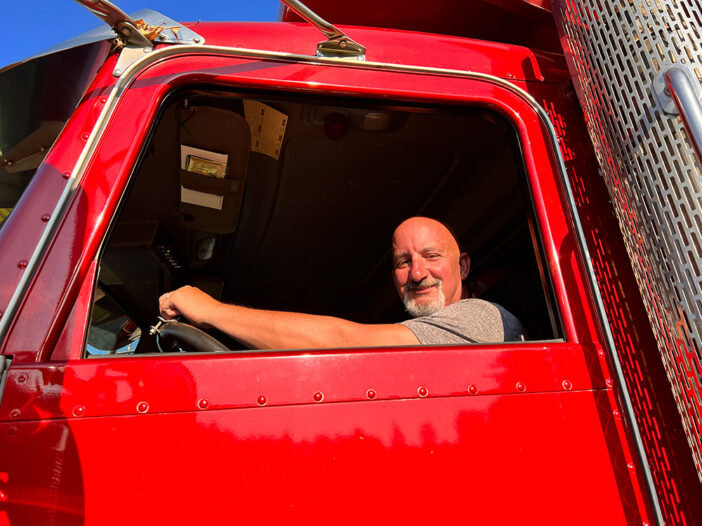
John Blodgett was a motor head growing up, fascinated with cars, trucks and engines. Whether by chance or destiny, when bootcamp in the Marines was up, he was assigned to Motor Transport. For more than 10 of the 21 years he served, he drove trucks and tractor trailers. He logged trips through almost every state. Overseas, he drove loads through the countries of the Persian Gulf, Honduras, the Republic of Korea and Japan. He retired from the Marine Corps in 2004 and returned to Waldoboro where he’d grown up. His first job back was at Poole Brothers Hammond Lumber in shipping. A year later, he signed on as a dispatcher for Midcoast Energy Systems. By the time he’d left there, 12 years later, he was working as an installation manager. But it was too much time behind a desk, so he decided to return to what he knew, truck driving. By luck, the recruiter for Northeast Transport in Waldoboro worked under John in the Marine Corps. John was practically hired on the spot. He started with local trips that took him to Canada, Bangor, Portland and Boston. Three months in, they offered him a run down to Virginia, and on the plane down to Richmond, he thought, “I don’t mind this.” He spent the next three or so years logging runs through or to every continental state but five. He is still on the books with Northeast Transport, but for the most part he works for Back Meadow Farm Landscaping and Land Development out of Boothbay doing excavation in a Class 1 truck. It keeps him closer to the new home he’s just built and to his wife and bulldog Zeus (a mascot for the Marines).
At Northeast Transport, I might leave on a late Sunday afternoon or early Monday morning with a load of lobster to Canada. There, I’d pick up a load of fish that’s due in Wisconsin by Tuesday afternoon. There’s no dillydallying, but you also need planning because, by federal law, we can only drive 11 hours a day.
You have an electronic clock hooked up to the engine and that clock is telling you exactly how much time you have left. Plus, we can only work 14 hours straight which includes both driving time and stopping for loading, and then you have to rest 10 hours. The max we can work is 70 hours a week and that includes driving and resting. And after that, we have to shut down for 34 hours. I’m really good at planning. If you aren’t, you might find yourself on the side of the road for those hours. And in New England, there isn’t a lot of parking for these big rigs and what spaces there are, they fill up fast. And all the time, your clock is ticking. But I won’t park on the side of the road. You’ll see trucks doing that, but it’s dangerous. People can die because other drivers don’t have much visibility at night.
But once in a blue moon, I get in a situation. I remember one time I was hauling a load of lobsters from Eastern Traders all the way to the top of New Brunswick. It’s empty country and mind you, there’s no cell phone service up there. And I was driving through the night because I had to be there by 5:00 in the morning. It was my first trip up there and I’m following the GPS, and I come to a bridge that could only take trucks up to 8 meters. I know I’m 13’8” but I didn’t know the meters. So I drop my airbags to lower my height. But it’s darker than a boot and there I am, hanging out the window and creeping along, saying “I think I can make it,” and I did.
No matter what, you got to respect these trucks. Loaded up, they’re 80,000 pounds minimum and that truck doesn’t want to stop. I’ve seen some bad wrecks out there. Coming across 40 through Missouri, I left Springfield heading back East, and it started to snow. Jeff Payson, my boss, had told me, “If you don’t feel comfortable driving because of the roads, pull over. We don’t care. We’d rather have you safe and the load safe than you wrecked.” Well, I was going probably 30, 40 miles an hour, freezing rain, snow, and trucks were flying by me, going up and down over mountains, and one guy gets on the radio and hollers to me, “If you can’t drive in this weather, then you need to have another career.” And I’m thinking, “Oh, well…” I pulled up in a rest area to see if it was going to clear up because it was really, really slippery, waited half hour or so until it looked like it was clearing before I got going. And when I went up over the next rise, I saw probably 30, 40 tractor trailers off the road, everywhere. And the guy that hollered at me on the radio? He was one of them.
It’s amazing, when you’re out on the road, to see how much stuff is transported by truck. I’ve gone to Kentucky to pick up bait for the fishermen. I’ve hauled rubber to Sanford, Maine that was made in from Vietnam. One time I brought a load of puzzles from Illinois to Union, because there’s a man there who takes the photos for the puzzles which he has made into puzzles in Illinois. After I deliver them to him, he then he goes out and sells them at fairs and places like Moody’s Diner. You just don’t realize that this stuff is around until you’re on the road like I was. I can sit in my living room and ask, “Is there anything in this room that didn’t come by truck? Me, my wife and the dog.”
Leave a Reply