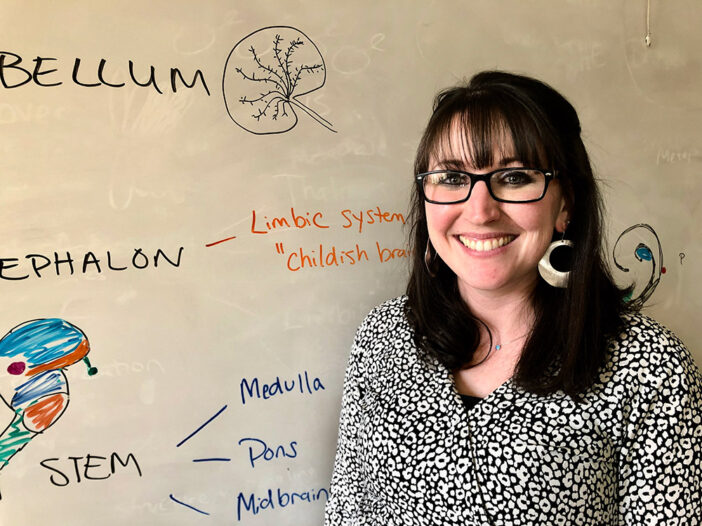
Jennifer Hatch found her way back to Medomak Valley High School as a science teacher, from where she’d graduated 14 years earlier. In fact, she teaches in the same classroom where she once took biology. She is the first person in her family to go to college. Her mother runs an excavating company with her husband, and her father is a lobsterman. Even though Jennifer grew up in Union and lives there now with her husband and two daughters, “being at Medomak, is like being home.”
A really good day is when I see kids excited to be in class. A really bad one is when they are looking at the clock. But usually it’s a moment and it passes. I’ve grown a lot as a teacher. In the beginning I wasn’t much older than my students, and I think I tried to assert that I was the teacher and they were the students. And so sometimes they were rude and complaining. I learned to give them more respect. And really, I’m a student myself, learning to teach better. I’m still working at finding the balance between reaching them where they are and my own high expectations for them. And failure is part of it. For me, for them.
One year in college I was accepted into a summer scientific research project. We were looking at the corneas of dogfish sharks and how UV radiation treatment could help strengthen the fibers inside. We ran experiments all summer long. But we could never get a reliable control. It was ten weeks, and I was being paid, making $500 a week. At the end, I had to write a report why we couldn’t do anything with our data. That whole summer was a failure.
Most of science is failing. And explaining those failures. But students, and probably most adults, have this vision of being able to take on a project and get results. But that is never what science is about. Science is about all the things that go wrong and trying to explain why they went wrong. And sometimes failure might be a success, because then we can tell a story from that failure.
My students might not go into science. They might have a business. That business might fail. Or they’ll have a challenge or obstacle that they haven’t planned for but that they’re going to have to face. Maybe they’re going to be a lobsterman facing all sorts of changes to their livelihood, like a lobster population that is shifting or traps that need to be more eco-friendly. If kids can learn how to deal with their challenges and failures here, then I feel they’re going to be okay in the future. In whatever field they go in.
I am really lucky. In every step of my life there were people around me showing little acts of kindness, there to guide and support me, whether teachers, friends, or grandmothers. I had this middle school teacher at a time when things were confused at home, so that sometimes I had to wait a while before someone picked me up from school. That teacher would develop projects for me while I waited, like constructing a T-Rex out of chicken bones, and I don’t even like dinosaurs. Her passion for science is a big reason why I kept pursuing it. I like learning how things work, how our cells work, how our DNA speaks to us, how we’re all so similar genetically but the very small differences can make big differences in our population.
My mom wanted better for us than what she had when she was growing up. So she taught us to give our all to anything we were doing, whether it was stacking wood, mowing the lawn, doing the dishes, or finishing our schoolwork. Not to do anything halfway. And the other thing she taught me was gratitude, like writing thank you notes. It’s funny – I didn’t realize how much a note can mean until I received my first note from a student. But back in high school I also wrote a few notes to a couple of teachers. And they told me they still have those notes. So I’m passing this down to my kids at school – they’re sending notes to all the people who helped put on the science fair. It’s easy to think you don’t make an impact. But a little act of thank you, something that takes maybe five or ten minutes, can make all the difference in someone’s day.
I struggle with the divisiveness in the world right now. Sometimes I live in my bubble because living outside of it is too stressful and worrying. I worry for both my students and my kids. What kind of place will the future be? The world is so tumultuous. I fear the divisiveness is getting passed down from one generation to the next, over and over again.
But then I see how cohesive the kids at school can be. In labs, they’re competitive but they’re also rooting for each other. At games, they cheer each other on. They work together to put on winter carnivals and spring revivals. I see how much of a family they feel together, especially in my smaller classes, teasing and loving each other.
I see this quality in Waldoboro, too. It’s a town that feels like a family, sometimes dysfunctional, but still a family. Sure, there are a lot of personalities, but people have each other’s backs. If something happens, like a fire, or some other kind of loss, it doesn’t take long before everyone comes together to be there for each other.
Leave a Reply