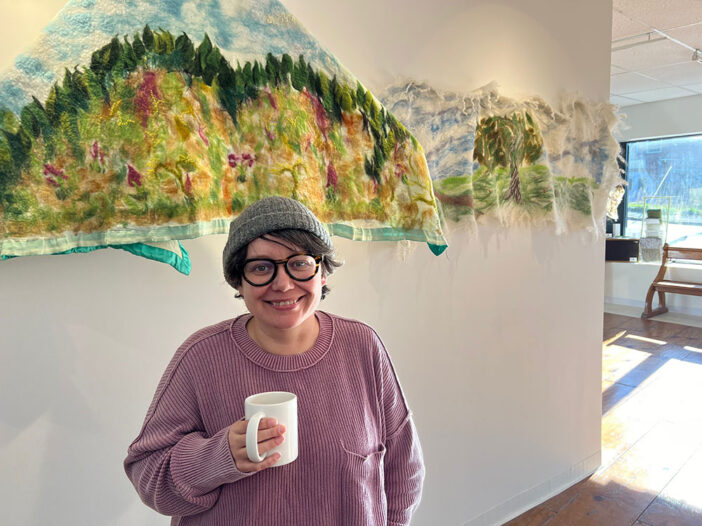
Maybe you know Jen Barrows through the artwork showing in her gallery Gravedigger’s Daughter on Main Street. Or maybe you’ve noticed the flag outside her building, which, for the moment, is a purple heart auxiliary flag. Family brought Jen back to Maine from Boston where she still teaches art and runs the back-end technology for Lesley University in Cambridge. More urgently, her father, a Vietnam veteran, was ill, and she wanted to be closer. She and her partner Brendan McGuirl moved to Waldoboro in 2020, was equidistant between her father’s home and her husband’s family. A year later, Jen opened the gallery which she named after her father who for some years, dug graves. The gallery is small, and it hosts largely solo shows, with one yearly group show. This year, it featured work of veterans – specifically, Jan Griesenbrock, Wayne Myers (both from Waldoboro) and Vincent Albanese (a student of Jen’s). Jen believes that art is for everyone which is why she brought back the ArtWalk Waldoboro series, because galleries are free. But alas for winter! Gravedigger’s Daughter re-opens Memorial Day 2025. Yay for winter, too! This is the time for making art. Jen is a multi-disciplinary artist working in video, photography, metal sculpture or whatever dictates. She works on commissions and shows in galleries. It’s work that asks viewers to question. And a persistent one is, “How do we reconcile our past with our present?”
My family was really poor. For air-conditioning, when my grandma would hang the sheets on the clothesline, I would go out and stand between them to cool off. And I would look through them at the fields. Or look up at the clouds. There were many ways to frame things!
My family is still really poor. But that made us figure out how to do things. It’s made me very practical. I can churn butter. I can make sausage. In the ice storm of ’98, we were without power for several weeks. But we were fine. And now I have these skills that so many people, especially my students, don’t know how to do any more.
Growing up, my grandfather lived two houses away. My uncle lived next door. My great-uncle lived on the other side of us. My other uncle lived on the other side of my grandmother and so on and so on. We were very close-knit. I had the run of those spaces.
My grandfather was in World War II. My great-uncle Al was in that war and in Korea. My dad was one of five boys, and he was the only one drafted to Vietnam. None of the others served. He wasn’t the oldest, but he became the one they all looked up to. He was the one they came to for advice because his life experience was so much broader than everyone else’s. He had traveled. And he had seen a lot.
But my dad also had PTSD. My parents divorced when I was young. Then my mother died. There was so much I didn’t know, didn’t understand. In grad school, I started working on a project using white handkerchiefs because my dad always used them. With white thread, I embroidered all the things I wanted to say to him. You had to open the handkerchief to read it. But it felt a little too secretive, and I began to think about the idea of a white flag instead and what it meant, which was me surrendering to my questions and the things I wanted to say to my dad.
My dad was sick for a long time. Have you ever spent time in a VA hospital? I spent many years in those waiting rooms. There are a lot of great people working there. But it’s not like any other hospital. In the waiting rooms are people with very visible injuries and bandages. There are a lot of amputees. It can feel scary. And when you go in and you look whole, you get a lot of people looking at you.
You also start to feel how incredibly underfunded these hospitals are. It’s so obvious we are not giving these folk enough. It’s so clear they deserve more. And it makes you ask, “What do we value as a society?”
When my dad was dying, I knew I had to ask about all the things I hadn’t understood.
My dad was in the infantry. He served in the 4th and later in the 25th Infantry. The first platoon he was in, everybody died in a battle — everyone but ten people. So, the Army assigned them to a different platoon, and they were in very bloody battles. He was a machine gunner, and after that first horrific battle, he didn’t have anyone else with him even though being a machine gunner is a two-person job — one person to carry the gun, and the other for the artillery. My dad was a one-man machine gunner with all the artillery and the gun, and on his own for the rest of the war — until he was wounded in action.
When my father came back, he got a job burying veterans at a veteran’s cemetery which was literally right down the street from our house. My dad didn’t know all the soldiers personally. But he knew their families. He saw them mourn. And he had stories about every one of them.
As children, we would go with him. He taught us how to walk properly among the graves and how to memorialize our dead. He taught us about the cemetery and why things were laid out the way they were, and why things were a certain type of way for each religion. It was very respectful. He taught us how to care for the American flag.
And he understood, more than most people, that you only have one life. And it is yours, to do all the things you want to do with it. He didn’t have a lot of opportunities. His parents needed him to work and earn money, so he only had an 8th grade education.
But this is what he taught me: only you know what you have. Only you know what you can give. And if you have something, you have to help. Which doesn’t always mean money. If you have skills and you can help someone who is struggling, why wouldn’t you?
My dad never said that. He never sat us down that way. But every single day, there were people showing up at the house. He was always helping people fix something. He was always going to mow someone’s lawn. Or giving them a ride. Or doing something else for them.
The only time I heard him express that idea was when he was meeting with the palliative care doctor at the hospital. She asked him what his favorite activity was, and he said: “I like to help people.”
He liked to do all kinds of things. But that was what he said. And for me, it was so obvious. Of course that was his favorite thing to do! I think it was because he had spent so much time seeing horrific things. But then, back home, seeing someone’s joy. I know when my father was drafted, Vietnam was not a place he wanted to go. I don’t think he believed that what he was doing was right. But he did it. And then, I think, he spent the rest of his life trying to undo it – by helping other peop
Leave a Reply