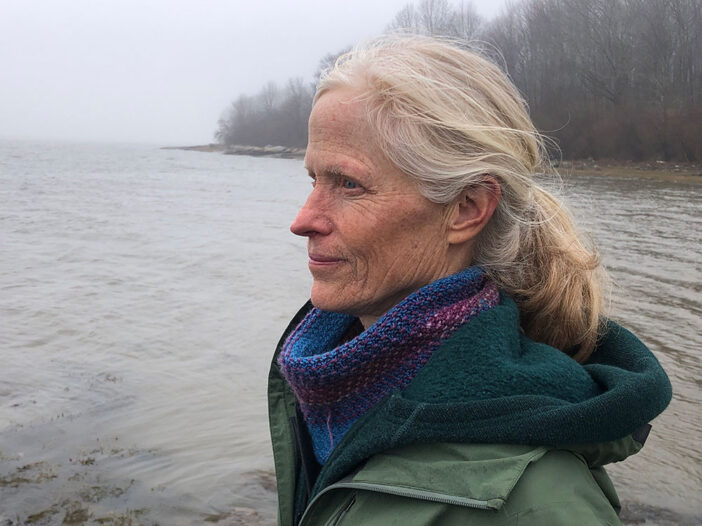
Janet McMahon has spent her life observing, studying and recording the ecology of Waldoboro and other parts of Maine. She has worked on Tall Ships, for Maine Audubon, for the Nature Conservancy and for the Watershed School in Camden teaching climate change. For 20 years she’s been working as a freelance ecologist for landowners, townships, conservations groups and state agencies. Along the way she designed a blueprint for creating a statewide system of ecological reserves to represent all the different landscapes in Maine and to protect its biodiversity. And on top of these things, she’s served on Town committees and been a founder of the re-opened Waldo Theatre.
There’s this moment I remember. I was working for a Robbie Robbins on his farm. He was deaf and very old school. Anyway, it was an early spring, and we were starting seedlings, and he saw this bumblebee on the ground. Bumblebees don’t move when they’re cold. So Robbie picked it up and cupped it in his hands to warm it. When bee could fly, he let it go. I was only a teenager, but I’ve never forgotten it. Robbie wasn’t thinking about ecology. It was probably the 1970s. He was just paying extraordinary attention to the things around him.
I do a lot of bushwhacking through the woods in my work. If I’m making a survey, I’m observing everything from stone walls, cellar holes, plow layers, to any other signs of how the land was used. I look at the soil to see if there if there are earthworms, because that’s a sign that the soil was cultivated once. I’m trying to see if the forest was always a forest, or if it’s one that has come back from a field. I’m checking the condition of the trees to see if they’re healthy or not. I’m studying what types of vegetation are growing. And what species are thriving. Or disappearing.
Some years back I did an inventory of the natural resources of the Medomak River Watershed. And I found a few surprises. For example, from north of Willet Hill in town and all the way out to Eastern Egg Rock, there is large mass of granite called a Pluton. Or Peter’s Pond on Gross Neck. It’s small and it looks like a quarry pond but it’s natural, and it’s more than 60 feet deep. It’s just beautiful.
And here’s a special one — there’s a stand of towering hemlocks covering several acres in the Town Forest. It’s one of the oldest hemlock stands in Maine. I cored one and counted the rings. It was more than 200 years old meaning some go back to the Revolutionary War. A core tells me about a tree’s natural history, too. If the rings are wide, like now, the tree is growing faster. If the rings are tight, maybe there was a drought, maybe an insect epidemic.
Some towns still have town forests that were established in the 1800s or earlier, probably for people to cut firewood. Waldoboro also had a tannery in town which also would probably have needed wood. So between the two, they must have cut a lot of hemlock in Waldoboro. But somehow this little stand of a couple of acres of hemlocks survived. I don’t know why. Maybe because someone protected it.
Change is always happening. It’s just that it’s happening faster now, a lot faster, than since we started having glacial cycles on the planet. You don’t have to look far to see them. You can see them here in Waldoboro, with the invasion of species like bittersweet and honeysuckle, or the influx of ticks, or the moon jelly blooms across Broad Bay in June. You can measure the change. Our tides are higher than they’ve ever been, a couple of inches higher now. And you can spot it in the wildlife. When I first moved here, we didn’t have cardinals. We didn’t see turkeys. Or turkey vultures. You used to see moose a lot. Now you almost never see one. The timing of the seasons is shifting. The blackflies are earlier. The growing season is longer. You see it in the ice. It used to be that most winters, the whole bay would freeze. Now it’s rare when that happens.
But I love it when it freezes. For a full freeze, for real ice, you need really cold temperatures without snow and a few windless days. That’s when you get an ice that is satin smooth. And I love to skate on saltwater ice. Even more than on freshwater ice. But then again, I’m obsessed with ice. Anyway, one day about five years ago, the bay froze, so we carried our skates to the shore and slid down the floes to get to where it’s smooth to put our skates. And off we went, upriver, without any idea how far we’d get. We were just having an adventure. We had only one tricky spot, by Hollis’s Point because there’s a lot of water moving underneath. Then we kept going. We ended up skating the whole four and a half miles to the town landing at Pine Street. I think we lunched at Narrows and then caught a ride back home. It was magical.
Having studied geology, humans are a blip. The world will go on, with or without us. But I look at the oaks next to our house that are over 100 years old and think of what they’ve endured. I imagine of the kind of patience a tree has, and that gives me hope for nature. But I also like to think we can make our planet a happy place for our own generations to come.
Leave a Reply