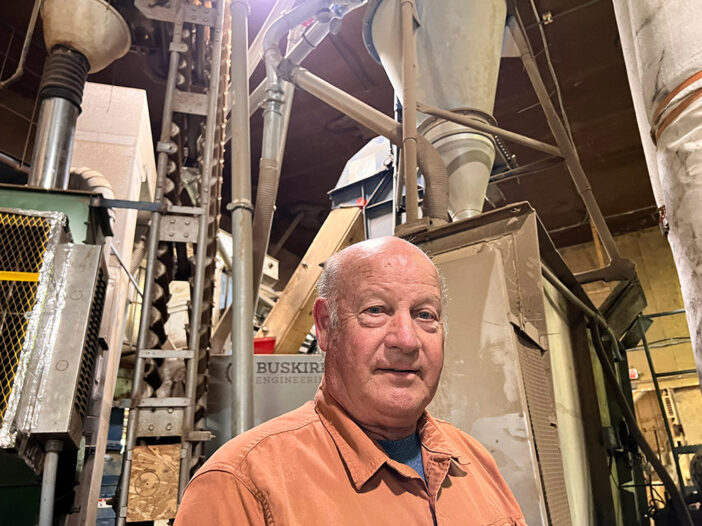
George Seaver has been in the seaweed business for 43 years. In 1990 he co-founded Ocean Organics, a company that makes a seaweed extract that supplements fertilizers. The company’s extract is used over domestic and overseas golf courses, in landscaping and greenhouses, and on farm fields throughout the US, including Aroostook County’s. Pictures in Down East Magazine brought him to Maine from Connecticut. As George says, “You can’t escape the beauty of Broad Bay.” He liked Waldoboro because it reminded him of Duxbury, MA where he’d grown up. The towns were about the same size and shared a history of shipbuilding. George also like that Waldoboro seemed to have people who had always been there, whereas the towns nearby seemed more populated with people who had moved there. So in 1977, he left his job at Pratt & Whitney as a mechanical engineer and bought a house. Thanks also to an article in Down East Magazine, he found work at Atlantic Labs. He went from a company with an employee register thicker than the Mid-Coast phone book to a company of just two people. Bob Morse hired him to set up a dryer for seaweed -- processing and dehydrating it for animal feed. George also worked with Bob on making seaweed into a liquid extract for applying on potato crops. George learned about the business of seaweed from top to bottom. After 10 years, he was ready to start his own company and he moved into the old pie filling factory across the street. He and his partners did it on a shoestring, choosing to fund it with home equity loans instead of grants. Ocean Organics started with two products. Today, the company offers over 50 seaweed-based products for plants.
Seaweed protects itself by being difficult to harvest. And a lot of Maine’s 3500 miles of coast isn’t anywhere near where you’d want to harvest. And there aren’t that many harvesters. It’s hard work. I think there are only 150 or so licenses in Maine. We buy from one person in Waldoboro – but not many people here do it. The total amount of harvesting in the state is about 2% of the total amount of seaweed along the coast. Just for comparison, Mother Nature alone tears off about 40% of the total every year and pushes it onto the beach. We know this from studies by the University of Maine. Commercial harvesting is about 1/20th of what Mother Nature removes every year.
People think seaweed is a fertilizer but it’s not. Seaweed extract itself has almost no fertility. It’s what’s called a ‘bio-stimulant’ which enables roots to grow stronger. Some people think it’s hoax or that it’s snake oil. But it’s not. Seaweed helps plants and crops thrive and produce. What we also know from the trials we’ve done over the years – and we’re doing more and more – is that seaweed helps plants recover from stress. And with climate change or unpredictable weather like drought or heat or storms, it can play an important role in enabling food production under bad growing conditions.
Seaweed has properties that influence the plant to grow slightly differently, in the same way that daylight, moisture or temperature does. It changes the properties of the soil. It sends a signal to the plant to grow more tubers if it’s a potato plant. It improves the properties of soil texture. Also, there are natural sugars that bacteria like, and bacteria are always good for your soil.
Waldoboro processes more seaweed, more rockweed, than any other town in the country. It’s wild-harvested and we take that and add value to it. We used to dehydrate it and market it as either a feed supplement or a soil amendment. But that’s the lesser value. Now we make an extract of it, and these extracts are where the real benefits are. And it’s efficient because we use less energy, and we use less seaweed than dehydrating it.
People ask, “How did you come up with this product or machine?” and my favorite answer is either “evolution” or “intelligent design.” If something doesn’t work, you keep changing it until it does. That’s the essence of evolution. But if it’s my own machine, I call it “intelligent design.”
One time we were trying to make one of our early extracts by adding nutrients to increase efficacy. We talked to farmers, golf course superintendents, salesmen and this and that, and then we went ahead. But we also wanted to make a product that cut costs at the same time. Well, we did. We came up with something that not only improved the response time but bettered how long it worked. And we just stumbled into it. If I’d gone to a chemist for a suggestion, and I did, they’d have told me as they always did, “I don’t know. You’ll have to try it.”
Engineering is a misunderstood profession. It’s more a way of thinking than figuring out how thick the bridge needs to be. In the US, if you’re trying to solve a problem, you gather a committee that’s going to solve the problem. In Eastern cultures, you create a committee to identify the problem. To analyze what the problem is. And once you figure out what the question is, the answer is almost self-evident. That’s how engineering is. If you figure out the question, the answer drops right out.
It’s awfully easy to under-estimate people. In Waldoboro, there’s lots of people who have always lived here, who have come from families who have always lived here. And they’re extremely capable, hard-working people. They can do anything they want to, anything they set their minds to. I think there’s a real streak in Waldoboro from the ship-building old families back in the 1800s and they were profoundly able. Those families are still here. They’re the great grandchildren of those families.
Leave a Reply