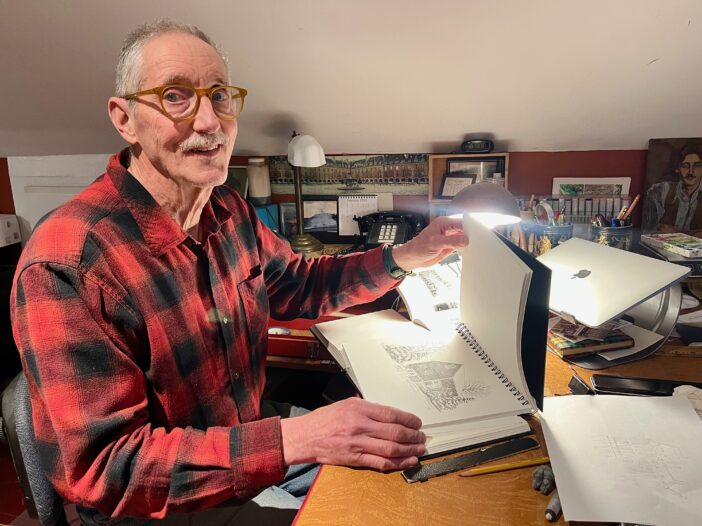
I don’t have an introduction about George Jones -- just an anecdote and it goes like this: When George moved to Waldoboro in 2004, he didn’t know a single soul, not even his neighbors. He only knew they had horses. Well, one day, he looked out the window to see the horses going up the hill. And his neighbors were away. George thought, “You’ve got to do something,” because as far as he could see, he was the only one who’d noticed the horses’ escape. But being new, and from NYC, he didn’t know anything about horses. So, he found someone else from down the road, and together they led back the horses from the middle of the road at Kalers Corner. And that is how he met his neighbors.
I’d never considered moving out of New York City until after September 11th. I was working in the development office at a private school in downtown Brooklyn. On the other side of the river were the World Trade Towers. When the first tower was hit, the school went on lockdown; but I went outside to look. I wish I hadn’t. When the second tower fell, we heard it fall.
I lived a mile or two away, but it was also in view of what was had been World Trade Towers. My backyard was full of the burned papers, as brittle as ashes, from the Towers. And every day brought more of them. It was a heartbreaking, horrible time. You woke up at night full of anxiety, and it wasn’t just me. I’ve never been in a place where there was such collective grief and worry. And it felt like we were living in the crosshairs of anybody who wanted to destroy us. I had to leave.
I ended up in Waldoboro because I had a friend who lived in Tenants Harbor, and she loved this part of Maine. I looked at only a few houses. When I saw this house, I fell in love with its gables and how it sits on a little knoll and how it was small but had lots of different rooms. It was missing most of its shutters, I made it my task to find them, paint them and put them on.
Now at night, when the wind blows, I hear can hear them banging against the house. I’m a spiritual person, I don’t believe in spirits. But I do think houses have a vibe. Other places where I’ve lived, I’ve felt a negativity that I’ve had to work hard to overcome. Here, while I knew nothing about the house itself, it felt like a fit, with this feeling of safety and of comfort. I knew it when I saw it.
What brought this house really alive for me was a chance encounter one afternoon when we were working in the yard. A car drove in the driveway and out came this older woman and her daughter. The older woman introduced herself as Nancy Smith. Her maiden name was Eugley. Celia Eugley, who had lived in this house for almost her entire life, was Nancy’s aunt.
Nancy told me that Celia’s parents Alden and Lettie Eugley had bought this place in 1897 and that Alden built the barn. Celia and her brother Ruel (who was born there) grew up in the house. Ruel was well-known in town because he smoked alewives in an old henhouse by Bear Market and sold them there. When she looked at the barn, Nancy said, “That work bench is in the wrong place.”
I said, “Where’s it supposed to be?”
She said, “It belongs over here.” And by God, when I moved it, it fit right up against the wall like a glove, whereas before it had been crooked.
That barn is very evocative. I feel it says more about its purpose than the house does. On a damp day it smells like urine even though it hasn’t had horses or cows in there for perhaps 80 years.
Much later, Nancy gave us pictures and told us stories. I could tell she dearly loved this place and her Aunt Celia. This first picture is of Lettie (her maiden name was Creamer) and Alden. It was taken right after they’d bought the house, and you can see that they’re sitting on chairs looking pleased as punch. And at their feet is two-year old Celia, who would live almost her own life in this house. I am so grateful for that day when they pulled into the driveway because, if they hadn’t done that, we never would have known each other. This history might have disappeared as often happens when people die. Their history just goes with them.
Just studying this picture alone, I have learned more about our property. For example, in the corner of the photo, in between the trees, you can make out a barn. But the barn’s doors are facing the other way.
That told me that this property belonged to that barn rather than the other way around, because the photo is from 1897, and Alden hadn’t built his barn yet. So, obviously something was going on before this house was built. I think way back, it was an early farm. There might even have been a house up the field out back because I’ve found pieces of brick way up the hill.
When I moved there was another barn back there in very bad shape. In fact, it was too badly gone to be saved, and in a snowstorm, it fell down. I think that was in 2009.
About six years ago, I came into some money when my mother died. I weighed how I should use it, and then I thought, “I’m going to fix the barn.” The foundation was slowly collapsing and if I’d let it go, the whole barn would have been lost and I didn’t want that to happen. And this place had been so good to me. I wanted to give it a gift.
And so, a wonderful man from Sawyer Brother’s jacked up the barn to move it aside, and they built a new foundation for it. I was there when they jacked it up again so as to put it back, The barn made a huge screech of a sound. But it was fine! And now it is level and straight.
Alden Eugley built that barn from re-used timbers as they did in those days. It’s a late post-and-beam English barn – English, because the door is on the side. When you stand inside, you can feel that there was a lot of pride and care put into building it. It’s 125 years old, and the roof is completely level. Even before we rebuilt the foundation, the roof did not sag. The house didn’t need me so much, but that barn did.
That was my gift. And now I feel I have pushed this house and this property into the future. In twenty years or so, I won’t be alive. But this place will be here, for whomever lives here next.
When I was growing up, we always moved, all the time. And then, in New York, I was always looking for another place to live. I had four different apartments there.
I remember the second time I visited Waldoboro, to look at the house again, and I remember parking downtown and thinking, “Oh, my god, I’m going to live here! I’m going to live in this little town.” I was so excited. I was finally going to settle in a place that would be my home.
But I was also coming here as an adult. When I first moved to NY to go to the School of Visual Arts, I lived way up at the tip of Manhattan. I was 18 years old and a gay man who could find safety in the refuge of the city.
But that day, at 49 years old, I realized I was confident enough in myself that I could now move to a small town – which I couldn’t have done when I was 18.
I’ve made this my home, and I am still learning about our land and our town. Being and sitting at the Historical Society is like being in an attic! And when I’m there, I keep making discoveries. For example, one day there, I learned there was a working pottery that was just across the road from where we live. It was around 1866, and it had a spring for the water and clay a big clay deposit. The potter had a horse, too, and the horse would go around the track for his potter’s wheel. He made pots! And that’s how it is. I keep learning.
Leave a Reply