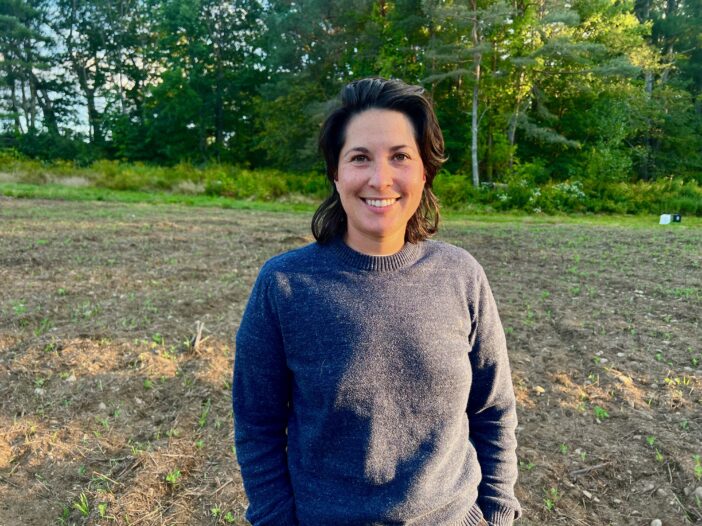
Who doesn’t love the person whose favorite pest is a tomato hornworm? Erin Espinosa thinks this insect is magnificent, and she’s a farmer. She marvels how the worm can camouflage itself into a tomato. And she appreciates the urgency that spotting one prompts, because a lone tomato hornworm can take out a tomato crop in a single morning. Truly, this is an insect that commands respect. Growing up in the Framingham area west of Boston, Erin has worked on farms since high school. And she was involved in everything from Student Council to contemporary dance to founding the school’s first environmental club. Empirical learning suited her better than the classroom. That said, she went to the University of North Carolina and graduated with a degree in environmental management and social justice leadership. Her father’s cancer diagnosis brought her back home, and she returned to the same local farm to work and learn about farming from the ground up. Her father died last year. Now, at 32, Erin is starting her own farm while also running Maine Coast Heritage Trust’s educational programs for youth. It is a new beginning.
The morning after prom was the first time I volunteered at the community farm. With my hair still in an up-do, my earrings on and my make-up smeared, I went and shoveled cow manure into a compost pile for two hours. And I loved it! I was so hooked I kept going back. I even skipped school to go to the farm because it was where I felt best.
From that point, I knew I wanted to have a career in farming. I came back home from college in 2017 because of my dad’s cancer, and that gave me the chance to continue farming. My old mentor hired me. And this time, I was more developed as a human, so I was able to be mentored more.
And that’s when I really dove into the details and technical skills that come with farming, like pest management, disease management, and season extension like growing in high tunnels – all things you know about passively, because you see them while you’re weeding and harvesting, but now you know them better.
By my fourth year, my mentor was bringing me into the decisions of crop-planning, budgeting, and I was learning to make really informed decisions. That’s when my love of efficient systems came about.
You see, on a farm, labor is such a valuable asset that there’s this drive to do things quickly and efficiently. Small, localized farms are not designed to make money. So, you try to cheat the system by going as fast and efficiently as possible.
Farming can be like working in a factory, with lots of repetitious motions, so the trick is to do it in a system that is easy and can be done in a short period of time. You’re never going to do it all, but you can try, and systems for creating a wash-and-pack area with a nice flow, or developing a distribution area where people come in and easily know where things are can help. And out in the field, when you’re weeding or turning soil, using the right tool makes it easier on your body.
A lot of people decide they’re going to leave their corporate jobs for farming — which is amazing, and we need more people doing that, and they have every right to go into this — but they kind of skip the step of working on farms.
And there is so much value in starting at the bottom and learning from the ground up. I still remember what it’s like to weed four hours in a row. And I remember how that hurt my body. So, I now work to diversify the workload. I know which weeder, rake or hoe is more efficient and does the best job. Take the hoe, for example. I’ll never have to hand-weed after planting if I come back with it two weeks later and run it between both sides of the crop — because by hoeing, you’re killing the weeds at a small stage.
Working on a farm teaches you to ask, “How can I make decisions now that will prevent more work later?” And that, I think, is the skill of a farmer.
That’s why I’m an advocate of people working on farms. But that’s easier said than done. You make no money as a farm worker! So, I can’t blame people for jumping over this step. The only reason I could do it was because I was living with my mom and dad at the time.
Coming to Waldoboro was serendipitous. I first started looking for farmland in Massachusetts, but they were all over a million dollars. And being a career farmer, I was like, “I have no money to do this.”
So, I broadened my geographic search to include Maine because I’d spent time with friends in the area. And every time I visited, I was like, “I’m in love with this area. Absolutely, deeply in love.”
I could breathe here. It was comfortable. And spacious. I’m still mind-blown by the surrounding wildlife. The morning birdsongs. And the golden hour at the end of the day which I watch every day. This winter I saw a possum for the first time, right outside my kitchen window. It feels childlike to see things for the first time. And that feels really nice right now.
In so many ways, this feels like the right fit. Which is uncomfortable to say, because people get really territorial about Maine. Which I understand because I used to feel territorial about Massachusetts.
People who have lived in other parts of Maine live here now. People from far away are here now. People from foreign countries, too. For any of us, we might feel way more at home here than the place where we were born. That’s been on my mind lately.
There’s a lot of binary thinking: ‘from-Maine’ and ‘not-from-Maine.’ All I know is I feel really at home here. I’ve loved everyone I’ve met. I feel so grateful to be here. I think, that wherever you truly feel your best, that is where your home is.
The farm is a big part of my home here. I’ve only been here since January. This spring and summer, I cleared the plot out back and planted a cover crop of oats. I also planted almost 100 willow trees. My goal is to grow willow rods for basket weavers and for nursery stock. Willow is my passive income project.
But I also want to offer a CSA because a lot of my farm career has been in diversified vegetable operations. I want to plant anything that will grow here as an annual: carrots; leafy greens like kale, Swiss chard, arugula, spinach, and different kinds of lettuce; plus tomatoes, eggplant, peppers, and squash.
But my favorite plan is to grow a ‘Pay what you can, pick your own,’ and plant it near the road. I hear things like, “People won’t pay you.” My farm-stand will be an experiment because I’m like, “If people aren’t paying me, maybe it’s because they need the vegetables, but can’t afford them.” Who am I to decide what people can or can’t have? A lot of people can’t afford to buy local food, including me.
But there are other ways to support local farms. If you can’t afford it, tell your friends to shop there. Or go in together on buying a share. Speak up for farmland in meetings.
I believe a farm is a community asset. And I want others to treat it like one, too. Because this is how we keep farmland.
Leave a Reply