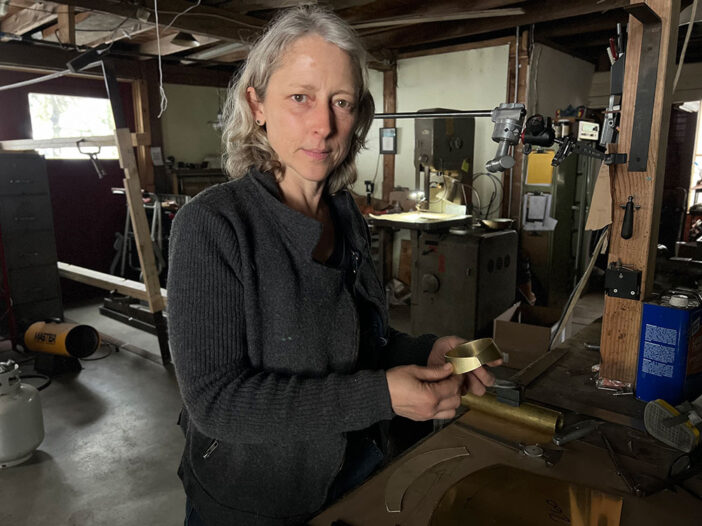
When Erica Moody (no relation to the Waldoboro’s Moody’s) fell in with a group of high-end tradespeople in Boston, she was awestruck by the exquisite beauty and design of their craftsmanship. And she realized: this was what she was meant to do. It just so happened that a metalworker named Pierre needed an assistant. For seven years, she learned everything she could from him, then went out on her own for another fifteen, engineering and fabricating things like fancy handrails and custom furniture for homes and restaurants. Metal is a particularly unforgiving medium. There is no room for mistakes, be it the pricing of the job, its production, its transportation, or its installation. Constant vigilance kept Erica from making a mistake, but she always carried inside the stress of that possibility, not to mention the care of three employees plus herself. The work was great. But so was the stress and lack of rest. Erica and her husband needed a re-set. Erica was looking for flexibility, smaller financial risks and work that could be sustainable. Her husband was struggling with addiction. They chose Maine. She had taught metalworking at The Wooden Boat School in Brooklin. And she had lived in Moody’s Cabins while doing custom metalwork for a home in Waldoboro. When they found a home with a barn in 2014, they moved. Erica scaled back, taking on smaller, commissioned jobs while developing her own designs. She was looking to make a product line that would give her more control and flexibility, something that she drew on as her husband continued to struggle. Eventually they went their separate ways. But in that time, Erica developed her line of serving utensils, a line that continues to expand in design, form, and color.
When I first began working in metal, I thought it was totally bad ass. It was, “Look what I can do!” I was an extremely shy 5’2” gal. Being able to do something that was unique and with such a strong material boosted my confidence.
It still impresses me to work with this rigid, strong material that I can manipulate by changing its form. I can heat so red hot that I can stretch and fold it, or I can work it cold to hammer and shape around materials. It can be delicate, it can be shiny, it can be thin, or it can be heavy. Even in a small piece, you can create all sorts of complexities. It amazes me. And then, there’s the way it feels in your hand, the way it balances and moves. I’m not sure you can get that in wood, pottery, or glass. There’s a dynamic inside metal that I think is really special – the way it can change over a small space, and still be strong and have structural integrity and beauty. And it’s always going to last a long time.
A lot of people ask me about the Japanese influence in my work. There is none. I admire Japanese work, but I don’t know anything about it. I think people are seeing the minimalism that came from my training and from the architects I worked with, which was a very modern and spare aesthetic.
My own aesthetic is different. I love antiques — but in a very pure, Puritan way, like how the Shakers designed. Their objects were practical. They made them for a purpose without a lot of ornamentation. With simple lines. That’s also why I love mid-century Danish modern. I love those experiments with bent plywood and sculpted wood, and maybe there’s brass in there, too. It’s work that is reserved.
The other reason I love antiques is that they have a history. It’s not just about their shape and design. It’s the worn areas – the ones from being worked on, or from being used. I think those are fantastic. And you don’t see that often in modern pieces. They are the marks the maker made, and the ones from all the different people who lived with it and used it.
Things made by hand do the same thing. You feel the story behind the maker. And you have the marks of it being made, even the mistakes. Something handmade has a human connection that is between its maker and its user. It makes it feel warm and personal.
My pie server has this iconic detail that came from a mistake, and now that pie server is my most popular item. A dear friend from Boston was having a birthday, and I wanted to make a gift for her. Because she’s a baker who loves making pies, I thought of a pie server. And I thought, “That would be fun to design.”
I wanted to model it after the pie server I had in my house, an antique with a narrow blade that was flexible and skinny. But I waited until the last minute to make it.
I work fast when I’m designing. I didn’t make drawings that night which sometimes I do. I just was responding to the material, and I came up with something I really liked. So, I riveted the handle onto the blade. But it was crooked.
To straighten it, I put it in the vise, but the vise squished the sheet of the brass, and I was like, “Arrrg,” because I thought I’d ruined it, and I was running out of time.
But then I looked at it again. I kind of liked how the steel was revealed and impressed into the brass. So, I continued to hammer around the brass blade, bending it the wrong way. And I loved how it came out. That was one of those mistakes that wouldn’t have happened except that I was hurrying. I couldn’t have planned that squished metal. But it became a detail in the pie server that I wouldn’t have otherwise. I love how accidents can lead us down a different path.
Leave a Reply