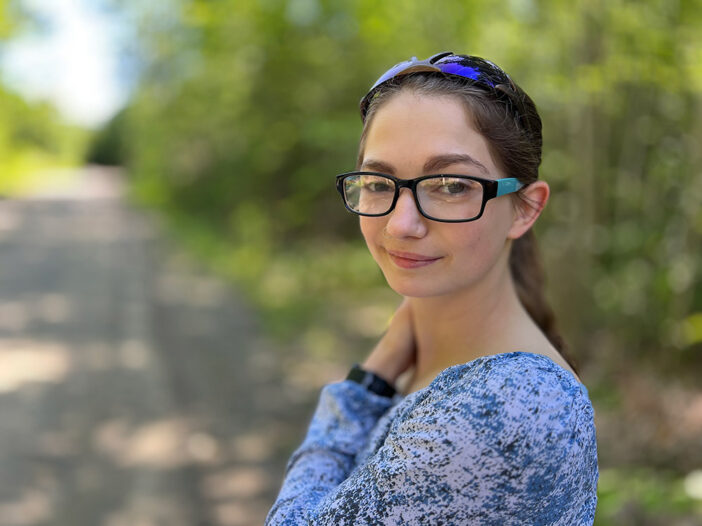
Downstairs at the Farnsworth Museum, student work from Medomak Valley High School’s Alternative Program (designed for students who learn empirically instead of in a traditional classroom) hangs alongside work from five other schools. And thankfully, there’s plenty of time to catch it – it’s on view through the summer. The exhibit is the culmination of a new year-long project called “Arts@theIntersection,” to expose students and educators to working artists and the process of making art. The Medomak students worked with printmaker Kel Differ alongside class teachers Kailey Borden O’Brien and Anna Myers. Within five hours the students had decided on the theme of homelessness because of their personal connection with it. Emmalynn Campbell, one of the exhibit’s contributors, isn’t sure about college. This coming year she is catching her breath, trying to recover from the various traumas she’s endured since arriving in Waldoboro about ten years ago, from bullying that started on her first day at Miller to a sexual assault by a neighbor soon after, to her abuser naming her publicly, and to her classmates telling her she asked for it. Only in senior year did things begin to calm down. And so, for now, Emmalynn is working at the Dollar General to save money for thing she wants to do above all else: enroll at a dog-training academy and be a dog trainer.
My biological father kidnapped me for a couple of weeks when I was two years old because my mom won custody, and he didn’t want to pay child support. He thought if he threatened her, he wouldn’t have to pay. He didn’t know that she had no control over that. The judge did.
But I didn’t know this. I don’t remember any of it. For years I didn’t even know that he existed. When I found out, it kind of clicked as to why we had to move around so many times. He kept on finding us and threatening to take me.
We were never on the streets homeless. But growing up, we bounced around a lot from family to family because my mom, who was working as a home health care aide, didn’t always have the money to get an apartment to rent. And then, one time, and out of the blue, our uncle kicked us out, and we had nowhere to go. That night we were thinking we might have to be on the streets. But my Nana, she saved us.
I would see homeless people in the streets constantly when we lived in Portland, or when we were traveling. And I hated that. I was like, “Why do they have to be on the streets? What aren’t we doing to help them?” It always bugged me. Especially seeing kids on the street.
In the project we all had a silkscreen of the shape of a house. It was the backdrop for our pieces. I drew a girl curled up in a ball to protect herself underneath a tent inside the house. I didn’t plan on turning it into a house, but it was kind of cool. To me, the house is the country we’re living in. And the tent and the girl — this is the way people are being treated. To me, homelessness is always being anxious, always being scared of what’s going to happen next, and never knowing if you’re going to be safe or not. Is someone going to try and attack you in your sleep?
The stereotype is that people who are homeless don’t care a diddly squat and don’t want to work. That’s wrong. A lot of people who are homeless are running away, running away from something a lot worse. Or they are so disabled that they can’t work. And they don’t have any family to support them. Or they are veterans who got up and fought for our country but come home and lose their families because of what they dealt with back then in war, and now are living in the streets.
People see a kid on the street and think, “That kid must be a delinquent or a druggie.” No. That kid probably just ran away from an abused home. Or is running away from a worse situation than you could ever dream of. But he ain’t got no one to trust, so he’s stuck with running away instead. I mean, we technically were running away from house to house because of my father, and it wasn’t easy.
So, I can’t even imagine what it’s like to be someone my age, or especially someone younger living on the streets, especially if you’re ten or nine, just before working age, and with no one’s who’s going to take you for a job. Or, if someone does, you risk being hurt or being put in an unsafe situation that could kill you. Just to make some money. There’s no reason for it.
What makes me afraid is that nothing is going to change: that no matter how bad our world gets, or how much we keep on killing our planet, it’s not going to change. That we’re not going to be able to change the prejudice and the self-hate and the need to destroy our own planet that’s giving us life. And for me, being bisexual and having a lot of LGBTQ in my family, I can’t get over the hate. People bring up God all the time: “In the Bible, this is a sin.” Well, my mom made me go to church when I was young, and in the Bible it says, “Thou shalt not judge.”
I have a very dark look on life. I don’t try to hope for much because I hate feeling disappointed. So, I just go with the flow because, more often than not, it’s crap anyways.
But hey, it’s got to equal out. So, I guess that’s my hope. There has to be some good. The seesaw always equals out at some point.
Leave a Reply