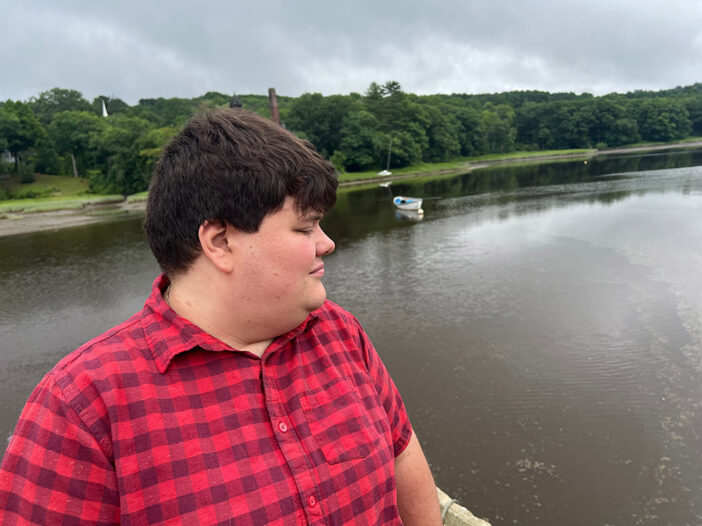
Elm Davis’s youth was full of poetry, music and private art lessons, in addition to attending school here, starting at Miller and finishing at Medomak Valley High. But with divorced parents, childhood also meant spending every other weekend with an alcoholic father. Elm enrolled in Job Corps and earned a certificate in construction technologies, leading to working on road crews in the Bangor area, doing everything from running a steam roller to working on roofs for three or four years -- that abruptly ended with a bad fall backwards into a pit. After a prolonged stay in the hospital, Elm returned to Waldoboro to heal. In time, Elm went back to work, first at Big Apple as a cashier and night stock person for about a year, then over at Circle K for five more years because the people were so great. In fact, Elm might still be there but for an offer to work as a Behavioral Health Professional/Ed Tech at Medomak Middle School in Special Education. That job called on all of Elm’s life experience, and heart, too, and Elm loved it. But, alas, a series of recent seizures have ended working for now. So who knows what is next for Elm?
The hardest part of loving an addict is knowing they can’t help it. I remember as a kid watching my dad asleep on the couch because he drank too much because he’d gone on a bender the night before, and me, beside him, making sure he was breathing and that he was on his side so he didn’t choke on his own vomit. I was probably twelve and spending every other weekend there at that point with him. And I remember being scared because if anything happened, I would have to make the call to Mom to come and get us.
The hardest thing to say to an addict is, “I can’t help you.” Or, “I love you and I care about you, but until you straighten out your life, I can’t help. You need to get your life in order first. And then, maybe I will help you, like with a 12-step program. But right now, you are making my life harder, and I can’t keep doing this. I have to move on. Your addiction is causing me issues at home and in school, and arguments with my mom.”
And sometimes you have to do that no-contact moment. I was a busy teen with my whole life ahead of me. At sixteen, I was in the theatre program at Medomak, writing poetry, doing art, in the horticulture program with Neil Lash, and involved with my local church group. And being around my dad was too much for me. So, I dropped contact with him, except when he was in the hospital, and then I would call.
But when he got so sick that they told me that he could die at any point, I came back to him. I was 21. He didn’t die until I was 31. I wanted to be there for him.
The hardest part of being with someone who is an addict is watching them suffer with their addiction. It was hard with my dad, and these days it’s hard with a friend of mine. I think she uses heroin. I bring her food and water and basic essentials. And make sure her bills are paid so she’s not homeless. But I never give her money.
It’s painful. Recently I went over to check on her and her dogs were barking. She was on the couch not moving. And she didn’t stir when I shook her. They’d trained us how to use Narcan when I was at the Circle K, and luckily I was carrying it. I squirted it up her nose. And she woke up. She was okay. But I still called an ambulance. I’ve had to use Narcan a couple of times, and not everyone is happy to be brought back. But my friend called to thank me the next day, and to say that she was in a psychiatric place because she was also suicidal at that point. I said, “Well, take care of yourself, and try to get clean.” And, as far as I know, she is two weeks clean. And I’m very, very proud of her.
We have talked since then. I remind her what it means for her to get her life back, and I say, “You can do this. We all want this for you. You are capable of this. You’re recovering. And that’s okay. You’re allowed to slip up. Recovery is not linear. It is far from that.”
This is something I’ve learned from my own family. You slip up. Again, and again, and again. And I know this from personal experience, because I’m an over-eater. I’ve been in Overeaters Anonymous for ten years. The longest I’ve made it without a slip-up is for one year. It’s a different type of addiction, a harder type, but I know shaking off any addiction is tough. Right now, I’m three months out. You mess up a lot, you get better, and you keep going. I have a lot of chips.
So, if Narcan saves someone’s life, maybe it doesn’t lead to a ‘come to Jesus moment.’ But maybe it does. You don’t know. What it does is save somebody’s life to go on. And yes, they’re addicted. That’s the nature of addiction. It’s a disease. It’s a chemical imbalance. And yes, ultimately, they chose it, but it’s not something they choose to continue.
We need Narcan in our lives, because otherwise, what’s going to happen to your best friend lying unconscious on the couch? What’s going to happen to a stranger parked behind a gas station at night and overdosed? What if that stranger is your dad, or your mom, or your sister or your brother? Or someone else’s? You would hate to lose them. And yes, maybe it won’t be their ‘come to Jesus moment.’ But maybe the following time, it will be.
I used to tell a friend from Job Corps who is now clean, “There’s no shame in getting help.” At any stage of your life, asking for help is not giving up. It’s admitting you need it. It’s saying, “I need a hand up.”
My dad died from cirrhosis of the liver which was most likely because of his alcoholism. He never had a ‘come to Jesus’ moment. He was just a very sick man who didn’t get the help he needed, surrounded by people in his life who degraded him, made fun of him, whatever. But there were also people who loved him and wanted him to get better. And unfortunately, the alcohol took him first. He never got to the point of saying, “I need help.”
Leave a Reply