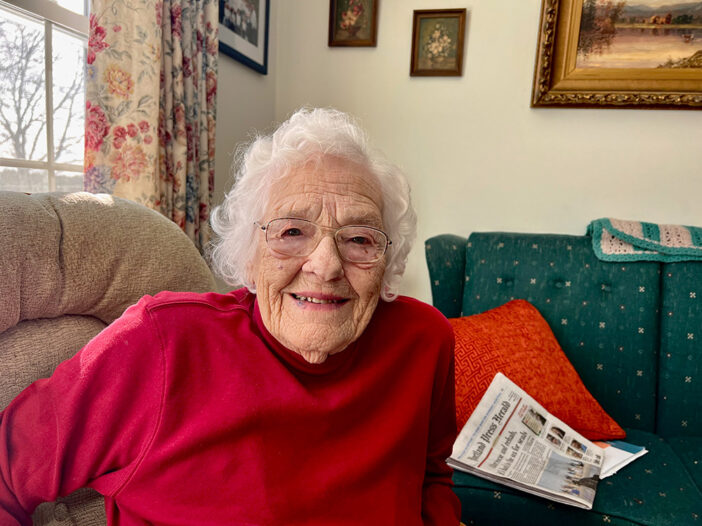
Winchenbach is Eleanor Smith’s maiden name and as such, her family settled on the German side of the river. Jasper Stahl’s history of the area notes two Winchenbachs from Waldoboro as serving in the Massachusetts Militia in 1777. Eleanor herself recalls a more recent history: how her grandfather Clifford built large (in that time) fishing boats and how her father, a carpenter with his brother Clyde, worked to build the Waldo Theatre and various houses in town, such as the one for my grandparents Russell and Mae Cooney. At 101 years old, Eleanor knows her memory is spotty. She recalls a childhood of playing outside with her older sister Ida sprinkled in with the usual chores of bringing in wood. She draws a blank on the war years when Waldoboro’s boys and men were fighting in Germany and the Pacific. Yet she has clear images of after the war and of the dances at Lakehurst. And especially how a certain Sherwood Smith from East Pittston asked her to dance one evening. That summer they went to many dancehalls to waltz and jitterbug. He stole her heart. They married at her home, and she wore the crepe wedding dress she’d made. Sherwood’s engineering work took them first to Portland, then to Augusta and finally to Waterville where they raised their family. And on his retirement, they returned to Waldoboro to live on land that was once her grandfather’s.
Dr. Sanborn came down the night before I was born, but I wasn’t ready to make my appearance. It was winter down on Gross Neck, and we had some heavy, heavy snow back then. So he said, “If I gotta wait for morning, I’m going to stay here.” So, he stayed, and I was born that morning.
We didn’t have electricity then, we had kerosene lamps, little ones and big ones. And we didn’t have heat. Well, we didn’t have anything except wood, and we were always warm. If we were cold, my sister and I would open the oven door and sit in front of it. We mostly lived in the kitchen. We had a pump there for our water and a well right out front.
When company came for dinner, we went in the dining room. Usually, it was our aunt and uncle, and every other Sunday we’d each take turns having a big dinner. Mostly my mother served roast chicken because we had chickens. We had roosters, too, so it was probably a rooster. She cooked everything on and in the wood stove. But that’s about the only time we were in the dining room. The living room was all outfitted nicely, too, but we didn’t stay in the living room either. It was mostly the kitchen.
There was a little school down there with a little wooden stove. There weren’t too many families down there that had children that went to school there. There was my sister, who was four years older than I was, and a Eugley boy and girl, and that was about it. Our schoolteacher lived over in Bremen. Either her dad would bring her, or she would walk. She thought nothing of walking back then. That was about five miles. It was probably a mile aback and forth to school for us, too. We got our exercise. Sometimes we’d go back and forth for our lunch. We thought nothing of that.
I had a tommy cat and she had seven kittens. But they were barn cats. They didn’t come inside, it wasn’t the thing to do. We had a dog, little Skippy, too. That was the dog that my dad took hunting. And we had a hound and it was a huge, long-legged dog. Just for rabbits. We ate the rabbits. Mum and I liked the legs, Dad and Ida liked the breasts. One rabbit made a good meal. We also had cows, and my mother would make the butter and take it up to the grocery store which was Gay’s, and exchange it for groceries. Paid five dollars for it and that bought quite a lot then.
For a long time we didn’t have a car, but eventually we did. But the roads weren’t paved, so in spring it would be very muddy. You had to leave early when it was frozen because if you waited too long, you’d be stuck in the mud.
Our house was near Peter’s Pond. Sometimes in the summer, when my father came home from work, we’d go up to Peter’s Pond. We had a little flat boat and there was a rock on the other side of Peter’s Pond. We’d row across and swim. But I never did any swimming. And I think it was because my mother didn’t. Ida learned to swim but I didn’t. I didn’t want to go in the water. I guess if my mother sat there on the rocks, I was going to sit on the rocks.
Later on, we moved up to Bremen Road. It was a little further out, but it was still closer to town than down in Gross Neck. If we wanted to go to see a movie or go anywhere, we’d walk. The pictures cost ten cents. And people would gladly give us a ride because there were only people from our local area. Of course, when I got into high school, there was a neighbor up the road that always used to pick up his son and daughter from school and he’d put as many people as he could to give us a ride home. All the neighbors, we took care of each other.
I wish I remembered more. I never used to want for words. It’s terrible to lose your thoughts and mind. That is the hardest thing. That and missing my friends. But I’ve had a good, long life.
Leave a Reply