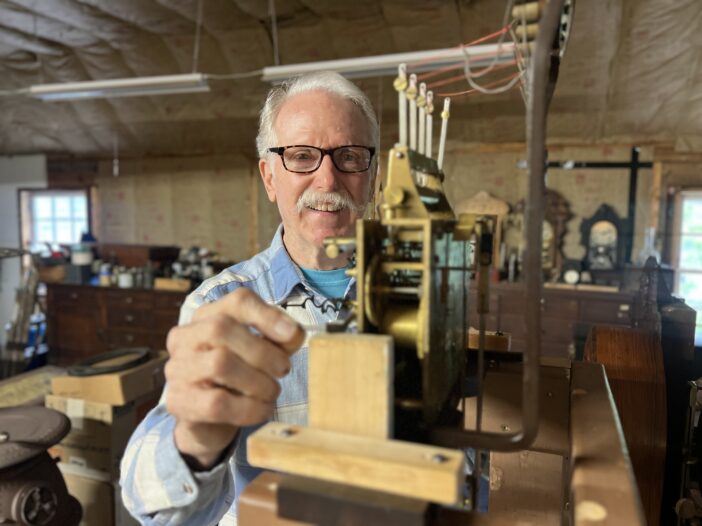
Waldoboro is full of treasures. They just can be hard to spot. Like Ed Openshaw, who’s lived here ten years and yet knows hardly anyone. And maybe it’s because his world has been mechanical antiques, and especially those making music. In fact, it’s a passion that has taken him from Pasadena to Los Angeles to Silverton, CO to Thomaston, ME to Rumney, NH, and yes, to Waldoboro itself. Ed is 77 years old, and he’s going strong. He still collects. And he still and repairs and restores player pianos, nickelodeons, merry-go-round organs, music boxes, clocks, wind-up phonographs and anything else mechanical that makes a musical note, and it’s all by word of mouth.
All through my childhood my mother and I would go out junking – it was mostly at second-hand stores but also antique stores. I loved doing that and getting things, even as a toddler. I’ve always loved antiques. To me, antiques have always been different from the other things that got used, abused, and then thrown away and replaced with something new. Antiques are handmade. They have character and beauty.
I was ten when I saw a wind-up phonograph with a crank on the side. I wanted it. The doors opened, for a horn, and there was nothing electric about it. My mother said, “What are you going to do with that?”
And I said, “Play it. Collect it. Have it.”
Well, I didn’t get it then. But she said I could get one for my birthday, so, my stepfather and I went out junking looking for one. We came upon one disappointment after another. We’d find a portable phonograph with a wind-up motor but then it had an electric pick-up. Or we’d see a credenza phonograph that took up a lot of space. Finally, in one antique shop, I came across a Victor upright phonograph. It was mahogany, and everything was gold-plated. When my stepfather saw it, he said, “Nope, can’t afford that. No way.”
I asked the guy how much it was, and he said, “$10 and I’ll give you a pile of records for it.”
My stepfather said he’d put up half the money if I put up the other half. Well, at ten, I was always mowing lawns, cleaning out garages, and doing all kinds of work for extra money. So, I bought that phonograph, and I still have it. And I keep the record that was on it when I bought it, and play it sometimes. It was the Coney Island Jazz Orchestra playing “Tell Me Why?” and “What Could Be Sweeter?”
Sometime after, someone gave me an antique radio and then an antique washing machine, a Thor, with large gear boxes on it. And I was twelve, big enough to ride my bike and go to stores on my own. Antique doorknobs was one of the first things I started collecting. At a dime a piece, I could buy a dozen or so each time I went out.
By the time I was thirteen, I was old enough to take the bus, so I could go further. I made friends with dealers and other collectors. I even had a mentor in Mrs. Phyllis Roller, and she gave me clocks, player pianos, phonographs and other mechanical things to repair.
I was fourteen when a collector friend brought back a trailer filled with antiques with a player piano deep in the middle of the load. I’d seen my first player piano in a music store a few years back, when I was about10 years old – the dealer had just gotten it restored, and the guy who’d done the work was showing him how it worked. And I thought, “I have to have one.”
Well, the player piano they brought back didn’t work, so we fixed it up. I learned a lot in the process. We needed to replace a lot of the tubing because the natural rubber was decomposing, so we used fish aquarium tubing for the piano; garden hose for other sized tubes; and radiator hoses for the large tubes. And we put patches on the bellows. We got it all fixed.
And it worked! If you pumped fast, it would play. It had a beautiful tone. It was an old Beckwith, made and sold by Sears & Roebuck, probably from around 1910.
They sold it to me for $250. To pay for it, I sold my doorknob collection, my first Edison phonograph, the Thor washing machine, and who knows what else. And with permission from my parents, I kept the player piano out in the garage. And when I played it, the neighbors loved it.
I didn’t go to college. I was busy buying and selling antiques. I found a business partner and friend, and we did more of the same. And my player piano collection kept growing.
At one point, it was the mid-1970s, we bought a merry-go-round that was in Griffith Park in central Los Angeles. I ran it for about ten years for kids and families, and those were the happiest years of my life. And then we ended that.
Many things happened after, including dissolving our partnership. But he was the reason I came to live in Waldoboro because he was living here and his health was poor. He died some months later after I moved. And I’m still here, in Waldoboro.
This is the first place, though, where I know hardly anyone. I know Alexa Stark and her brother, and my neighbor who is so young I could be his grandfather. I got to know the lady across the street, but she went into a nursing home. And I’ve met a couple up the road. They like antiques. It sort of helps if there’s something in common.
And I am still collecting. I can’t help but collect. I don’t need anything. I really don’t have room for anything. But I keep dragging stuff home. Little things mostly. It’s that I see the beauty, I see the artistic angle of an antique, and I can’t help but want it.
And since being here, I have added a photo player to my collection, that is, a player piano with sound effects, too, that they used for silent movies. This one can make Claxon horns, doorbells, sleighbells, steamboat whistles, bird whistles, and all kinds of percussions and orchestra instruments. It has everything. It was exactly what I wanted. It’s the ultimate in a player piano, with organ pipes and orchestra bells. I can even add a xylophone to it.
But being three times the width of a player piano, it needs a lot of room to get to it, to make repairs, and I haven’t done that yet. But once I do, they’ll last. Things built a hundred years have a habit of lasting. Best of all, the photo player uses home player piano rolls, and I have a collection of about 6,000 of those. You have to be crazy to want more than one player piano. But there’s something magical about them.
They conjure up visions of another time, and I picture them in an old hotel lobby, a saloon, or a restaurant where they wanted music, but to hire musicians or a band, well, that was would have been too expensive.
And oh, the music! They are a part of the past, one that goes back a hundred or a hundred and fifty years ago. My grandparents lived with these instruments. And their parents did, too.
My grandfather always talked about the old phonograph he had in his house – but when his father brought it home in 1910 or something, it was a new phonograph!
Leave a Reply