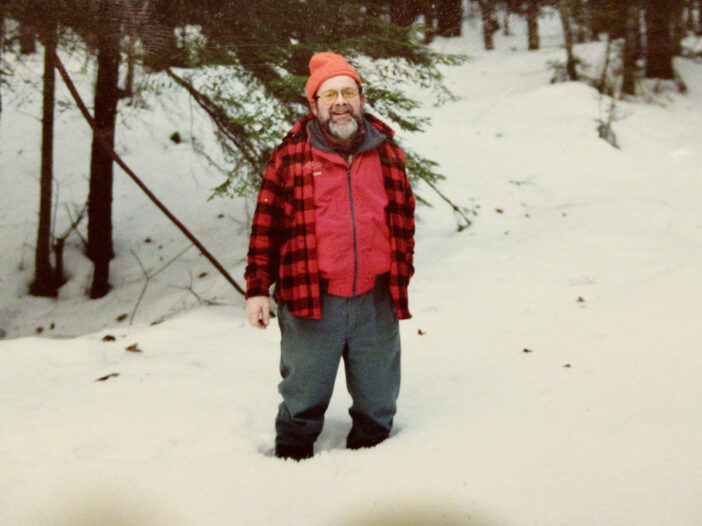
David and Jean Lawrence made their home on Wagner Bridge Road. Their son Matthew has returned with his wife Renee. They live in his parents’ old home, among a million memories. Even the ham radio he and his father once used, sits on a desk in the next room from where we talked. This piece is about David Lawrence, a man deeply remembered in Waldoboro, whether as a woodsman, hunter, a Master Electrician, ham radio operator, historian (with a specialty in ancestry) or faithful member of the North Nobleboro Baptist Church. David graduated from high school in 1953 and joined the Navy promptly after. He needed to provide for his mother because his father had died when he was fifteen, and David was an only child. He sent home three quarters of each paycheck for the four years he served. At some point, after moving back here in 1970, he was overcome by depression. For a few years he struggled with it, and then he conquered it. In his early fifties, he began to suffer from rheumatoid arthritis. Yet as soon as a bout passed or after an infusion, as soon as he could move again, he was back working, or hunting, or sawing lumber at his mill, or working with his tractor. He was that kind of man. Ask anyone in Waldoboro, and they have a story about David Lawrence. They will tell you how he helped them out. And they’ll go on about his mastery, curiosity and warmth. And how much they loved him.
I started working with my father when I was six years old. Dad was an electrician and the sole proprietor, and he did anything and everything from rewiring old farmhouses, new construction and even some commercial work. He was the electrician at Medomak Valley High School for a number of years. It was just Dad and me. I learned everything I know from him.
I remember the first time– it was summer, and we were on the ride home from the day and he said, “If you’re going to be working, what do you need to get paid?” Well, being a kid, I didn’t know what to say. We never had allowances because we never needed for anything. It wasn’t always what we wanted, but it was what we needed. So, I said, “Well, fifty cents an hour?”
And he said, “Well, alright. You’ve got to keep track of your time and timecard and all that,” and he taught me. He always came through.
In the morning, when we stopped for a break, he’d pull out his thermos. He poured me a little in a cup, my first cup on the job, and said, “There you go.” And I said, “But Daddy, it’s black,” because my grandmother used to make coffee for me with cream and sugar.
“Well, you’re on the job now. You’ve got to learn to drink your coffee black.” That first taste was so bitter, but it caught on. I have drunk my coffee black ever since.
Dad was a master at old houses. He knew right where to drill. He would look at it, go into the cellar or a crawl space with a drill and a bit and come out on the other side of the wall. He never popped a hole in a wall, ever. He taught me where to look for the sill in the wall, how to figure out the houses with post and beam, where the spacing was, and everything. He was a master craftsman. I used to joke that I was the best guy on the other end of a wire snake because I was small and could get into spaces.
He would always say, “If it’s worth doing, it’s worth doing right.” He taught me to have pride in myself and what I do. “It doesn’t matter what your job is. When you’re in school, that’s your job. When you’re at home stacking wood, you don’t just throw it around. You do it, and you do it well. And you clean up after yourself.” Dad was meticulous about cleaning up at the end of the day. He’d say, “If you work neatly, your work comes out neater.”
He always called himself a jack of all trades and master of none. But he could wallpaper beautifully – his father taught him. And carpentry? There was nothing he wouldn’t try or do. He was simply a master, and from scratch. And electrician – meticulous, and his tools were very important to him. You bought quality tools to do a quality job.
My father was, ‘what you see, is what you get.’ He would do anything to help anyone. He gave his best to everything he did. And he expected the same of anyone else. And if his heart wasn’t in something, he didn’t do it. If something bothered him, he would hold it inside and keep it to himself until he’d been provoked. Then he let you have it. He had his strong opinions. And he was very conservative in almost all his thinking.
He had strong feelings about the news. And politics. Whatever the flavor of the day was, it could get him excited. Even locally, back in the day, he did not always agree with things that were going on with the School Board. He would see it from all sides, from my mom who was a teacher and a department head, and then from the newspaper, and then from other people. But he liked to stay in the background. He left the spotlight to Mom. That was Mom and Dad’s yin and yang.
They met at a time when my father was living and working in Groton, CT and visiting on his sister and her husband in Wickford, RI on weekends. Part of Sunday morning was going to First Baptist Church which happed to where my mother attended because she was living in Wickford. Anyway, she caught his eye singing in the choir, and that was that. This is how they became Jean and Dave. Or Dave and Jean. They were married in Wickford at that church, on August 13, 1960.
Dad’s very first lesson to us kids was: “Respect your mother. I know boys will be boys. And I know boys will have fun. But if you ever do anything to embarrass your mother, you’ll have to deal with me.”
When it came to supporting each other, you couldn’t stick a sword between them. They were lockstep. It could be church or the school or something about us – it didn’t matter. On the really important thihngs, they were absolutely solid together.
But they not above having a good, knockdown, drag-out argument. It was the little things, and for the life of me, I can’t remember what they were. They let the steam fly, and then they came back together again. But I don’t think my father ever admitted he was wrong, which I understand because I’m a little like that. It’s something that goes unsaid, and you move on from there.
The dinner table was our time together. No matter what the job, Dad always came home by 5:30. And my mother, even at her busiest at the school, would be home, too, by 6:00 the latest. We would have started dinner then because we were old enough to put on the potatoes and stuff, and she would finish it.
Dad would have a beer, and my mother might have a half glass of sherry. They would sit and talk for a half hour. Then it was time for dinner when we all talked about our day. That was how we knew what was happening and what was going on with each other either at school or at work. And we’d plan the next day or the weekend.
And after that, we’d sit down and watch the news. But Dad didn’t care about local news. He timed for weather. And then we would all watch Walter Cronkite.
Leave a Reply