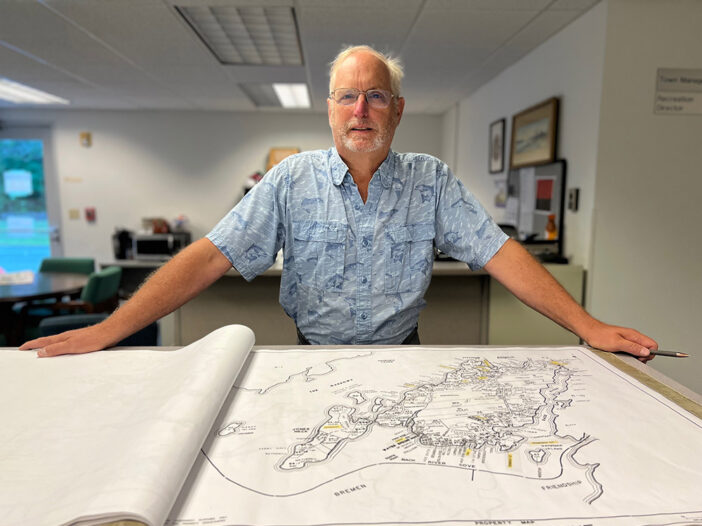
After high school Darryl McKenney enrolled in Central Maine Vocational Technical Center in Auburn to become a surveyor. But the class had a wait list so they suggested tax assessing which also had mapping and dealing with deeds. He went for it. Darryl was 19 when he graduated. By luck, there was an opening for a job in Waldoboro, for the town’s first tax assessor. That was 41 years ago and even though Darryl talks of retiring, he’s still here. Back then, the job encompassed other jobs, too, such as building codes, the welfare department, driving the ambulance, even shoveling the roof of the town hall. When he was a boy, his mother instilled the importance of helping where needed. Sometimes that meant cleaning out neighbors’ chicken houses in the middle of the night handling heavy broiler chickens with spurs in a shed that smelled of ammonia. Other times it was raking blueberries in the hot sun from dawn to dusk because he’d signed on to do that and he was needed. Darryl is Palermo-born-and-raised and lives there still with his family. To him, saltwater smells and is overrated which is why he likes North Waldoboro so much. It’s quiet, full of wildlife and smells of fir.
These days I’m going door to door to every house in Waldoboro. And there are about 2,800 properties with buildings. I’ll finish next month. The last time we did this for buildings was in 2008. Well, there’s lots of new buildings now. And, old or new, the values are changing.
I’m trying to reach about 250 properties a day. I compare each place with the tax records. I also have a sketch of the property. Or a picture. If I see there’s a new metal roof, I note it on the cards I carry for each property. Some sites I can do right from the car. If everything looks the same, I go. But if I can’t see it from the road, I drive in. If all is fine, I move on again. But if I have a building permit for a new deck, shed, or something else — or if I see something new — I knock on the door and measure the dimensions of the new structure. You need that to establish what it would cost to build to get its value. So, I make a note of those. On the other hand, if I see that a building has been taken down or is in disrepair, that lowers the property value. So, I write down that, too. It’s kind of crazy that the nicer you keep the property, the more tax you pay.
Generally, people are very pleasant. But you never know what you’re going to find. You might head up the driveway and catch a lady stark naked in mosquito weather and you go, “Whoaaaa,” and she runs to the back door while you stand at the front door pretending you didn’t see anything.
You can go from a mobile home with a blanket for a door and a baby on the floor – a property that really has no value except that it’s their home — to million-dollar properties, all in the same day. Everybody thinks that an assessor has the right to be on properties because you’re doing your job by following up. But you don’t. If someone tells you to leave, you do. But then you have to guess what the property is and what its value is. It just takes time.
To set value on a property, you start with the sale price and then you factor in what a similar property has sold for. There are a bunch of town tax schedules we follow: salt water versus a pond, deep water versus tidal or usable, forest versus field or yard, Route 1 versus a paved road or a dirt road. You do this with every property.
When you have a deed for a piece of land, I map it, value it and check for a well and the septic as well all the buildings. And I love mapping. It’s like a big puzzle. I like pulling out the deed. Looking at it and comparing it to the surveys that have come in. It’s fascinating to go back in time, looking at the old tax maps from the 1800s to the present, and how they’ve changed and what’s happened since. And now, with new surveys being done with satellites, they are much more accurate. It’s all about being fairer.
Some people think the Town manager tells me to go out and find more money for the town. They think property values are based on the needs of town government. But we don’t know where the tax rate is going to kick out. We just know what we voted for in terms of money – for the town, the school, the programs. And I am an agent for the Board of Assessors. They are the ones who have the final say as to what the schedule is.
The state keeps the right to tax, and they do not give that up. They establish what is taxed and how. They set the laws for exemptions and current use such as for tree growth, farmland and open space. Everybody needs their break, and somebody’s always got to pay.
Property tax is the only way the Town can collect from the non-resident. It’s why some want to keep property taxes as high as possible. But they are not the people who are sending kids to school. Nor have police or ambulance needs.
And forest, open space and farmland add to the beauty of Waldoboro and are why people live here. So, I think you have go with one rate for everyone. But then you catch the Maine person who has always lived here and might be struggling. So the State Legislature initiated a tax deferral for Mainers so as not to force them out.
But the state still collects. It just collects after the death of the owner, on the sale of the property. It’s like we say in the industry, “Death is final,” (well, that may be debatable) “but taxes will go on forever.”
Leave a Reply