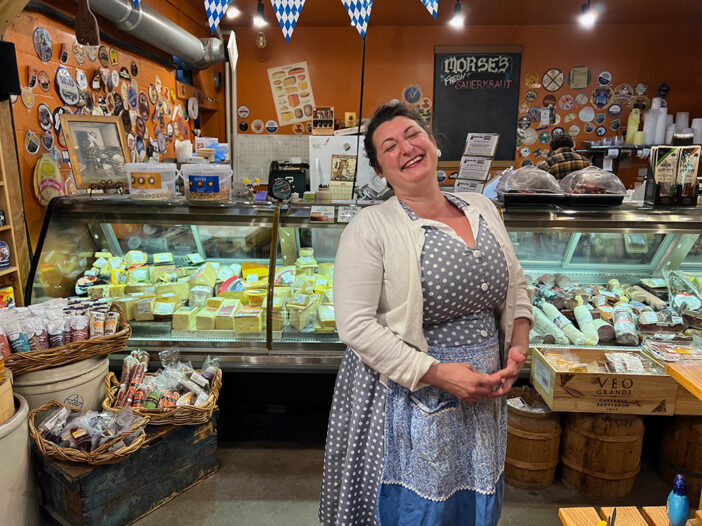
Cody LaMontagne and her husband James Gannon took over Morse’s Sauerkraut eight years ago. They’d grown up in Sumner, near Buckfield. James was her first boyfriend. Their parents each had small sustenance farms, and each came from a tradition of pickling. At Farmington, Cody studied political science, and James, archaeology. She also spent a year in France where she learned about real prosciutto, cured meats, and most of all, a way of eating and tasting food that she hadn’t experienced in rural Maine. Together they opened a bakery/cheese shop with a daily changing menu in Lewiston. But when Morse’s came up for sale, they leaped on it. It was everything on her imaginary list from selling specialty foods, to cooking for and running a restaurant to living close by in a rural landscape. Morse’s has become a Maine institution, founded by Virgil Morse who had started delivering barrels of pickled cabbage to John Gay’s store in Waldoboro in 1910. In 1918, he hung his shingle. A half century later, he passed it to his son Virgil Morse, Jr., and when he fell ill, his wife Ethelyn took over. Today, James manages the fermenting and most of the store’s ordering, and Cody manages the store, staff, and bookkeeping, as well as cooking the pastrami, corned beef and the traditional German grab and go items. With a section of Asian condiments now in the store, Morse’s has come a long way from its European roots. But its anchor will always be its sauerkraut and pickles.
We don’t want to be the ones who drop the ball and start messing up the kraut. Or the pickles. We’re very conscious that this place has been here for over a hundred years. Morse’s has been a special place for multiple generations of the same family. We don’t want to be the ones to ruin it.
When we took over, people were scared we might mess it up. I think our mantra for the first couple of years was, “Don’t mess it up,” because we knew that there’s this natural inclination to make something more yours when you take it over. In the restaurant I made the recipes more mine. But not the sauerkraut.
Sometimes people come in and ask we don’t make kimchi, too. I’m not going to take that chance. The lactobacillus is in the air over where we make the kraut. It’s inoculated in the wooden boards that hold down the kraut, it’s in the tampers and the smaller wooden barrels in the store where the kraut gets finished. It’s all inoculated with the culture that’s in the sauerkraut. A totally different strain could get in the air and change everything. To us, Morse’s sauerkraut is a serious responsibility.
We make it by hand like it’s always been made. It’s all old-school except for the machine we use for shredding cabbage, which Virgil adopted, too. We cut and quarter the cabbage heads by hand. We pack and tamp it down by hand in big barrels. We jar it by hand. It’s a lot of cabbage. Last year it was 120 tons of cabbage that we made into sauerkraut. The same thing with the pickles. We wash the cucumbers by hand, pack them in barrels by hand, then later in jar them by hand, and in high season this can mean getting in 8,000 pounds of cucumbers to pickle at a single time.
I think the key to running a business — and be healthy while you’re doing it — is to realize that mistakes are going to happen all the time. You just have to figure out what went wrong quickly, address it, and let it go. One time, a whole bunch of buckets went out without any kraut juice on them. One of the guys at the warehouse forgot to juice them for one round. And juice is very important to kraut because it’s full of lactobacilli that keeps the kraut alive. When the juice is gone, it gets funky fast. A customer called to say something wasn’t right. When we figured out the problem, we called everyone and got new buckets to those customers right away. We just rolled with it. It’s sauerkraut. It’s not heart surgery.
But COVID changed us. Like everyone else, we had to close the restaurant, and that was hard for me, because it brought me so much joy. But it also made us ask, “What’s really important to us?” We realized what mattered was our health and the health of the people who worked for us – who are a crew of extremely exceptional people who take their work very seriously and add so much to being here.
But even with the restaurant closed, we were working six days a week, from 8:00 in the morning to 6:00 at night. And in summertime, the line in the deli never stops which is fun but exhausting. Each morning, we’d start stocking the shelves, and then we’d open which put us behind all day long. So, we’d work late instead.
I think it’s easy to create stress where we don’t need it. We put expectations on ourselves. Or we let other people’s expectations push us to try to do impossible things. I don’t want my staff so overworked that they’re having nervous breakdowns. No one should have a nervous breakdown over cheese or sauerkraut.
So, we let go of the restaurant completely. We cut back our days from six to five. We cut our hours, opening at 10:00 now and closing at 4:00. Maybe someday I’ll have a schnitzel wagon out front. But the fact that I have a job where I get to do all the things I love like cooking, talking about food, and being with staff and customers? It’s still pretty amazing to me.
Leave a Reply