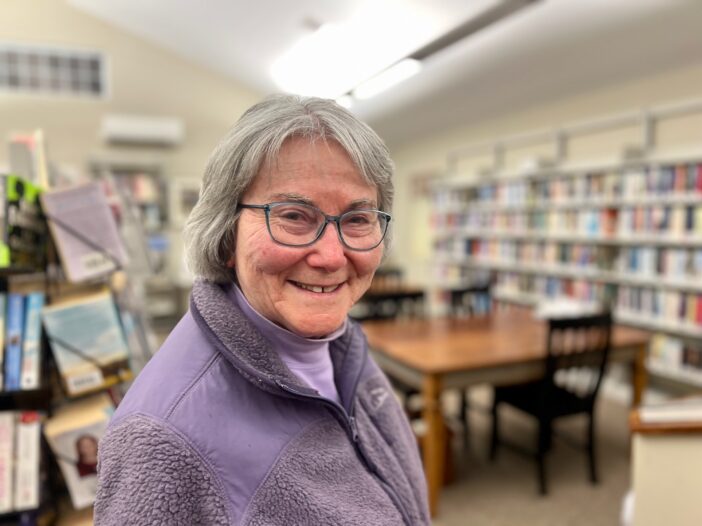
Spend time with Claire Riser and you’ll feel her curiosity. And if you speak another language, you’ll see her positively light up. She grew up all over the country, from California to Tennessee to Pennsylvania to Massachusetts. Her father was a marine biologist, and her family followed his work from teaching position to teaching position. Claire herself continued the tradition, from attending college in Michigan to teaching in Indiana, Puerto Rico, Texas, and finally in Waldoboro after an offer to teach English and Spanish at Medomak Valley High School. Claire ended up teaching, depending on the year, French, Spanish and English, with her happiest schedule being the year she taught Spanish, French, and Spanish. Claire loves foreign languages that much. One of the deep pleasures of a small town is getting to know people. Or getting to know them better -- because you may already know Claire from being a student, or from at Broad Bay Church where she is a deacon, or from her work at Audacity, The Penobscot Bay Language School, or New Hope, all in Rockland. And just maybe, in reading of this article, you, too, might find yourself signing on to learn a language. Because even as an adult, it’s achievable. Claire herself started learning Italian when she was 66, and, as she says, she’s fairly fluent now. Then, just four years ago after turning 76, she started German. There’s no age-cap on learning a language.
Two events in my childhood were probably the greatest influences on my life. The first was when my father took a teaching position at Fisk University, a Historically Black University in Nashville. The student body was almost 100% of African heritage, and the faculty was mixed, We lived in faculty housing. It was 1950, I was five, and we lived in an integrated neighborhood for six years. Because I was the oldest, sometimes my father would talk to me about what was going on in Tennessee. I remember him saying, “There is one law for the black man and another for the white man. If a black man kills a white man, something happens. If a black man kills a black man, something different happens. If a white man kills a black man, something different altogether happens.” He was telling me that there were different systems of justice, depending on who you were. I never forgot that.
The second event was when I was in 9th grade and going to school outside of Boston. I was in an honors program, and we had to take at least two years of one foreign language. My father encouraged me to take both Latin and French. For French, I signed up for a new curriculum they had introduced that year. Our new textbooks were all in French without a single word of English, and we were prohibited from writing anything but French in our notebook. It was very difficult. After a couple of weeks, I told my father, “I can’t do this. I think I should switch to the traditional class.” But he encouraged me not to give up. And before the year was over, I’d decided I wanted foreign languages to be my major in in college, and to work in that field.
I am a shy person, and I was especially shy in those days. But I enjoyed speaking French! I think when you’re speaking in another language, you become another person. In English, I was shy and quiet. French was a language that made me feel confident and free. Even today, of all the languages I’ve studied, it’s my favorite.
But in Spanish I feel joy. I can feel the welcome and surprise that people give me for speaking in their language.
Speaking other languages gives me the ability to enter into conversations. And when needed, to help people. It could be overhearing this Italian family in the Rockland Hannaford who were trying to figure out where they could find their shopping items. And because I could speak Italian, I could direct them.
But there were more urgent ways I was able to apply, in other cases, my fluency in Spanish. When I lived in San Antonio, I was involved with several immigrant groups, and often I would translate for people. I would also translate at conferences, symposia and ecumenical church services. One time afterwards, someone pointed out, “When you translate for a woman, you always use the “I” for the speaker. But if it’s for a man, you use “he” for the pronoun.”
I hadn’t realized that. Mostly, I was overwhelmed with how heartbreaking their stories were. Afterwards, I’d feel broken inside, too, because what they were saying weren’t just words and sentences for me. Maybe that’s why I used the pronouns as I did.
My youngest granddaughter wanted to learn a language, and she asked for my advice in choosing. She liked French because she was studying dance, and many of the terms are French words; and she liked Italian because she was also studying music, where the terminology is in Italian.
I told her what I’d learned as a teacher, “Choose the language that most appeals to you, regardless of how useful it is to anybody else. Then, try Duolingo any of those language apps to hear it. Listen to music sung at a slower pace in Italian and French music — or by someone who enunciates well. And watch movies in those languages, too.”
I’m studying German right now, and we’re in a gap between classes. So, I listen to tapes in the house and in the car. And I like to practice with Duolingo. It all helps. In fact, 90% of the music I listen to is in another language. Music is incredible for retention.
To me, learning a language is like opening a giant door! It’s this opportunity to communicate with all sorts of people that I otherwise wouldn’t be able to converse with.
It’s fun to learn a language, and I know most people don’t understand that. I love learning how to pronounce things. I like the challenge. I enjoy the grammar. In German, I’m seeing all sorts of connections to English, both grammatically and in terms of vocabulary, much of which I never knew before.
I had an idea for our congregation to hear Scripture in the service, either in French or Spanish. I thought of it as a way of reminding us that throughout the world, there are people reading and worshipping as we are, but in other languages.
We still do it, intermittently. To me, it feels like we are inviting their voices into our sanctuary.
Learning a language is a way of opening ourselves up to people all over the world. Communicating in someone else’s language welcomes them. It says, “Your language is as good as mine.” It gives them the opportunity to be their full selves.
Leave a Reply