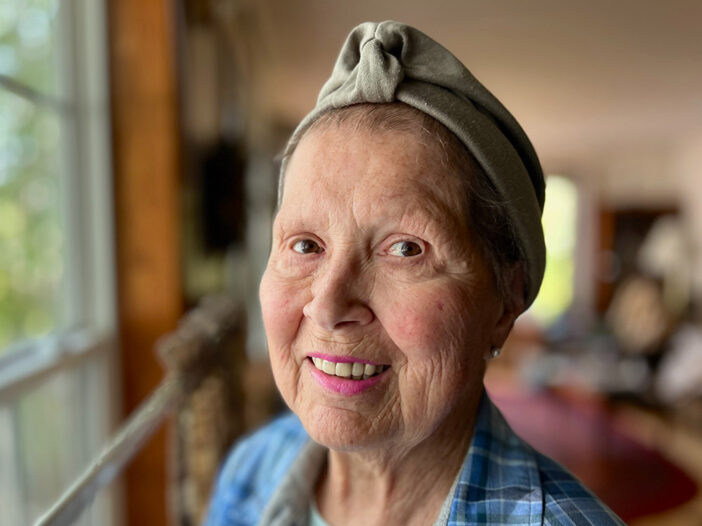
When Carol Hall Perry worked at Sylvania, she worked every job at least once on the factory floor. And every shift. When she started in the late 1960s, it was Sylvania Electric, with over 300 employees. In 1970, the plant became GTE-Sylvania; in 1993, Osram-Sylvania. Carol left Sylvania around 1998. Osram-Sylvania shut down in 2005, letting go of the 134 workers who were still punching in. Making filaments for lightbulbs is a many-step process, the first being to draw tungsten wire through an SA1 machine and run it through the machine to make a coil. That coil gets sent to the furnaces for tempering; it is threaded for a second time around a mandrel and coiled; then, cut to length; then, immersed in baths of hydrochloric and sulfuric acids so as to leave behind a perfect, coiled filament. The factory made a range of different-sized coils, and workers had to be vigilant. The last step was inspecting the filaments in an air-conditioned room before shipping. When Carol got breast cancer in 1989, she had to take a break because of the chemo, and as cancer will do, it made her ask: “What are the things I haven’t done?” She was 42 and had never completed high school. She got her GED and took a test to see what she’d be good at. Funeral Home Director was what came up. Eight years later, she left Sylvania for mortuary school and on graduation, joined the family business, Hall Funeral Home. At 76 and retired, she now steadfastly fights new bouts of cancer.
You went in early because you had to punch in and there was always a line. If you were late, they’d dock you. Then you went to your station to find out how it had gone the night before, if there was a problem machine or a new order, like for 5 million coils needed by Friday. Stuff like that. Then, you’d set up and start.
But when they had a power failure, all that wire you’d threaded and was now running would unravel. All the tension in the machines would let go. On all 300 machines. You’d spend your whole shift just to get that cleaned up. That was a bad day. But I still liked those machines the best. You were moving all the time. The third shift, if you could do it, was the shift to work. I liked it especially when the kids were in school. I could come home and rest all day and see them for suppers and bed, then go to work. On third shift, everyone got along. They helped each other.
Second shift was a little less laid back. And you missed the children’s games. But first shift? Forget it! All the engineers and everybody was around, and they made you feel like you had to be watched. You really felt the pressure. But you adjusted. And most of the time everyone was good to work with.
The plant was a gigantic room divided into divisions. You had the workers on the floor, then supervisors, and up top, the engineers. They went by the book and would come down and say, “Do this, this and that,” and we’d say, “That’s not going to work because we’re running the machines, and we know it’s not going to work.” But they wouldn’t listen to us. So, after we’d run off so many bad coils, they’d be like, “What happened?” We’d say, “We told you it wasn’t going to work. Put your book down and come down and work with us.”
Some supervisors, you’d do anything for. But sometimes you’d get one who carried a vendetta. No matter what you did, it wasn’t right, and you’d get called into the office and you’d say, “I’m sorry. I’m doing the best I can do.” And they’d say, “Well, you need to do 50 percent better.” But that was on the C13 machines, and I didn’t really like those. They had cutters that came down, cut, cut, cut. Well, I’ve got all my fingers, but they’d tell me, “Hurry,” and I’d say to myself, “I don’t think so, ha ha.”
I wasn’t that keen on working by the furnaces. You were in this corner and there’s fires all the time, you’re moving things in and out and it was 120 degrees. They gave us salt pills. Plenty of water. And fans, but it just blew the hot air around.
Then I worked in the acid room. That was hot work, too, because you was dealing with hot air and the fumes from the acids and caustic soda. We wore special coats and glasses, but we didn’t have the protection like there is today.
We had breaks, of course. Ten minutes in the morning, a half hour for lunch and another ten minutes in the afternoon. A typical eight-hour shift.
Back in the old days they used to have Sylvania dances at the high school gym, like at Christmas, and everyone would dress up in their finest, and they’d have a band from Augusta, and everyone would be lined up below and the orchestra on the balcony. It was like one big family.
Then new management came, and it changed when GTE owned it. Then later when the German company came, people started to watch their backs. They were afraid for their jobs. And the orders got bigger and bigger, and they wanted it faster. But somehow, we managed.
They still have reunions about once a year, though we haven’t been for a couple of years because we haven’t felt so good. My husband Jim has Parkinson’s and I have my cancer. Believe it or not, a lot of people who worked there have died of cancer. And there’s a few like me, just hanging in there.
I try to think I did everything really well. It was a good job, with good money and good benefits. But it was hard work. I can’t believe I worked there for 25 years.
Leave a Reply