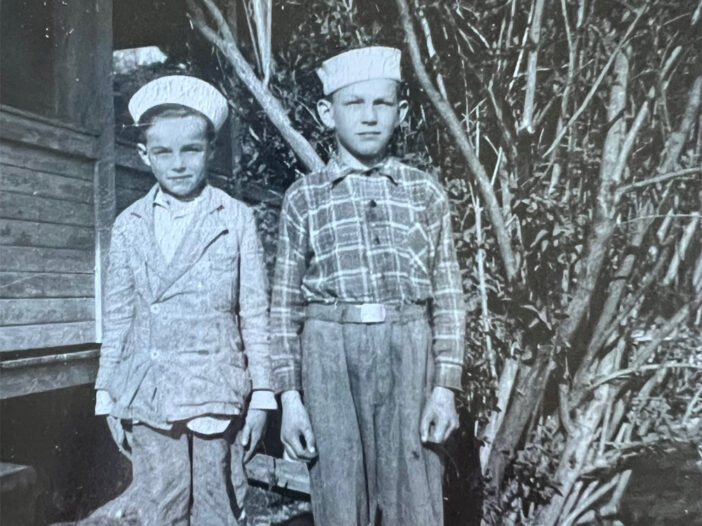
For a man who has often been overlooked, faced unspeakable cruelty, and absorbed loss after loss of loved ones, Bob Benner dwells on the sweetness of his life. Maybe this stems from being 88 years old. Maybe it’s wisdom for all of us. Certainly, the five years in this piece –Waldoboro’s war years – were some of the happiest in Bob’s life, ironically, years that extended until it was time to leave high school. There were the summer years when he worked at the Piercy estate. He was a small, thin boy of eleven, and he still managed to move the gigantic cement roller over the tennis court. Inside, they put him to work polishing numerous sets of silver, which he did without leaving a fingerprint. They were jobs he took pride in. He even made a friend in Mrs. Piercy’s mother to whose house he delivered the mail. And all the while, on the farm, he was mowing and hauling wood, splitting wood and pumping gas, helping with haying and calving and anything else that needed doing. Real life, perhaps, began after high school when he worked as a shipping clerk for the woolen mill in Warren. That led to another decade of making gravy and pie fillings at the canning factory, where for the first time in his life, he made friends with fellow Waldobororians. He spent the next decade at Bear Hill Market and made many more friends. There, he washed floors, worked the cash register, and managed the vegetables, frozen foods, and the cookie aisle. Then he found work at Bicknell in Rockland which produced stone-cutting tools for the quarry workers where he stayed for eighteen years. And lastly, closer to home, he cut fabric for Common Sense Designs which produced a line of children’s clothes. Wherever he went, though, low wages were the common denominator.
We lived far away from town, and that was kind of the bad part. We were the only ones down here. I had no school friends or anything, and that was very difficult. Even now, I’m more or less a loner.
Some of my best friends were elderly women. Bertha Plaistead was one. She lived down the road, and when she come down the road to visit, she would always greet me as “My beautiful brown eyes.” And it might be a pencil, it might be a crayon, or it might be a tablet. She always had a little thing for me. She was a wonderful, wonderful lady straight through my life. She was family to me.
The movie theatre was our main thing for fun, and the Waldo was the grandest place around. Nobody had a theatre like that. The seats were the very best. And they kept a check on you, especially kids like us, so you didn’t let any popcorn fall on anything. You sat there, and you behaved yourself, not like at Rockland where they’d be screaming and everything.
When we started going, I was little, maybe six years old. The three of us, my brother Ronnie and my sister Sylvia and I would walk to town in the afternoon and go to the first showing. I had two cousins that worked there, one at the ticket counter and one at the bar, and sometimes I’d lose my quarter. But I was just a little kid, and they’d just shuttle me right in.
We’d go for the first showing. I don’t know if they do it anymore, but back then the movie always began with the news. On a Saturday they might have a western and then we would stay for the second which was usually a scary movie, like a vampire movie, and I used to be scared to death. By the time we’d walk out, it would be dark, and we’d have to walk home. And especially as a little kid, it was quite a ways.
Well, we’d start off and suddenly we’d hear a rustle in the bushes, and oh, my gosh! My brother and sister would start running, and I’d grab hold of my brother’s shirt and hang on for dear life. If they didn’t, I’d still be standing there, terrified. Can you imagine opening the casket?
The town of Waldoboro used to be crowded with people in the war years. All the stores were open, and you often had to walk in the street because there were so many people on the sidewalk.
Beginning on Friendship block, there was a grocery store, then a drug store. The 5&10 was way down at the end, and Eaton owned that. Everybody liked Eaton and his wife. They were nice people. Wilbur Hilton had a grocery store on that side. Clarence Benner and his wife had a shoe store – he’s related to me. And there was a barber shop somewhere in there. And Alva Achorn had a store, too. It was a good-sized grocery. And going down Friendship St. beyond Storer’s a little ways, there was also a man that ran a taxi cab.
Gay’s Grocery was at the corner, and a little down the hill on Main Street, a huge furniture place. There was the Waldoboro Newspaper which ended up to being Lincoln County News. And there was a shoe repair shop somewhere, too. Several buildings aren’t there anymore, and one of them had a bowling alley below with ping pong tables, while above them was where the entertainers came. And some of the singers couldn’t keep a tune.
Anyway, one of the things I wanted to show you was my ration book. You would see that very little of it was ever used. Each one of us had a ration book. But even if you had the ration card, you couldn’t get some things. That is, if you had money, you could get it, but not the rest of us. And we knew that. The store owner would say to us, “There’s no such thing as any sugar here.” And then somebody with a lot of money would walk in and say, “I want 20 pounds of sugar.” And they would pass the sugar to them. Right there, with Dad standing in the store.
Those years were difficult, particularly for my mother. See, my oldest brother, Otis, Jr. – he was named that after my father who is Otis, Sr. — he left for the war on the day he turned seventeen. He left on his birthday. That would have been in 1943. He joined the Navy, and he was assigned to a hospital ship in the Pacific where there was a lot of bombing. My bother wanted to be a doctor.
Otis, Jr. was ten years older than me. And he was not only my brother. He was my very best friend for all my life.
Well, Mum – the first thing she had Dad do after my brother left, was get him to put up a flagpole. And every morning during the war, that flag went up. Mum was very patriotic. And she listened to the radio before we went to bed. She listened to everything, the whole nine yards.
Already, two of my mother’s brothers were in the War. One was a pilot making flights from England, and the other was in the Pacific fighting the Japanese.
When it got to be bedtime, I would go to bed. I was the youngest so I went up first, and Mum would follow. After I was in bed, she would read me a Bible story — it was a children’s book, and she’d always leave off before the story ended. It was shorter for her that way, and also, I think, she wanted to keep me in suspense. Then, we got on our knees to pray. The prayer went like this: “Please, God, watch over my brother Otis.” And then I said my uncle’s names and when we finished, we prayed for all those other soldiers serving.
I honestly felt that where both my uncles were and where my brother was, that they were in the worst parts, and that they could have been killed at any time. There wasn’t a night, in all the time Otis was gone, that we didn’t pray for him. And I really have to believe that the prayers helped. I truly believe in prayers.
Otis made it back. And so did my uncles. But the war destroyed my uncles. Their families suffered terribly from that. But I’ll tell you this: their children grew up into some of the best adults ever. They all kept good homes, they all were hard workers, and quite a few are still alive.
Otis, Jr. never talked about the war, but I think it affected him, too. He never went back to medicine. When he got back, he built the house next door. Later, after he got married, he moved in there and never left except for the last four years when he was in the hospital in Bangor. All through the years, he did carpentry, often for nothing. That was one of his big things in life – if there was an elderly person and the roof was leaking, he’d patch it or fix it so they could stay there.
And he did beautiful stonework. He was amazing at that. You should have seen his fireplaces and chimneys and things. Most of the people he worked for were widows in the neighborhood or in Nobleboro. Otis never asked for any more money than what they gave him. He just did it. Then he hit this woman who was restoring homes. That’s when he finally got a bank account. I can’t tell you enough about my brother.
I had Otis until just two years ago. His passing was the hardest thing I ever had to deal with, because there hadn’t been a day, outside of when he was in the war, that I hadn’t seen him. Especially in later years. We were always back and forth. If something happened, we called each other. And if there was an emergency, you’d drop everything to go there.
I still pray every single night. I pray for him, Mum, Dad and a lot of people beyond. It’s a lot of family, and those living, too, but I also pray for other people, those who are having a hard time. I have had prayers answered. That much I know.
Leave a Reply